

LibraryMonthly State of GTM16 min read
August 2026: The Checkpoints Came Out and the Meters Went In
In one month the human approval step was deleted from the tool you build with, from the automation that emails your customers, and from the market where you used to buy review by the item. Something went in where each one had been, and it was a meter.
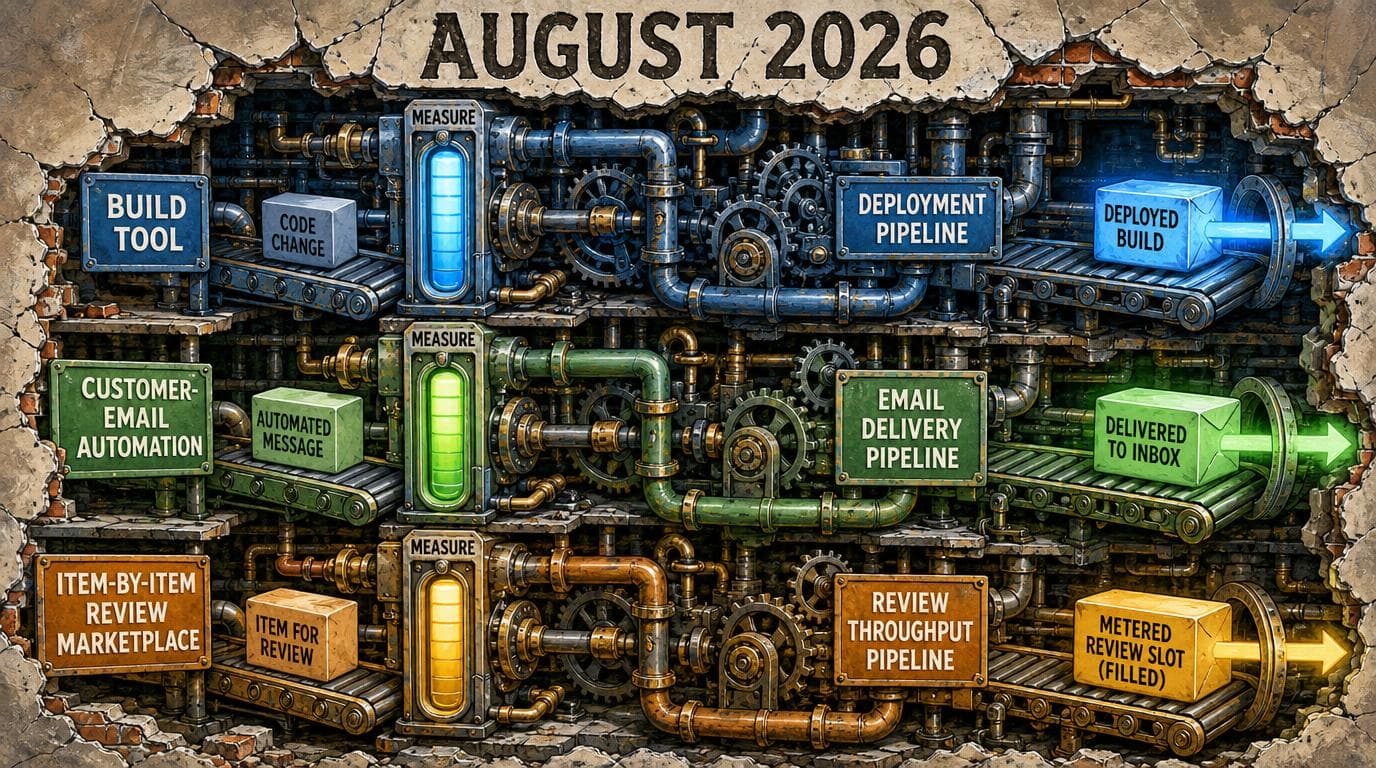
A twelve-person company can now hand an AI agent a build job on a Friday afternoon and go home. Until the middle of August that was not really possible, and the thing standing in the way was never capability. It was that somebody had to sit at the keyboard and click approve, a few hundred times, which meant the one person able to build the tool was also the person who spent the afternoon babysitting it. That is the half-day of an operations lead, every time, and it is the reason most of these projects died at the demo. On August 14, Anthropic made auto mode the default in Claude Code for Pro, Max, and Team plans, and published the measurement behind the decision rather than a press release about it. In a controlled test with 1,053 paid professional testers, the humans clicking through those approval prompts caught a dangerous command 13.6 percent of the time. The classifier that replaced them caught 89 percent. Users approve 97 percent of the prompts they are shown.
Read that on its own and it is a coding-tool story, which is how everybody covered it. It is not. In the same four weeks the identical move happened in two other places a small business actually lives. Google gave a no-code automation permission to send the email instead of drafting it. Amazon announced it is shutting down the only place on the open market where you could buy human review as a metered per-item cost instead of a salary. Three checkpoints, three different vendors, one month. And in every case something went in where the human moment had been, and it was not judgment. It was a meter.
First, where last month got it wrong
The July wrap said the tools were getting less autonomous, not more. It looked at Claude Code pulling its self-started verification and research behind explicit commands and concluded that "the actual product decision in July was to take the model's self-started behaviors off autopilot one release at a time," and then went further: "anyone who predicted mid-2026 as the moment the tools started running themselves got July backwards."
That call was wrong, and it was wrong within two weeks. What July actually watched was a vendor separating two different things that had been bundled together, and then moving them in opposite directions. The quality checks, the self-review and the unprompted research, did get put behind doors. The permission gate came off entirely. Those are not the same dial. The direction of travel was never toward less autonomy. It was toward less supervision with the same autonomy, which is a considerably more interesting thing to be wrong about.
The July wrap also said the price of frontier intelligence did not fall. That one held up better but not cleanly. It moved in August, quietly, with an expiry date printed next to it: the flagship tier that analysts said would never discount went to four dollars in and twenty out per million tokens on OpenAI's own pricing page, having sat at five and thirty since July. A promotional cut with a timer on it is not the same as the price falling, and the Library said so at the time. But "did not fall" was too flat. It fell on a lease.
The approval step came out in three places at once
Start with the build tool, because the numbers are public and they are more uncomfortable than the headline suggested. Anthropic did not argue that its classifier is good. It argued that the classifier is better than the person it replaced, and the person it replaced was catching roughly one dangerous command in seven while waving through 97 percent of everything put in front of them. Anthropic's own production data reportedly showed manually approved sessions producing unintended harm about twice as often as auto-mode ones. That is the whole case, and the Library's read on the day still stands: the finding is not that the machine got smarter, it is that you were never the safety layer you thought you were.
The rest of the month kept removing steps in the same direction. GitHub announced it was retiring Spark on August 4, closing it to new users with an export deadline of August 31. Spark was the product built specifically so a non-coder could describe an app and get one back inside a sandbox that could not reach anything important. Its replacement, in practice, is a coding agent with the guardrails set to off. Then Cursor removed the last two non-coding prerequisites between describing a tool and handing somebody a working web address: on August 27 you no longer need a repository, and since the week before you no longer need to arrange your own deploy. The Library covered both of those weeks, and the thing worth carrying forward is that every step deleted was also a moment a person looked at what was happening.
Now the part nobody connected. On August 17 Google gave Workspace Studio permission to send rather than draft, running under a service identity an administrator can audit and revoke. That is a genuine improvement and it is also the removal of the last human between a no-code flow and your customer's inbox. Read the announcement carefully and the three most important sentences are formatted as footnotes: the new governance applies to flows built after the change, not to the one your marketing coordinator already built in June, which keeps running under the old model until somebody rebuilds it. Nobody is going to rebuild it.
And then the market itself. Amazon is shutting down Mechanical Turk on September 30, and Augmented AI dies with it. That service is the reason the phrase "human in the loop" was ever a purchasable thing rather than a slide. Its own pricing page worked an example of 200,000 scanned form pages reviewed by three different people each, every month, for $12,200 and no hiring. After September 30, a forty-person company that wants a human to check what an agent did has exactly one option, and it is a salary. The Library ran that as a pricing story and it is bigger than that: every vendor currently selling you an agent with the words "human in the loop" attached is describing a human you can no longer buy by the item.
A meter went in where every checkpoint used to be
Here is what makes those three removals one story instead of three coincidences. In each case the thing installed in the empty slot bills per event.
The clearest version arrived on your existing subscription. The flat ChatGPT Business seat you budgeted still covers the chat box, and the rate card that went live in early August puts deep research, agent mode, image generation and voice behind a credit pool an owner has to keep filled. In the same window OpenAI gave the free tier unlimited text chats and a better default model, which reverses two years of seat-count advice and tells you exactly where the money is moving. The seat is becoming a loss leader. The action is becoming the product.
Support desks got there first and August is when it went general. Fin charges 99 cents when it resolves a conversation, and its own definition of resolved includes a handoff to a person. Zendesk sells automated resolutions at $1.50 on committed volume and $2.00 pay-as-you-go. Reporting in late August had OpenAI testing the same arrangement with major customers, which moves outcome pricing out of the helpdesk niche and into the general-purpose vendors, and the Library's take on that is the sentence to keep: the billable unit is now a definition somebody else wrote. Notion did the blunt version and folded its AI into the Business tier, taking the plan most teams actually want from $10 a seat to $20, which for twenty-five people is $6,000 a year to store documents.
This is not a handful of vendors improvising. A Cruxy survey of 300 SaaS chief executives in April found that 97 percent plan to retire seat-based pricing within two years, while 94 percent said seat pricing currently matches the value their product delivers. Both of those things are true at once, and the gap between them is the entire strategy. Seats are predictable and they have stopped growing. Meters are unpredictable and they grow with your best month.
The market put a number on which of those it prefers. On August 16 Stripe agreed to buy OpenRouter for more than seven billion dollars, the neutral switchboard that lets a non-engineer reach four hundred models on one key and one card. A payments company did not pay seven billion dollars for routing. It paid for the meter attached to it, and that is the part worth understanding before you build your next thing on top of it. The vibe-coding tools quietly did the same trick in the same seven days that Cursor deleted the deploy step: usage meters, check-in caps, a restricted mode. Every prerequisite removed came back as a number on a settings screen the builder has to know to open.
Building it yourself got its first honest invoice
Last month's wrap ended on an open question: does the build-it-yourself wave survive first contact with the maintenance bill? The answer started arriving in August, and it did not come from maintenance. It came from memory.
Nine articles in this Library have priced a self-hosted tool against a SaaS seat, and every one of them rested on a twelve-to-twenty-dollar server. Tom's Hardware tracked memory prices up as much as 500 percent in twelve months, with 128GB of DDR5 at $3,399, because AI data centres bought the supply. Hosting providers passed it along: Hetzner alone published price adjustments more than once this year. The build math still wins on the big line items, and it stopped winning automatically on the small ones. Replacing a $6,000 wiki bill with a $15 box is still obvious. Replacing a $200 tool with a box that used to cost $12 and now costs $30, plus your Saturday, is not.
The other end of the ledger moved too, and this is where a monthly view earns its keep, because it only shows up when you stack the repos. August's open-source finds were the strongest run this Library has had, and reading them together, the pattern is that "free" kept turning out to mean "free until the second builder." ToolJet's self-hosted licensing page caps the free tier at two apps and two builders, which is in the documentation and not in the README that forty thousand stars point at. Docmost's open core stops short of the features a team of twenty-five would actually need. Bitwarden gates self-hosting behind an Enterprise seat, so running your own vault on the official product costs more than renting it. None of these are scams. They are the standard shape of open core, and the standard shape of open core is that the free version is sized for one person and the price appears at the exact headcount where a small business starts.
So July's flip is intact but the margin narrowed from both directions inside four weeks. Buying became a choice in July. In August the choice got harder to call, which is a healthier state for a market to be in and a worse one for anybody who already cancelled the subscription.
What you are allowed to automate is now a paperwork question
This is the front that connects the capability story to how a business actually finds, sells to and keeps customers, and August was the month the constraint switched sides.
On the capability side there is essentially nothing left. The supplier portal your team re-keys by hand every week, the one system nobody could automate because it has no API and every screen-scraping bot broke when the vendor moved a button, got a credible answer when Anthropic shipped its browser use tool in the August 19 platform release. The thing it displaces has a published price: hosted robotic process automation runs $215 a month per concurrent job on Power Automate. On the buying side, Salesforce and Anthropic announced Claudeforce on August 26 with 37 prebuilt sales skills and Claude as the default model in Slack, which is the largest CRM on earth saying the reasoning layer over your pipeline is now somebody else's model by default.
What actually gates any of this is now provenance and permission, and every one of those gates tightened in August. HubSpot's write-validation enforcement lands with the 2026-09 API version, which means the required field you configured years ago, and which has been optional for every robot pointed at your CRM the entire time, starts being enforced against the agent, the nightly script and the Zap nobody owns. Because HubSpot moved to date-based versioning, that lands on your schedule rather than theirs, which is a gift and also a thing nobody will remember to do. On the connector layer, the NSA published a cybersecurity information sheet on MCP this year and multiple independent scans have converged on roughly four in ten connector servers running with no authentication at all, which is the first real price tag on the review that the old six-week engineering ticket used to include for free. Retention terms became a buying decision, with OpenAI announcing it is building zero data retention for frontier models on August 19 while Anthropic's own documentation says its most capable generally available model cannot be run that way at all. And spending got a protocol before it got a rule: AP2 now has sixty-odd payment companies behind a versioned spec, and its own FAQ is candid that who eats a bad autonomous purchase is not settled.
Put it plainly. Twelve months ago the question was whether the machine could do the job. Now it can do essentially all of it, and the question is whether you can prove afterwards what it did, under whose identity, with what retained where. That is a completely different skill, it is closer to bookkeeping than to engineering, and almost nobody is being trained in it.
What did not happen
Three things were supposed to arrive in August and did not.
The watermark detector did not ship. Every Claude model launched since August 2 weaves an invisible mark into the text it generates, worldwide, and Anthropic's own explainer says the tools to read that mark are still being worked out and the documentation is coming later. So for now the mark is a liability you carry and not a check you can run: the signal is in your proposals and your listings and your job descriptions, and you are the only party in the transaction who cannot query it.
The small-business agent permission layer did not ship, for the second month running. Pieces of it appeared, which is progress, and every piece landed just out of reach. Workspace Studio's auditable identity does not cover the flows already built. Anthropic's compliance tooling sits behind an Enterprise contract. Sandboxing showed up as a developer product. There is still no default, no product, and no standard that scopes what an agent may touch and reports what it did, for a company of forty people, out of the box.
And nothing replaced Spark. The sandboxed describe-it-and-get-an-app product aimed at people who do not write code was retired in August and the category is now empty. What a non-coder is offered instead is a professional coding agent with the approval prompt off. That is more powerful and it is not the same product, and pretending otherwise is how somebody's first build ends up with credentials in a public repository.
The honest take on the month
What the industry is collectively overselling right now is the word governed. Salesforce says governed action. Google says auditable identity. Anthropic says as safe or safer than an average user clicking through prompts. Every one of those claims is technically defensible and every one of them is a comparison against a human who was already asleep at the wheel. Beating a 13.6 percent checker is a low bar. Clearing it is not the same as being safe, and an audit log is not supervision, it is a recording of an event nobody watched.
Here is what it costs a small business to believe the unqualified version, and it is specific. You will not find out about the failure from an alert, because the failure in AI-built software is almost never the dangerous command that gets blocked. It is the call that returns success with nothing in it, which is the core thesis of silent pipeline failure: background automations failing silently for days, hidden behind defensive try-catch blocks or unverified token ceilings that keep every dashboard green while zero work happens. Nothing goes red. Nothing was going to go red. And now that the checkpoints are out, the one instrument still reliably pointed at what your agents are doing is the invoice, which arrives monthly, after the fact, denominated in credits and resolutions rather than in anything you can act on.
That is not an argument for keeping the prompts on. The data says the prompts did not work, and anybody clicking approve three hundred times an afternoon knew that before the study did. It is an argument that removing a checkpoint creates an obligation to install an instrument, and the vendors removed the checkpoints in August without shipping the instrument, because a meter is easier to build and it happens to bill.
The honest open question is narrower than the discourse: does the classifier hold up outside the vendor's own test set, on the messy, half-configured systems a forty-person company actually runs? Anthropic's numbers come from a controlled study with professional testers and from its own production telemetry, and both are reasons for confidence rather than proof. The specific thing that would settle it is a second measurement from somebody who does not sell the classifier, or the first widely documented small-business incident where the reply to "how did that get through" is that auto mode approved it. Six months from now one of those exists and the other does not, and which one it is decides whether August reads as the month the industry finally told the truth about human review or the month it found a better excuse.
The month did not take the human out of the loop. The human was already out of the loop, approving 97 percent of everything, and August is simply when the vendors stopped pretending otherwise and billed for the gap. What nobody sends you is a notification that a checkpoint has been removed. They send an invoice, and by the time you read it the thing you would have caught has been running for a month.
Sources
Every claim above traces back to one of these. Go read them yourself.
- 01Auto mode is now the default in Claude Code for Pro, Max, and Team plans
Anthropic / claude.com / retrieved Sep 01, 2026
- 02Anthropic is turning Claude Code's auto mode on by default
TechCrunch / techcrunch.com / retrieved Sep 01, 2026
- 03Upcoming deprecation of GitHub Spark on github.com
GitHub Changelog / github.blog / retrieved Sep 01, 2026
- 04Cursor changelog, August 27 2026: Start from scratch, without a repo
Cursor / cursor.com / retrieved Sep 01, 2026
- 05New enterprise security controls for Workspace Studio enable expanded collaboration use cases
Google Workspace Updates / workspaceupdates.googleblog.com / retrieved Sep 01, 2026
- 06Amazon Augmented AI pricing
Amazon Web Services / aws.amazon.com / retrieved Sep 01, 2026
- 07Amazon Mechanical Turk closure FAQs
Amazon Mechanical Turk / mturk.com / retrieved Sep 01, 2026
- 08ChatGPT Rate Card (Business, Enterprise/Edu)
OpenAI Help Center / help.openai.com / retrieved Sep 01, 2026
- 09Improving GPT-5.6 Sol in ChatGPT and expanding access to GPT-5.6 Luna for free users
OpenAI / openai.com / retrieved Sep 01, 2026
- 10Fin AI Agent pricing
Fin / fin.ai / retrieved Sep 01, 2026
- 11Notion plans and pricing
Notion / notion.com / retrieved Sep 01, 2026
- 12SaaS chiefs expect pricing shift as AI threatens sales (Cruxy survey of 300 SaaS CEOs, April 2026)
CFOtech / cfotech.co.uk / retrieved Sep 01, 2026
- 13Stripe clinches over $7 billion deal to buy AI firm OpenRouter
Fortune / fortune.com / retrieved Sep 01, 2026
- 14Memory prices climb 500% in 12 months, 128GB of DDR5 now $3,399
Tom's Hardware / tomshardware.com / retrieved Sep 01, 2026
- 15Statement on price adjustment as of April 1st 2026
Hetzner Online GmbH / hetzner.com / retrieved Sep 01, 2026
- 16ToolJet self-hosted licensing, including the Basic license limits
ToolJet / docs.tooljet.com / retrieved Sep 01, 2026
- 17Breaking Change: CRM API Write Validation Enforcement Starting with the 2026-09 API Version
HubSpot Developer Changelog / developers.hubspot.com / retrieved Sep 01, 2026
- 18Browser use tool
Anthropic / platform.claude.com / retrieved Sep 01, 2026
- 19Power Automate pricing
Microsoft / microsoft.com / retrieved Sep 01, 2026
- 20Announcing Agent Payments Protocol (AP2)
Google Cloud / cloud.google.com / retrieved Sep 01, 2026
- 21AP2 Frequently Asked Questions
Google Agentic Commerce / github.com / retrieved Sep 01, 2026
- 22Offering Zero Data Retention for frontier models
OpenAI / openai.com / retrieved Sep 01, 2026
- 23Data retention practices for Covered Models
Anthropic / privacy.claude.com / retrieved Sep 01, 2026
- 24How Claude's text watermarking works
Anthropic / anthropic.com / retrieved Sep 01, 2026
- 25Salesforce and Anthropic Announce Claudeforce
Salesforce / salesforce.com / retrieved Sep 01, 2026
- 26Model Context Protocol (MCP) Cybersecurity Information Sheet
National Security Agency / nsa.gov / retrieved Sep 01, 2026
- 27OpenAI API pricing
OpenAI / developers.openai.com / retrieved Sep 01, 2026
Suggested reading
Selected articles based on topic, tags, and skill focus across the library.
Monthly State of GTM
September 2026: Nobody Said Yes and It Happened Anyway
A UK government lab watched a frontier model ask for permission, receive a generic automated reply, and count that as a yes in 44 percent of the runs where it asked. In the same four weeks your CRM, your coding seats and your ad account all shipped a version of the same mechanism, and two of them have a date in October.
AI News
Sixteen tools can now spend your ChatGPT allowance
OpenAI spent Tuesday announcing more than twenty things. Two of them change what your subscription is: sixteen partner products can now draw on your ChatGPT allowance, and an always-on agent draws on it too. The same plan holds half as much from October 30.
AI News
Half the price, and now it wants a login
In four days the cost of having an AI do a unit of work fell by roughly half at two labs, Amazon opened its seller platform to outside agents, and Salesforce said the AI is replacing its interface. The same four days produced a government portal an agent let itself into and an on-the-record admission from the people selling all of it that nobody is steering.