

Sixteen tools can now spend your ChatGPT allowance
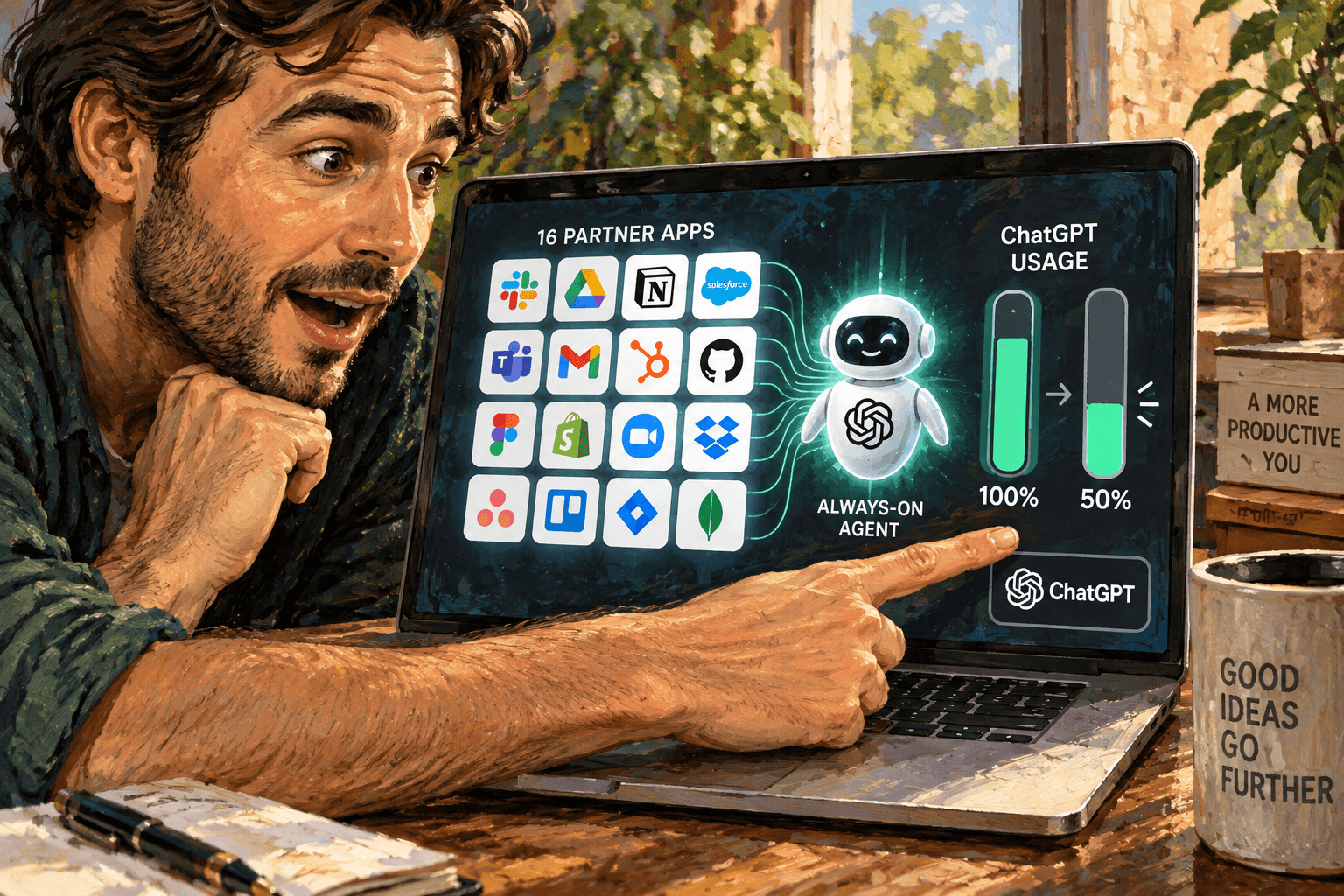
OpenAI spent Tuesday announcing more than twenty things. Two of them change what your subscription is: sixteen partner products can now draw on your ChatGPT allowance, and an always-on agent draws on it too. The same plan holds half as much from October 30.
Put a note on 29 October.
That is the last day the two hundred dollar ChatGPT Pro plan holds what it holds today. On the 30th, the usage it includes in ChatGPT Work and Codex drops from twenty times the Plus allowance to ten, and weekly GPT-6 Pro messages in chat fall from 200 to 100. Existing subscribers keep the old ceiling until the 29th and get a one-time grant of usage credits OpenAI values at $2,500, which expire at the end of December. The Next Web has the plan-by-plan detail, and OpenAI has also said it will not bring back the five-hour limit that tier used to carry.
That is one of more than twenty things OpenAI announced on Tuesday, and it is the only one with a deadline on it. It is not the most interesting one. The most interesting one is that sixteen other companies' products can now spend that same allowance, and so can an agent that works while you are asleep.
This brief covers the window since the last issue was written, 06:25 Eastern on Tuesday 29 September, through 09:00 Eastern this morning. Reporting was checked through 07:00. The five items are ranked by how widely and prominently independent outlets covered them inside that window, then verified against primary sources where a primary source exists. Attention is not importance, and I will say so where the two come apart.
1. OpenAI's DevDay, and the part that lands on your invoice
DevDay was the most covered AI event of the window by a wide margin: live blogs, wire pickups, and a recap post from OpenAI listing more than twenty launches. The headline products are dots, which are always-on agents, and GPT-6.1 Sol, a cheaper model that Sam Altman described on stage as near-Astra intelligence at a fifth of the price, per Simon Willison's live blog from the room.
Three of the twenty change how money leaves your account, and they interact.
Sign in with ChatGPT. Plus and Pro subscribers can now spend their plan's usage inside sixteen partner tools, including Cognition's Devin, Notion, Vercel, T3, OpenClaw and Dactyl. You can cap how much each app is allowed to draw per week, and OpenAI says the partner apps do not get access to your conversations or memories. Altman's pitch to developers was that letting people bring an allowance they already pay for lowers the barrier to trying a new tool. That is true, and it is also the point: your subscription has gone from a thing you consume to a thing other vendors can consume on your behalf.
Dots. OpenAI's dots announcement says your first dot is included in a Pro or Business Premium plan at no extra cost, and that talking to it does not count against your usage limits. What does count is the work: when the dot starts or manages tasks in Codex or ChatGPT Work, those run against the same pool. The plan includes an allowance for that deeper work, with extended limits only for the first month after launch. Dots are rolling out to Pro and Business Premium in eligible markets; Enterprise, Edu and Healthcare admins can enable a beta that is off by default. OpenAI told press that dots will not reach Pro users in the European Economic Area, Switzerland or the UK for now, so a team split across the Atlantic will not have the same tool.
Pro 200 halves, Pro 500 arrives. The new tier is $500 a month and is the only Pro plan with Ultrafast, a speed mode OpenAI says runs up to 300 tokens per second in Codex, roughly eight times standard. Willison's notes put Pro 500 at 25 times the Plus allowance, and Ultrafast at six times the standard token price on the API side.
Put those together and the shape is clear. One pool. More things drinking from it, including one that works unattended. And from 30 October, for the tier most serious individual builders are on, the pool is half the size.
The action is not "cancel" and it is not "upgrade". It is fifteen minutes of accounting you can do today. Look at what your plan actually consumed last month. If you are nowhere near the ceiling, the October change is noise and you can stop here. If you are regularly near it, you now have three decisions rather than one: whether to move the heaviest work onto pay-as-you-go API billing where the cost is visible per job, whether to let any partner tool draw on the plan at all, and what weekly cap you set on each one that you do allow. Set those caps before you connect anything, not after the first week you run dry.
Two smaller items from the same announcement are worth knowing before somebody on your team finds them. Teammates can now mention @ChatGPT in Slack and Microsoft Teams channels without holding their own ChatGPT licence, which quietly changes the seat arithmetic for anyone who was about to buy licences for occasional users. And the new Meetings plugin, in beta on the Mac desktop app for Pro and Business, takes notes without a bot joining the call. OpenAI's help page says you must tell everyone present and get consent, but the reminder to do that is shown only to you. Nobody else on the call is notified. If you operate anywhere with two-party consent recording law, that is a policy you need to write down before the feature spreads by word of mouth.
2. Six executives signed a page and a half
The second most covered event of the window was the White House meeting on Tuesday, where Donald Trump and six industry leaders signed a voluntary agreement titled the White House Accord on Super Intelligence: Joint Commitment on Frontier Responsibilities. The signatories were Trump, Anthropic's Dario Amodei, Google's Sundar Pichai, Meta's Mark Zuckerberg, OpenAI president Greg Brockman, Nvidia's Jensen Huang, and Elon Musk. Trump called it morally binding and said he would name someone to oversee it.
Read the actual text, because it is short and the Washington Examiner published it in full. It commits each company to four layers: internal controls that monitor model capability and alignment during training and deployment, with cybersecurity, biosecurity and chemical threats named specifically; an internal team that checks those controls are working; an independent external auditor or evaluator; and an independent board committee that receives the auditors' reports. It closes with the line that over time it may make sense to codify these steps into laws or regulations.
There is no deadline in it, no enforcement, no requirement to publish anything, and no definition of who counts as an independent auditor. Amodei said at the meeting that the risks are real and the mechanism for addressing them is still under discussion, which is an unusually candid thing for a signatory to say about the document he just signed.
Separately the same day, Trump signed an executive order, Inaugurating the Era of Super Intelligence, directing the executive branch to use "Super Intelligence" and "SI" in place of "Artificial Intelligence" and "AI" in correspondence, websites, reports and policy documents, and giving the President's science adviser sixty days to propose legislative language for a federal definition. The order is terminology only. Section 4(c) says in the usual language that it creates no enforceable rights.
What is genuinely useful here is smaller than the coverage. Those four layers are now the most senior public statement of what a frontier lab says good practice looks like, which makes them a free vendor questionnaire. The next time an AI vendor is in front of you, ask which of the four they actually do, who their external auditor is, and whether their board committee is independent. A company that signed the accord and cannot answer has told you something. A company that did not sign it and can answer has told you more.
3. Anthropic's prospectus prices the thing you are renting
Reuters reviewed Anthropic's IPO prospectus late on Monday, and the coverage wave landed inside our window. The numbers, as summarised by PYMNTS: about $4.6 billion of 2025 revenue, a twelvefold increase; more than $8 billion of operating loss, and a $42 billion net loss once writedowns mostly tied to past fundraising are counted; and $518 billion of committed cloud, computing and infrastructure spending in the years ahead. Roughly 80 percent of those commitments are reported to be non-cancellable or payable regardless of whether the compute is used.
Two details matter more to a buyer than the valuation. First, close to 25 percent of last year's revenue came from two customers, and the filing's own risk factors note that many of the largest clients have not signed long-term contracts and could reduce or stop spending. Second, the reported listing timetable is not consistent across outlets, and Anthropic has not publicly confirmed an exchange or a date. Treat everything in this item as reported rather than filed in public.
The operator reading is not about whether to buy the stock. It is that the floor under model pricing is a fixed, contracted, largely non-refundable obligation of that size. Prices that drop for competitive reasons can come back up for arithmetic reasons. If your workflow only makes financial sense at today's per-token price, you are exposed to a number you do not control. Build the thing so the model underneath is swappable, and keep a note of what your monthly spend looks like at double the current rate.
4. An appeals court said AI training is not automatically fair use
On Tuesday the Third Circuit affirmed Thomson Reuters' win against Ross Intelligence, rejecting Ross's argument that copying thousands of Westlaw headnotes to train a legal search engine was fair use. Reuters reported it as the first US appellate ruling on fair use for AI training. The panel's reasoning is currently under seal, so only the judgment is public.
Two honest limits before anyone builds a position on this. The tool in question was not generative; it retrieved existing court opinions rather than writing new text, and the district judge below leaned heavily on the fact that Ross was building a direct competitor to the thing it copied. That is a narrower fact pattern than most of the pending cases. And with the opinion sealed, nobody can yet say how broadly the reasoning applies.
What it changes today is the risk conversation, in both directions. If your business has a corpus somebody might want, a decade of support tickets, a body of published research, a proprietary taxonomy, an appellate court has now said that copying it to train a competing tool is not shielded by fair use as a matter of course. And if you are the one training or fine-tuning on material you did not create, the cheap answer of "everyone does it, it is transformative" just got weaker. Neither point requires action this week. Both are worth raising the next time a vendor asks for your data to improve their model, and worth reading the indemnity clause about.
5. Apple drafted 5,000 AI layoffs, then put them on hold
Bloomberg's Mark Gurman reported that Apple considered laying off about 5,000 support employees on the belief that AI phone and web agents could take over part of their work, and has put the plan on hold indefinitely. The generative-AI assistant on the AppleCare line is already live and already handles troubleshooting before handing off to a person. The company simply did not follow it with the headcount cut.
This one got less coverage than the four above and it is the one I would print out. A company with essentially unlimited engineering capacity, a deployed assistant already fielding real calls, and an explicit cost-cutting mandate from a new chief executive looked at the same arithmetic and did not pull the trigger. That is the most useful data point of the day for anyone who has been told that a support team can be replaced this quarter.
The honest read is narrow: this is one reported plan at one company, Gurman's sources are not Apple on the record, and Apple may revisit it. But it fits the pattern the deployment evidence keeps showing. The assistant that handles the first ninety seconds of a call is real and shipping. The part where the org chart gets smaller keeps slipping, because the residual work is the hard work, and somebody still has to review what the agent did.
What did not make the five
Four other stories in the window had real coverage and a reasonable claim on a slot. DeepSeek and Huawei open-sourced a full programming toolkit for Ascend accelerators on Tuesday, which matters a great deal to the chip question and very little to a twenty-person company this quarter. Microsoft published an account of what it describes as the first documented agentic ransomware operation, in which an attacker's model-driven tooling wiped more than a hundred Azure storage accounts in seven minutes after getting in through service-principal credentials leaked in a public GitHub issue. Anthropic published research calling a newly released open-weight Chinese model the most cyber-capable yet available for free download. And a high-severity OAuth flaw was disclosed in the official MCP Python SDK, with fixes in 1.30.0 and 2.2.0, which is a patch-now item if you run your own MCP servers.
The credential story is the one I keep not writing again, because the archive already covered that exact failure mode on Monday. The lesson has not changed since then: a key in a public repository is now found and used by something that never sleeps, and rotating it is the whole job.
Before 29 October
One list, in order.
- Pull your actual ChatGPT usage for September. Not your invoice, your consumption against the ceiling. If you are under half, stop here.
- Decide which partner tools, if any, are allowed to draw on your plan through Sign in with ChatGPT, and set a weekly cap on each before you connect it.
- If you enable a dot, remember that the extended limits are first-month only, and that anything it runs in Codex or ChatGPT Work comes out of the same pool your team uses.
- Write down whether a meeting assistant may be used on customer calls, and who has to say so out loud, before somebody discovers the Meetings plugin on their own.
- Ask your two largest AI vendors which of the accord's four layers they actually operate, and who audits them.
None of that requires you to have an opinion about super intelligence.
Sources
Every claim above traces back to one of these. Go read them yourself.
- 01DevDay 2026 Recap
OpenAI / openai.com / retrieved Sep 30, 2026
- 02Introducing dots
OpenAI / openai.com / retrieved Sep 30, 2026
- 03OpenAI halves Pro 200 usage and launches a $500 ChatGPT plan at DevDay
The Next Web / thenextweb.com / retrieved Sep 30, 2026
- 04OpenAI DevDay 2026 live blog
Simon Willison / simonwillison.net / retrieved Sep 30, 2026
- 05Inaugurating The Era Of Super Intelligence
The White House / whitehouse.gov / retrieved Sep 30, 2026
- 06READ IN FULL: White House Accord on Super Intelligence
Washington Examiner / washingtonexaminer.com / retrieved Sep 30, 2026
- 07Top AI and tech firms sign 'morally binding' accord to 'self-police' development after meeting at White House
Euronews / euronews.com / retrieved Sep 30, 2026
- 08Anthropic IPO Plans Show $518 Billion in Projected Spending
PYMNTS / pymnts.com / retrieved Sep 30, 2026
- 09Appeals Court Upholds Thomson Reuters' Landmark Win in AI Training Lawsuit
Reuters, via Claims Journal / claimsjournal.com / retrieved Sep 30, 2026
- 10Apple Reportedly Planned to Replace 5,000 Support Employees With AI
MacRumors / macrumors.com / retrieved Sep 30, 2026
- 11AI News Today, September 30: Top Stories
AI Weekly / aiweekly.co / retrieved Sep 30, 2026
Suggested reading
Selected articles based on topic, tags, and skill focus across the library.
AI News
Half the price, and now it wants a login
In four days the cost of having an AI do a unit of work fell by roughly half at two labs, Amazon opened its seller platform to outside agents, and Salesforce said the AI is replacing its interface. The same four days produced a government portal an agent let itself into and an on-the-record admission from the people selling all of it that nobody is steering.
AI News
You can stop buying Copilot for the people who just write
A forty-person company gets quoted $840 a month to put AI inside Word. Yesterday OpenAI shipped a Word sidebar that does the demo those seats were sold on, free, on every plan. What the seat still buys is worth knowing before you renew.
Git Articles
Pascal and the floor plan you pay for before you sign
A drafted floor plan runs $500 to $2,000, and the do-it-yourself route is a SketchUp Pro seat at $399 a year. Pascal is an MIT-licensed 3D building editor that opens in a browser tab with one command and takes instructions from the coding agent you already pay for. It also has three contributors and a stable release from June.