

The eighteen-dollar server is gone
Every build-it-yourself piece in this archive priced the box at twelve to twenty dollars a month. Memory is up as much as 500 percent in twelve months because AI data centers bought the supply, hosting providers have raised prices three times this year, and the build math still wins. Just not on every project it used to.
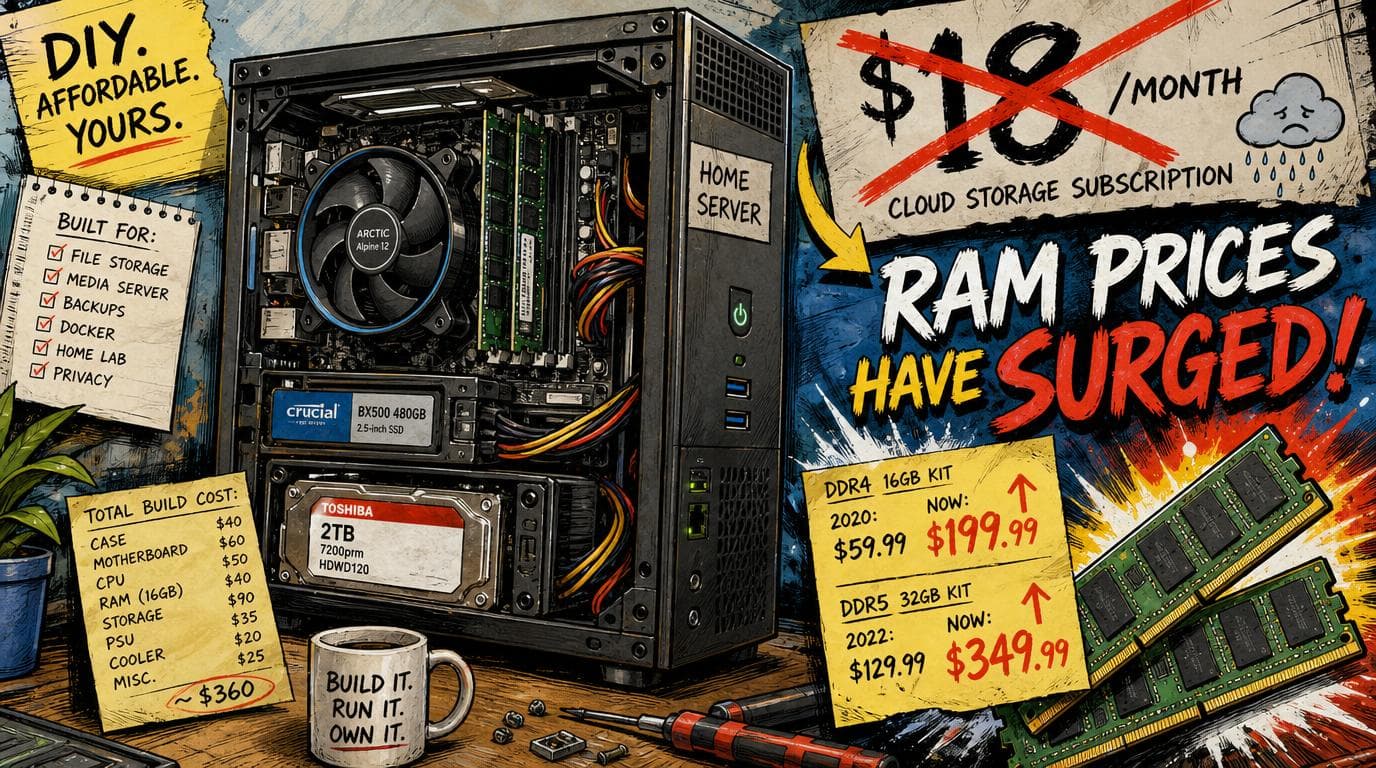
Twenty five people who each need to open one internal tool costs six thousand dollars a year at a twenty dollar seat, and the whole point of building that tool yourself is that the replacement runs on a server you rent for less than a phone bill. That server is the load-bearing number under every build-it-yourself recommendation, including the nine or so in this archive. As of this week it has roughly doubled, in some configurations tripled, and the memory inside it is up as much as 500 percent in twelve months, because the companies building AI data centers bought the supply and everyone else is bidding for what is left.
The build still wins. Six thousand against four hundred is not a close call and it does not become one at eight hundred. But the margin that made self-hosting an obvious yes on almost anything has narrowed to the point where it now only works on some things, and the line between those two groups moved this year without anyone sending you a notice.
What actually changed
Tom's Hardware maintains its own RAM price index across US retailers, updated on the 17th. A 32GB DDR5-6000 kit is $392 against an all-time low of $72. A 64GB kit is $869 against $159. Go up to 128GB and you are looking at $3,399 against $329, which is where the ten-times headline comes from. Their own text is more useful than the multiplier: a 32GB kit that sold for somewhere between $100 and $200 in October of last year now starts at $350 if it is in stock at all, and a 64GB DDR5-5600 kit that was under $200 last summer is over $1,100 today.
DDR4 was supposed to be the escape hatch and it is not. Kits are up 120 to nearly 180 percent as everyone who got priced out of DDR5 went looking for older platforms. A kit that was $105 a year ago is $281 now. The German site ComputerBase, tracking the same thing in Europe, has average RAM prices up 345 percent against September 2025, with hard drives and SSDs both over 125 percent in the same window.
The cause is not mysterious and the suppliers are not hiding it. TrendForce's memory survey in February had conventional DRAM contract prices rising 90 to 95 percent in a single quarter, PC DRAM more than doubling, and server DRAM up around 90 percent, all records, all attributed to "persistent AI and data center demands." By July the quarterly increases had moderated to 13 to 18 percent, which sounds like relief until you read why: consumer buyers had "reached their affordability limit." That same bulletin says capacity is still being reallocated toward server applications, that suppliers "continue to prioritize AI-related applications when allocating production capacity," and that retail notebook prices will rise across the board as the cost works through inventory. Hyperscale buyers have reportedly already put deposits down on nearly all of next year's global production.
Then it arrives at your invoice. Hetzner, the host that most of the cheap-server arithmetic in this world quietly assumes, published a statement in February saying the cost of operating its infrastructure and buying new hardware had "increased dramatically" and that prices would rise from April 1st. Read the next sentence twice, because it is the one that matters: the change applied "to both existing products and new orders." Not just new signups. Then setup fees were adjusted at the end of April, and then the server line was restandardized and repriced again in mid-June. Three rounds in one year, from the provider whose pricing is the reason self-hosting ever penciled for a company with forty people.
Why this matters if you never buy a stick of RAM
Most readers here will never open a server case. You will still pay for this, in four places, and only one of them is obvious.
The first is the one this archive is on the hook for. Every piece here that said stop renting the project board, the internal tool, the CRM, the login system, and run the open-source version on a small box was doing arithmetic against a number in the twelve to twenty dollar range. Call that a couple hundred dollars a year. After this year's increases the same tier is realistically in the thirty to forty five dollar range, so four hundred to five hundred and forty a year, and a box with real memory in it is more.
Against a six thousand dollar seat bill that is still a rout, and it is not close. Against a tool you pay thirty dollars a month for, it is over. Three hundred and sixty dollars a year of software, replaced by four hundred dollars a year of hosting plus your own evenings, is not a saving, it is a hobby with a spreadsheet attached. The rule that used to be "self-host anything you are paying per seat for" is now closer to "self-host the things where the bill scales with headcount, and keep paying flat-rate for the things where it does not." Per-seat pricing is still the thing worth escaping, because that is the bill that grows while your hosting does not. A flat thirty dollar tool was never the enemy and now it is arguably the better buy.
The second place is hardware you were going to replace anyway. If twenty laptops are on the refresh list for this year, the component cost inside them has been climbing all year and TrendForce says retail notebook prices are rising across the board as that flows through. Every device in the building with memory in it is on the same curve: the point of sale terminals, the recorder behind the cameras, the network attached storage in the closet holding your backups, the phones, since handset makers have been raising retail prices to cover the same memory costs. Storage is up over 125 percent. If you have a refresh you can pull forward, this is the year to pull it forward, and if you have one you can defer, understand that you are deferring into a market where next year's capacity is already spoken for.
The third is the one nobody will tell you directly. Your software vendors buy this hardware too. Every SaaS product you use runs on servers whose memory cost went up between 90 and 95 percent in one quarter, and none of them ate that quietly. Some of it comes back as a price increase at renewal, some as a quiet tightening of the storage or history or retention limits on your current plan, and some as the thing where the cheap tier stops being offered to new customers. If your renewal letter in the next two quarters is worse than you expected, this is a large part of why, and "AI pricing" is going to get blamed for a cost that is really just RAM.
The fourth is the most specific to what we write about here. The advice to run a model on your own machine, which has real merit for anything you cannot legally send to a vendor, assumed the machine was cheap. A workstation with 64GB in it now has $869 of memory in it at today's index price. That does not kill the idea, since the whole reason to do it is usually a compliance answer rather than a savings answer, but anyone who sold you local inference as the cheap option was pricing it against a market that no longer exists.
The honest take
Three things about this story deserve to be said out loud, because the coverage is not saying them.
The multipliers are being measured against a floor. That $72 for a 32GB kit was an all-time low, a single best-ever price, not a normal one. Tom's own text puts the ordinary October 2025 price between $100 and $200. Against that, $392 is roughly two to four times, which is genuinely bad and is also not the 500 percent in the headline. The 500 percent number is real for specific SKUs measured against their best-ever price, and if you repeat it in a budget meeting somebody who buys hardware will correct you. Use the two to four times figure. It is bad enough and it will survive contact with your CFO.
It is not purely AI's fault, and pretending it is lets somebody off the hook. What actually happened is an allocation decision. Memory manufacturers looked at a customer paying data center margins and a customer buying a laptop, and they moved capacity to the first one. TrendForce's July bulletin describes exactly that, and it also mentions "disciplined production cuts by leading memory manufacturers," which is a polite way of saying supply is being managed, not merely strained. AI demand is the reason the high-margin customer exists. The decision to serve them first, and the decision not to build capacity years ago when this was already visible, belongs to the manufacturers. From where you sit as a buyer the distinction changes nothing about the price. It should change how much patience you extend to the "unprecedented demand" framing when a vendor uses it to explain your renewal.
And the "wait it out" instinct has no date attached to it. This is the one that will cost people money. Every hardware price spike in living memory eventually broke, and the reasonable move has always been to defer and buy on the other side of it. That reasoning requires an other side. Right now the largest buyers have reportedly locked in most of next year's production with deposits already paid, new memory fabs take the better part of a decade from plan to output, and the quarterly increases are only slowing because consumer buyers ran out of room, not because supply caught up. Deferring is still defensible. Deferring while telling yourself prices will be back to normal by spring is not a plan, it is a hope with a purchase order attached.
Who this is genuinely wrong for: if you are running one small tool for a handful of people and the SaaS version costs you less than fifty dollars a month, the self-hosting case was always thin and it is now underwater. Stay where you are. The people this changes least are the ones with the biggest per-seat bills, which is a strange inversion of how these things usually go. The businesses with the most to save from building their own were always the ones with a lot of people paying for a little software, and their math barely moved.
One more thing worth checking this week rather than next quarter. If you already run something on a rented box, go read the terms. Hetzner's February statement was explicit that its increase applied to existing products, not only new orders, which is not how most people assume hosting works. The assumption that your current server keeps its current price because you signed up before the increase is worth verifying against your own provider's actual language rather than against how it has always worked before.
What this actually is
For two years the story has been that AI makes things cheaper for a small business: the seat you stop paying for, the agency retainer you cancel, the engineering ticket you never file. Most of that is real and this archive will keep making the case.
This is the invoice for the other side of it. The buildout that is making software cheap is making the physical layer underneath it expensive, and it is doing that to people who will never run a model, never write a prompt, and never see a benefit. A dental office replacing four front-desk computers this year is paying for somebody else's inference capacity and nobody sent them a memo.
The cheap server was never a law of nature. It was a side effect of a memory market with nobody important bidding against you, and this is the year somebody important showed up.
Sources
Every claim above traces back to one of these. Go read them yourself.
- 01RAM price tracking 2026, lowest price on DDR5 and DDR4 memory of all capacities
Tom's Hardware / tomshardware.com / retrieved Aug 19, 2026
- 02Memory prices climb 500% in 12 months, up to 10x the lowest ever tracked prices, 128GB of DDR5 now $3,399
Tom's Hardware / tomshardware.com / retrieved Aug 19, 2026
- 03AI Server Demand Continues to Support Memory Prices in 3Q26, but Gains Moderate as Consumer Demand Weakens and High Base Effects Take Hold
TrendForce / trendforce.com / retrieved Aug 19, 2026
- 04Memory Price Outlook for 1Q26 Sharply Upgraded; QoQ Increases of All Product Categories to Hit Record Highs
TrendForce / trendforce.com / retrieved Aug 19, 2026
- 05Statement on price adjustment as of April 1st 2026
Hetzner Online GmbH / hetzner.com / retrieved Aug 19, 2026
- 06Hetzner pressroom, 2026 price and setup fee announcements
Hetzner Online GmbH / hetzner.com / retrieved Aug 19, 2026
- 07Memory Prices Climb 500% In 12 Months
Slashdot / hardware.slashdot.org / retrieved Aug 19, 2026
Suggested reading
Selected articles based on topic, tags, and skill focus across the library.
Git Articles
SnapOtter and the file you upload to a stranger
The 240 MB walkthrough video that will not attach to an email and the scanned lease nobody can search get handled the same way in most small companies: whatever free converter site came up first. SnapOtter runs 200 of those tools on one container inside your own network, and the honest cost is not the subscription you cancel.
Git Articles
OpenMAIC and the authoring seat you use twice a year
Turning the safety manual into actual training costs $1,749 a year for one Articulate seat that somebody opens twice, or five figures if you hand it to a course shop. OpenMAIC takes the PDF and builds the course, MIT licensed, and it shipped a release yesterday.
Git Articles
Pascal and the floor plan you pay for before you sign
A drafted floor plan runs $500 to $2,000, and the do-it-yourself route is a SketchUp Pro seat at $399 a year. Pascal is an MIT-licensed 3D building editor that opens in a browser tab with one command and takes instructions from the coding agent you already pay for. It also has three contributors and a stable release from June.