

Your human in the loop is now a headcount
Amazon's own pricing example had 200,000 scanned form pages read by three different people each, every month, for $12,200 and no hiring. On September 30 that stops being something you can buy, and the reason is not that it stopped working.
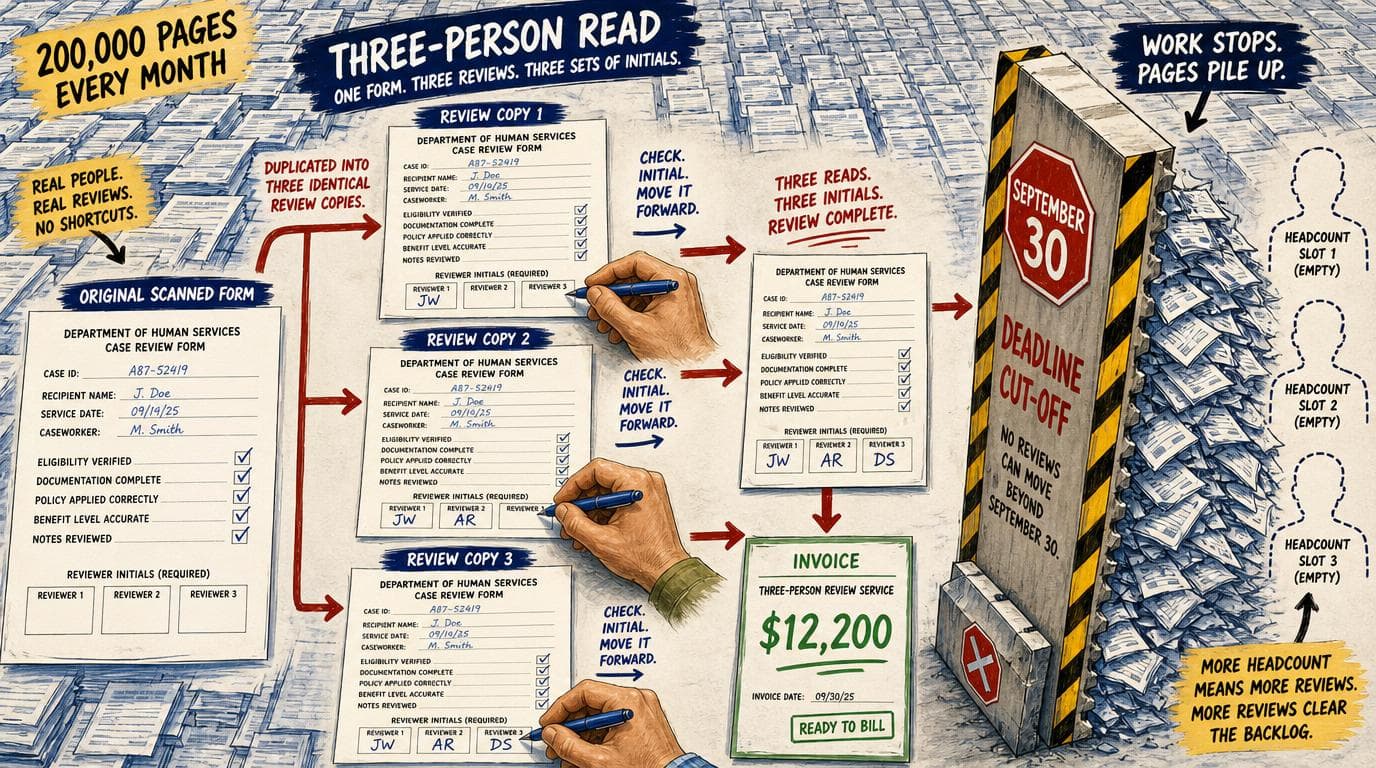
Amazon's own pricing page works an example that is worth reading twice. A document processing company pushes 200,000 pages of scanned forms a month through an extraction model, has every single one of those pages read afterward by three separate human beings, and pays $12,200 for the month. No job posting. No staffing agency. No headcount. Just a rule in the code saying that when the model is unsure, put this page in front of a person, and a line on the AWS bill that works out to a shade over six cents a page. That example is about to stop being something anyone can buy. Amazon confirmed this week that Mechanical Turk closes on September 30, and it is taking the two services built on top of it along with it.
The part of the announcement everyone skipped
The reporting on this has been almost entirely elegiac, which is understandable. Mechanical Turk launched in 2005, Jeff Bezos called it artificial artificial intelligence, and there is an obvious irony in real AI finally eating the service named after a chess-playing hoax that hid a person inside a cabinet. Fine. That is the eulogy, and CNBC and everyone else already wrote it.
The operational detail is four sentences down the closure FAQ, under the heading "General," and almost nobody quoted it: "This closure also applies to SageMaker Ground Truth and Amazon Augmented AI. The Amazon Mechanical Turk Worker type will no longer be available when creating labeling jobs or human review workflows as of September 30, 2026."
Augmented AI is the one that matters here, and it is not a crowd marketplace. It is a piece of plumbing. You point it at a model, you set a confidence threshold, and anything the model is not sure enough about gets routed to a person, reviewed, and handed back to your pipeline with the correction attached. Receipts the extractor could not read. Photos the classifier flagged at 61 percent. Product descriptions that came back weird. It was the closest thing anybody ever shipped to a programmable human, billed by the item, on demand, at two to eight cents an object depending on what you were reviewing.
The dates, since they are short. New signups already closed on July 30. Task submission stops on September 30. Requesters get thirty days after that to approve or reject work, so anything not actioned by October 30 auto approves and bills. Prepaid balances refund within thirty days. Transaction history stays downloadable until January 28, 2027, and note that Mechanical Turk only ever kept your task data for 120 days anyway, so if there is anything in there you want, that is a this-week job and not an October job.
The thing you actually lose is a price, not a website
Almost nobody reading this ran a Mechanical Turk requester account. That is not the point. The point is that for twenty years there was a published, verifiable, unnegotiated price on one sentence: a human will look at this one item and tell you what it says.
That price was somewhere between one and ten cents. Amazon's fee schedule was 20 percent of whatever you paid the worker, doubling to 40 percent on batches of ten or more assignments, with a one cent floor per assignment. In the worked example above, the reviewer payment was $0.012 a page and the company paid three different people to read each one, because triple redundancy on a penny is still cheaper than being wrong.
Every automation decision a small operation has made in the last five years has been priced against that number, whether or not anyone knew it. The moment you say "we will let the AI do it and have someone check the ones it is unsure about," you have quietly assumed a market price for someone. When that price is six cents, checking everything twice is free and you design a careful system. When that price is thirty five dollars an hour fully loaded for your own ops lead, checking everything twice is a person's entire Tuesday and you design a system that checks almost nothing.
Same workflow. Same model. Completely different business, decided by a number most people never looked up.
What is left, and what it costs
The replacements are real, and none of them are the same shape.
Prolific is the closest thing to a going concern with an API, and it is excellent at what it does, which is recruiting screened research participants. Its published guidance is to pay people at least twelve dollars an hour, with an enforced floor around eight. That is a defensible, humane number and it is also roughly ten times the effective rate the old crowd marketplaces cleared at. It is priced for a study, not for a pipeline that fires four thousand times a day.
Clickworker and the managed annotation vendors still exist and will happily take the work, but they sell projects. There is a scoping call, a minimum, a statement of work, and a turnaround measured in days. Toloka, which was the last real per-task competitor at volume, folded its crowd into its expert platform in July and moved upmarket with everyone else. The market did not fragment. It moved.
So for a business under two hundred people, the honest menu after September 30 is: send it to a model, or put it in front of somebody who already works for you. The middle option, the one where an anonymous stranger somewhere handles the ambiguous 4 percent for pennies and never appears on your org chart, is going away, and it is going away because almost nobody was buying it anymore.
The honest take
Start with the part that is genuinely good news, because it is most of the story. Amazon is not closing this out of malice or even out of cost cutting. It is closing it because the models got better than the crowd at the exact tasks the crowd was best at, and cheaper, and faster, and dramatically more consistent. Categorize this product. Is there a person in this photo. Does this review violate the policy. Pull the invoice number off this scan. If your workflow is one of those, you do not need a human tier at all any more, you need a second model pass and a spot check, and if you are still budgeting for outsourced eyeballs on that work you are buying something you stopped needing about eighteen months ago.
Now the part the vendors are not going to bring up.
The reason you wanted a human on the uncertain items was never that humans are good at reading receipts. It was that the model does not know what it does not know, and a second opinion from a different kind of mind is the only check that catches a confidently wrong answer. Replacing that reviewer with another model does not eliminate the uncertainty. It launders it. You get a number that looks like agreement, produced by a system that shares the original system's blind spots, and it will agree enthusiastically with the same mistakes.
Which brings up the genuinely funny thing about all of this. In 2023 a team at EPFL ran a summarization task on Mechanical Turk and, using keystroke analysis and a synthetic text classifier, estimated that somewhere between 33 and 46 percent of the crowd workers were completing it with a language model. They titled the paper "Artificial Artificial Artificial Intelligence" and they earned it. The human floor under a lot of AI pipelines had already been replaced from the inside, quietly, by the workers themselves, three years before Amazon got around to turning off the lights. Anyone who has been treating a crowd-sourced review layer as their independent check has possibly been buying a slightly worse model at a considerable markup for a while now.
And here is the one that will actually cost somebody money this quarter. Go look at whatever agent you are currently being sold. Read the deck. Somewhere in there, usually near the compliance slide, is the phrase "with a human in the loop," and it is doing an enormous amount of load bearing. It is the sentence that makes the risk acceptable, the sentence your insurer likes, the sentence that lets a firm say yes.
Ask who the human is.
The demo never answers that, because in the demo the human is the salesperson. In your building the human is you, or your operations lead, or the one person on the team who is good at catching things. The vendor's pricing accounts for the model calls. It does not account for the forty minutes a day somebody now spends adjudicating flagged items, because that time appears on your payroll and not on their invoice. It used to be possible to answer that question with a marketplace and a line on an AWS bill. From September 30 the only true answer is a name and an hourly rate, and that number belongs in the ROI math right next to the subscription, not in the footnotes.
What to actually do about it
If anything you own touches Mechanical Turk, Ground Truth or Augmented AI, this month is the whole window. Pull your task data down before the 120 day window rolls past it, confirm the payment details on the account so your balance refund actually lands, and get anything mid-flight approved well before October 30, because unactioned work auto approves and you pay for it either way.
If you do not touch any of it, and you almost certainly do not, do the smaller and more useful exercise instead. Take whichever AI workflow you already have running, find the branch where something gets flagged for review, and put a real name and a real hourly cost on that branch. Then count how many items land in it per week. Most people doing this honestly for the first time discover one of two things: either the queue is small enough that the whole review step is theater and should be replaced with a weekly audit of a random sample, or the queue is large enough that they have accidentally hired somebody without noticing.
Both answers are useful. Neither one costs six cents.
For twenty years the cheapest sentence in software was "a person will check it." It was never true that it was free, only that somebody else was absorbing the difference, and the bill for that arrangement is arriving on September 30 addressed to whoever wrote the workflow.
Sources
Every claim above traces back to one of these. Go read them yourself.
- 01Amazon Mechanical Turk closure FAQs
Amazon Mechanical Turk / mturk.com / retrieved Aug 27, 2026
- 02Amazon Mechanical Turk pricing
Amazon Mechanical Turk / mturk.com / retrieved Aug 27, 2026
- 03Amazon Augmented AI pricing
Amazon Web Services / aws.amazon.com / retrieved Aug 27, 2026
- 04Artificial Artificial Artificial Intelligence: Crowd Workers Widely Use Large Language Models for Text Production Tasks
Veselovsky, Horta Ribeiro and West (EPFL) / arxiv.org / retrieved Aug 27, 2026
- 05Prolific pricing
Prolific / prolific.com / retrieved Aug 27, 2026
- 06Amazon service Bezos once called 'artificial artificial intelligence' is shutting down
CNBC / cnbc.com / retrieved Aug 27, 2026
Suggested reading
Selected articles based on topic, tags, and skill focus across the library.
AI News
Sixteen tools can now spend your ChatGPT allowance
OpenAI spent Tuesday announcing more than twenty things. Two of them change what your subscription is: sixteen partner products can now draw on your ChatGPT allowance, and an always-on agent draws on it too. The same plan holds half as much from October 30.
AI News
Half the price, and now it wants a login
In four days the cost of having an AI do a unit of work fell by roughly half at two labs, Amazon opened its seller platform to outside agents, and Salesforce said the AI is replacing its interface. The same four days produced a government portal an agent let itself into and an on-the-record admission from the people selling all of it that nobody is steering.
AI News
Your email subscription just grew a webhook
Zapier puts webhooks behind its $19.99 Professional plan and counts every step your automation takes against a task allowance. On Monday the same outbound webhook, plus connectors to HubSpot, QuickBooks, Salesforce and Slack, started showing up inside Google Workspace with no second bill and no meter. The tier that can restrict where those webhooks point is not the tier most small businesses are on.