LibraryVibecoding News and Updates8 min read
Nothing went red for sixteen days
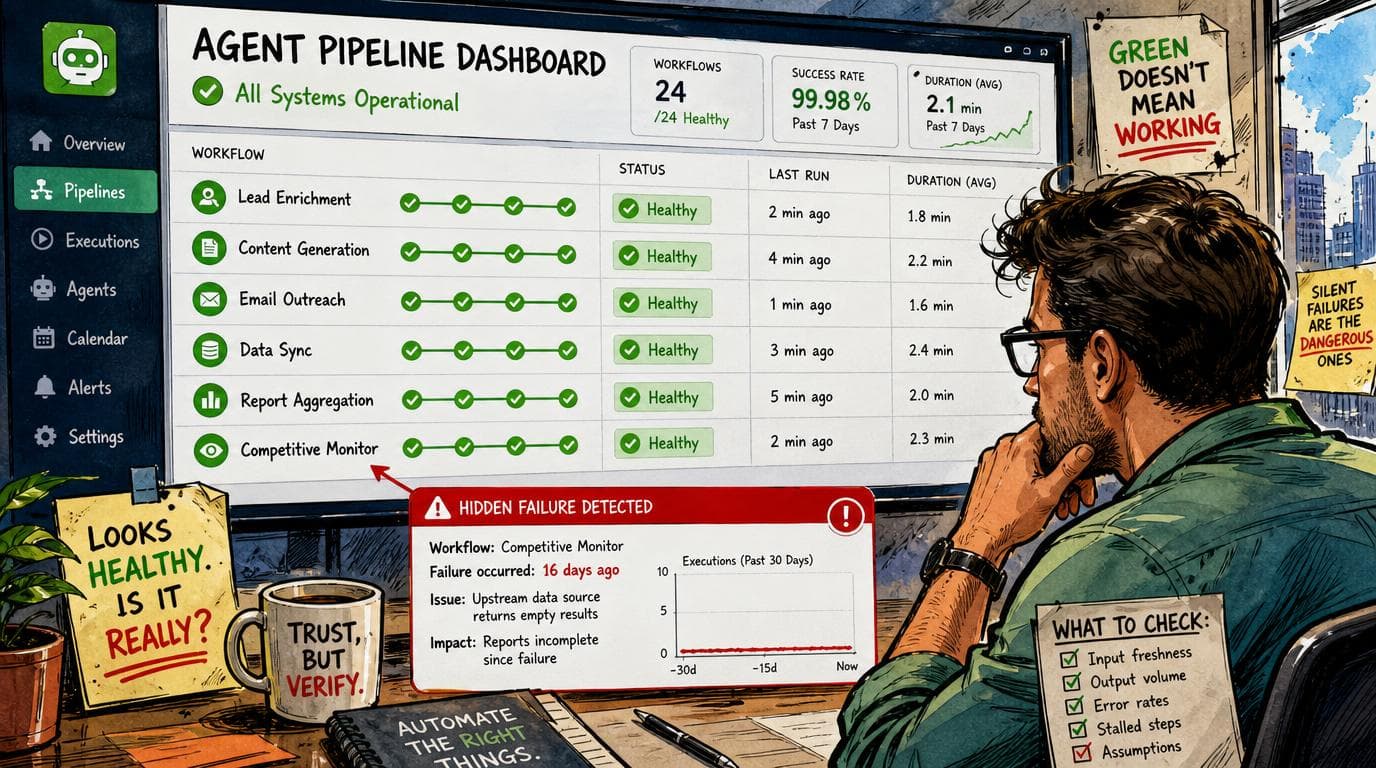
Auto mode is now the default across coding agents, allowing operators to hand off workflows and walk away. But the most dangerous failure in AI-built systems is not the loud crash or the blocked permission; it is the silent call that returns HTTP 200 with empty data, wrapped in a defensive catch block that keeps every dashboard green.
The operations lead or RevOps builder in your organization can now assign an agentic coding assistant a multi-file task on a Friday afternoon, close the laptop, and review the merged pull request on Monday morning. That capability stops costing the hour developers used to spend babysitting terminal prompts, because auto mode became the default for sessions on Pro, Max, and Team plans. That reclaimed hour is tangible productivity.
What nobody puts on the marketing announcement is the failure mode that auto mode cannot see.
When unattended agents build production workflows, the most destructive defect is never the catastrophic command that triggers a permission prompt or crashes a server. It is the routine that fails completely while reporting complete success. A pipeline can run dark for sixteen days without firing a single alert, turning a monitoring dashboard red, or throwing an unhandled exception. Every scheduled invocation reports success because nothing dangerous was attempted. The workflow simply did nothing, flawlessly.
That is the actual ceiling in production vibe coding today, and auto mode does not move it.
What actually shipped
Eight releases landed in the Claude Code changelog between versions 2.1.225 and 2.1.232. The marquee headline was the auto mode permission default. Alongside it, version 2.1.225 introduced spend limits on the API gateway where threshold warnings specify remaining quota, reset intervals, and administrative contacts. Version 2.1.232 enabled subagent forking by default, allowing helper sessions to inherit full conversation contexts rather than starting cold, and added session mentions so independent agents can hand off discoveries by name.
The most revealing details sit in the security and notification fixes. The changelog documents a PowerShell permission bypass, a Windows issue involving Git Bash symlink resolution, nested repositories quietly inheriting parent workspace trust, and Bash input redirections that bypassed permission checks on specific platforms. More significantly, three entries addressed events that occurred completely silently: streaming responses that truncated without warning, background session takeovers that lacked notification, and audio connection refusals that failed to render an error.
Taken together, the engineering distribution reveals a clear theme: in the exact week the vendor removed the human checkpoint that made you the final safeguard, the majority of engineering effort was directed at silent seams where systems failed to announce what occurred. The real operational frontier is not model reasoning capacity. It is observability.
The anatomy of the silent failure
Silent failures in agentic systems share a consistent structural signature: the value a function returns when it fails is indistinguishable from a legitimate value when it succeeds.
When a hard failure launders itself into a normal looking result, every downstream system behaves exactly as designed when receiving normal data: it processes nothing, logs success, and exits.
1. The reasoning token trap
Consider an automated pipeline generating customer communications, summary reports, or social distribution drafts. The workflow queries a modern reasoning model with high reasoning effort and sets a maximum output limit of 2,000 tokens.
On reasoning API endpoints, internal thinking tokens bill directly against that exact same token ceiling. OpenAI documents this constraint plainly in its platform guides: if generated tokens reach the max_output_tokens value you have set, the API returns a response with a status of incomplete, and this can occur before any visible text tokens are generated at all.
The consequence is brutal. The API call incurs full billing charges, returns an HTTP 200, and hands back an empty string. It is not an HTTP error; it is a successful transaction with zero visible output. The application function receives the empty payload, handles it gracefully, logs the task as completed, and moves to the next record. The pipeline appears healthy, yet zero output was produced.
Testing identical prompts across varied source inputs reveals why this bug is so difficult to catch: thinking duration varies drastically. A straightforward summary might consume 1,200 reasoning tokens and emit 350 tokens of clean output, finishing well within the 2,000-token ceiling. A complex source input with subtle contradictions might demand 2,100 reasoning tokens. Under the exact same prompt and settings, the complex task hits the ceiling during internal deliberation and emits nothing.
Because the failure is intermittent, it resists basic testing. Workflows that work on Tuesday fail on Wednesday, get dismissed as transient network quirks, and leave large batches of records unpopulated in production databases.
2. The empty array failure
An even simpler pattern occurs in data enrichment and synchronization pipelines. An API credential expires or a third-party gateway alters its authentication header format. The network client throws an authorization error.
An agent, instructed to write robust and resilient code, wraps the external call in a defensive try-catch block. When the call fails, the catch block intercepts the exception and returns a default empty array: [].
An empty array is the exact same data structure returned when an API search executes successfully and finds zero matching candidates. The scheduled job runs every morning, reports green across the board, and logs an honest count of zero matches. A business directory or CRM enrichment queue can sit idle for weeks, accumulating zero new records, while daily status digests report that the sync completed on schedule.
3. The silent stream completion
Streaming interfaces present a third variation. When an application streams model responses token by token, the generated loop is designed to append arriving chunks to an active UI container or message queue. If a upstream proxy or model provider truncates a response before streaming begins, the connection establishes, zero tokens arrive, and the streaming loop terminates cleanly.
Because no exception was thrown, defensive catch blocks never trigger. Fallback messages and error banners remain unrendered. An end user or downstream listener receives a blank response, while system monitors record an HTTP 200 connection that opened, completed, and closed normally.
The confident comment problem
The most insidious hazard in AI-generated software is that an agent will write a confident, plausible justification that persuades human reviewers to stop inspecting.
A language model does not mislead intentionally. It generates the most coherent, professional explanation available in the style of the surrounding codebase. When an agent inserts an arbitrary 2,000-token ceiling above an API call, it frequently accompanies the number with an inline code comment:
``typescript // 2000 tokens covers reasoning and output together, measured by stable execution across benchmarks ``
A human engineer or operator reading that code comment sees the word "measured," assumes a proper performance benchmark was conducted, and approves the pull request. In reality, no measurement took place. The agent observed that a neighboring call with a lower limit failed loudly, noted that 2,000 did not immediately crash, and synthesized a professional explanation asserting stability.
Furthermore, agents lack contextual memory across project boundaries. Even if a specific failure pattern was diagnosed, tested, and resolved in one service module, an agent generating a new endpoint in a sibling directory will introduce the exact same defect again. The model optimizes for the specific prompt and file in its immediate context window, blind to the architectural lessons recorded three folders away.
Recent platform updates introducing persistent forked sessions and multi-agent mentions are deliberate attempts to address this boundary friction. But as long as context is segmented, hard-learned operational constraints will fail to propagate automatically.
Three operational rules for unattended workflows
Organizations building tools through vibe coding cannot rely on traditional compiler errors or permission prompts to catch silent degradation. Defensive error handling naturally converts loud failures into quiet ones.
Three practical habits protect production workflows from silent decay:
1. Demand the provenance of operational numbers
Treat every magic number in generated code as an unverified guess until empirical data proves otherwise. Timeouts, token limits, concurrency caps, retry backoffs, and similarity thresholds must have demonstrable origins.
Ask the coding agent directly: _"Where did this number come from, and what live measurement produced it?"_ If the explanation relies on phrases like "typically sufficient" or "industry standard," treat it as a placeholder. A placeholder is acceptable during prototyping; a placeholder disguised as a verified measurement creates production blind spots.
2. Force empty states to declare their cause
Any routine that can legitimately return zero results must explicitly distinguish between "the query ran and found no matching records" and "the query could not execute."
Never allow a catch block to silently coerce an authentication failure, network timeout, or schema mismatch into an empty collection ([] or ""). Classify errors explicitly. If a third-party token expires or an endpoint rejects parameters, the return value must communicate the failure state directly, alerting operators that an outage occurred rather than reporting an empty day.
3. Monitor output volume, not job execution
A passing cron job or a green pipeline indicator proves only that a process launched and terminated without throwing an uncaught exception. It provides zero guarantee that meaningful business work occurred.
Instrument monitoring around business output: rows written, records enriched, notifications dispatched, or summaries generated. If a pipeline that typically processes fifty records a day reports zero records for forty-eight consecutive hours, trigger an alert regardless of whether the underlying job finished with an exit code of zero.
The ceiling, named
Auto mode's security model is designed to prevent irreversible damage: deleting production databases, overwriting system files, or executing untrusted network scripts. That is a necessary safety net.
What auto mode cannot evaluate is whether an operation that produced nothing was supposed to produce something. From the vantage point of an operating system or terminal sandbox, an empty string and a completed report look identical.
The tools have become exceptionally proficient at avoiding overt harm, but they remain indifferent to silent inaction. Real operational resilience requires designing systems that measure what actually came out the other side.
Sources
Every claim above traces back to one of these. Go read them yourself.
- 01Claude Code CHANGELOG, versions 2.1.225 through 2.1.232
Anthropic / github.com / retrieved Aug 14, 2026
- 02Auto mode is now the default in Claude Code for Pro, Max, and Team plans
Anthropic / claude.com / retrieved Aug 14, 2026
- 03Reasoning models: allocating space for reasoning
OpenAI / platform.openai.com / retrieved Aug 14, 2026
Suggested reading
Selected articles based on topic, tags, and skill focus across the library.
Vibecoding News and Updates
Nobody audits your guardrails except the changelog
The settings file listing what your agent may never touch is what replaced sitting there clicking approve on every command. Between September 6 and September 10, roughly ten fixes shipped describing places that file was not being enforced, and the only reason you know is that somebody wrote it down.
Vibecoding News and Updates
Your agent has an app store now. The label is one paragraph and a link.
There are 2,282 prebuilt add-ons in the public catalogue for one coding agent, published by 1,863 different accounts, and on Thursday whatever you switch on in your account started installing itself into every machine you sign into. Four of those 2,282 listings say what the plugin actually contains.
Vibecoding News and Updates
The repository you cloned is also a settings file
On September 18 coding agents started reading a project instruction file most people have never opened, and on September 24 a batch of fixes landed about which settings a repository is allowed to change on your machine. Both are the same story: when you point an agent at a folder somebody else wrote, that folder gets a vote before you type anything.