

LibraryVibecoding News and Updates11 min read
You can ship it without a GitHub account now. Every step they removed was also a checkpoint.
On Thursday the last two prerequisites between describing a tool and handing someone a working web address came off: no repository, no deploy, no terminal. In the same seven days both vendors shipped meters, caps and a restricted mode, because the steps they deleted were the places a person used to look.
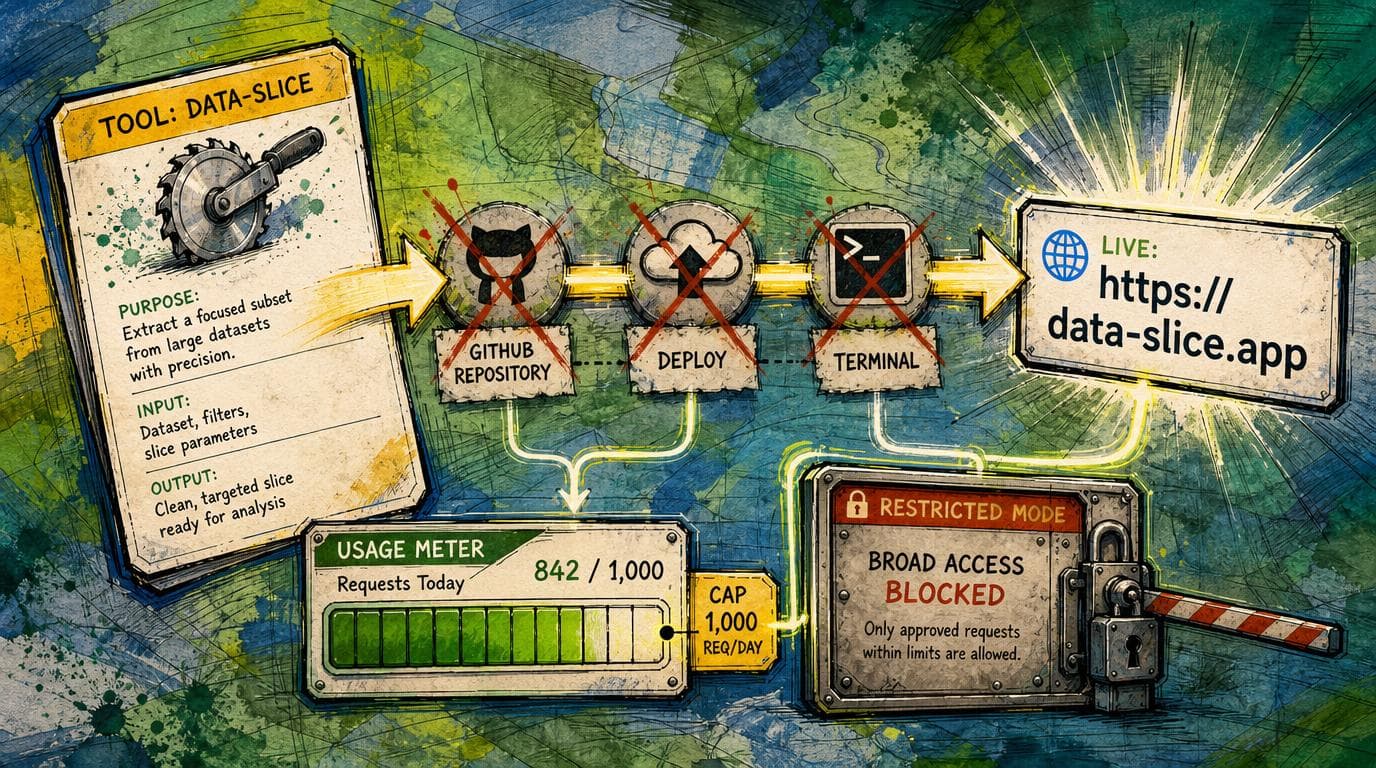
The lead router you have been waiting on since June can be built, previewed, and handed to a coworker as a real web address today, by you, in a browser tab, with no GitHub account, no terminal, and nobody in engineering involved at any point in it. Cursor turned that on Thursday. The version of that request that existed in July went into a ticket queue and came back in six weeks if it came back at all. The version that existed on Wednesday still needed somebody to make a repository, connect a host, and know what a deploy was, which for most of the people reading this is the same thing as needing engineering. As of Thursday it needs twenty dollars a month, plus another twenty to the company that puts it on the internet.
That is the whole change, and it is bigger than it sounds, because the two things that came off were never the hard part of building. They were the entry fee.
The prerequisites came off in three releases across ten days
Read Cursor's own changelog for Thursday and the sentence is plain: "Cloud Agents no longer require a connected GitHub or other third-party SCM provider to get started." You pick "Start from scratch" in the repo picker and you prompt. Cursor makes the repository in the background, and you do not have to know that it did. When the thing works, there is a "Create repo" button that turns the scaffolding into something you can name, set to private, and share.
Two more sentences in that same entry matter more than the first one. Cursor now port-forwards the agent's running environment straight into your browser, so you watch the thing work instead of reading a description of it working. And: "Connect a Vercel account and hit publish to get a live URL for what you built."
Prompt, watch, publish. There is no step in there that requires you to have ever seen a command line.
That did not arrive by itself. It is the third piece of a run that started ten days earlier. On August 17, per the changelog, Cursor started hosting code itself, in early beta, on all paid plans: repositories, pull requests, browsing, and two-way sync with GitHub for anyone who already had it. On August 19 the cloud agents got the ability to run without anybody driving them, described in that entry as agents that "operate as a system, building and shipping software on their own without the need for intervention at each loop." They subscribe to things now. A pull request, a Slack thread, a schedule. An agent that opens a pull request automatically subscribes to it and drives it to completion, fixing CI and answering bot comments. Subagents get their own machines.
Then Thursday removed the account you needed to use any of it.
Line those up in order and the shape is obvious. Host the code, so the agent has somewhere to put things. Make the agent able to keep working, so it does not need you at every step. Remove the account, so a person who has never made a repository can start. Ten days, and at the end of it the distance between "I want a thing" and "here is the link" is a subscription and an afternoon.
The bill is forty dollars, and two of the meters are not yours
Here is the part the announcement does not do for you.
Cloud agents are not on the free plan. Cursor's pricing page puts the free Hobby tier at "limited Agent requests" and lists cloud agents under Individual, which starts at twenty dollars a month. Teams is forty per user. Every plan includes some model usage and then keeps going: "On-demand usage allows you to continue using models after your included amount is consumed, billed in arrears." Billed in arrears means you find out afterward.
The publish button needs a Vercel account, and this is where the reader most likely to be burned gets burned. Vercel's free Hobby plan exists and it is genuinely free, and Vercel's own pricing page says in its FAQ that Hobby "is for personal, non-commercial use." A quote calculator your sales team uses on live deals is not personal and it is not non-commercial. That puts a real internal tool on Pro at twenty dollars a month, which comes with twenty dollars of included usage credit, and after that, in Vercel's own words, "you can pay as you go, uncapped."
So call it forty dollars a month before one person visits the thing, and two separate usage meters running in two separate dashboards, neither of which is the tab you built the tool in.
I want to be fair about the comparison, because forty dollars is not the story. Against a contract developer, forty dollars is nothing. Against the six weeks in the ticket queue it is less than nothing. The reason to write the number down is not that it is large. It is that it is the first number in this whole workflow that nobody puts in front of you, and it is variable, and it is the one that is still arriving in November.
Every step they removed was also a place somebody looked
Now the part that is worth the fifteen minutes.
Making a repository, connecting a host, running a deploy, approving a command: those were friction, and everyone is right to be glad they are going. They were also, and nobody designed them this way, the four or five moments in the process where a human being looked directly at what was about to happen. Not carefully. Not as a review. But you saw the thing. You clicked the button that put it on the internet, and in the half second before you clicked it you knew you were putting something on the internet.
Take those out and the looking does not move somewhere else. It just stops.
You can watch both vendors reckoning with that in the same seven days, which is why this is one story and not two. Go read the Claude Code changelog for this week with that in mind, and it is almost entirely about rebuilding, in software, the checkpoints that stopped existing in hardware.
Version 2.1.243, on August 25, added a Loops breakdown to the usage screen: "per-loop run count, total tokens, tokens per run, and last run, so runaway or chatty /loop tasks are easy to spot." A loop is a task you told the agent to keep repeating on its own. That is a meter, and it exists because the thing it measures now runs when you are not there. The same release added a setting so an organization's actual contracted model rates show up in the cost display instead of list price, which is another way of saying somebody discovered that the number on the screen was not the number on the invoice.
Version 2.1.246, the same day, capped how often a parked session will check back in on long-running background work: at most three times per goal, and three more only after you say something. Four days earlier, 2.1.239 had already made those check-ins back off to thirty minutes, then an hour, then every two hours. Read those two entries next to each other and you are watching a company tune the frequency at which a working agent is allowed to interrupt a person who has walked away. That is a product surface that did not need to exist a year ago.
And on Thursday, the same day Cursor removed the repository, 2.1.248 added a mode called --restricted that "removes the built-in tools that run commands or code and WebFetch," keeps file access inside the working directory, refuses to let anything bypass permissions, and ignores your settings files entirely. A muzzle, shipped as a flag, for the exact configuration everybody is now being encouraged into.
Meters, caps, and a muzzle, in the same week as the publish button. The friction did not disappear. It got moved out of your hands and into a settings file, and settings files are opened by people who already know what they are looking for.
What that looks like in unattended production
When teams move from interactive vibe coding to unattended automations running on schedules, the failure modes change shape. When a human sits at the terminal, failure is immediately visible. In unattended workflows, things fail quietly, and the two most common failures illustrate both halves of this transition.
The first is a number nobody watches: the prepaid balance or rate quota of a downstream service. In automated publishing, document synthesis, or lead enrichment pipelines, stages depend on upstream API credits (third-party visual generation, LLM reasoning tokens, or web-scraping tiers). When that balance drains to near zero, upstream steps continue succeeding, records validate, and downstream assets quietly fail to render. If your release gate demands a complete artifact before deployment, finished content sits unrendered for days because one auxiliary API call failed closed.
The real danger is the unmeasured burn rate. An automation runs for weeks against a prepaid pool of credits. Until someone measures the exact token or dollar cost per execution unit, the rate of spend remains invisible until operations halt. That is how automated pipelines run dry in production without triggering a single warning until the balance is exhausted.
Nothing about that is exotic. It is what happens to every unattended workflow that consumes metered resources. Development environments added loop meters and spend limits this week for that exact reason.
The second failure pattern is silent configuration drift around default targets. Consider an automated workflow that pushes updates to a repository or staging database with a default argument like branch = "main". That default was entirely sensible when the project began. When the deployment architecture evolves to separate staging or content branches, nothing forces a compiler check on the default. An automated service keeps committing to the original branch, creating an orphaned copy while the production branch remains unchanged, and webhooks processing pushes report success because a commit occurred. The source of truth quietly forks, and every status dashboard stays green.
In many systems, those bugs only surface because an access token happened to lack write permissions on the target branch. A permissions accident ends up doing the work that an explicit contract should have handled. The proper fix is eliminating optional defaults on external targets: make destination branches and environments required, explicit arguments so misconfiguration becomes an immediate build failure rather than a silent fork.
That is the honest version of what unattended software requires. Safety cannot rely on leftover configuration or lucky permissions errors. It requires explicit budgets and rigid boundary contracts.
The ceiling moved, and it is now the third week
Every week this series asks where these tools stop helping and start costing, and this week the answer moved somewhere new.
It is no longer the first hour. That used to be the wall: you needed an account, you needed to understand a repository, you needed to know that "deploy" was a thing that happened. Gone, genuinely, and for the RevOps or ops person who has been priced out of building by exactly those three facts, this is the best week of the year.
The wall now is the third week. It is the Tuesday in November when the tool your team now depends on needs one change, and you do not have a developer, you do not read the code, the agent that wrote it has no memory of it, the repository lives inside a code host that was ten days old when you started using it and is still labeled early beta, and the running bill is split across two vendors on usage-based plans. Nothing in Thursday's release touches any of that. Nothing was supposed to. But the release does move a lot more people to the place where it matters.
Two things are worth doing before you publish anything, and both take under ten minutes. Set the spend cap on the host, because Vercel gives new teams a default on-demand budget of two hundred dollars and will optionally hard-pause your projects when you hit it, and a hard pause you chose is better than an invoice you did not. And in the first week, write down what the thing actually costs to run per use, per day, whatever unit makes sense, and put that number somewhere a human reads. Not because it will be big. Because "we never knew the burn rate" is how automated workflows stall in production, and it is the single most repeatable failure in anything that runs while you sleep.
Friction was never the price of building. It was the price of noticing, and this week both vendors started selling it back to you as a setting.
Sources
Every claim above traces back to one of these. Go read them yourself.
- 01Cursor changelog, August 27 2026: Start from scratch, without a repo
Cursor / cursor.com / retrieved Aug 28, 2026
- 02Cursor changelog: Origin code hosting (Aug 17) and always-on cloud agents (Aug 19)
Cursor / cursor.com / retrieved Aug 28, 2026
- 03Claude Code changelog, versions 2.1.239 through 2.1.248
Anthropic / code.claude.com / retrieved Aug 28, 2026
- 04Cursor pricing: Hobby, Individual, Teams, Enterprise
Cursor / cursor.com / retrieved Aug 28, 2026
- 05Vercel pricing: Hobby, Pro, and Enterprise plans
Vercel / vercel.com / retrieved Aug 28, 2026
Suggested reading
Selected articles based on topic, tags, and skill focus across the library.
Vibecoding News and Updates
Nobody audits your guardrails except the changelog
The settings file listing what your agent may never touch is what replaced sitting there clicking approve on every command. Between September 6 and September 10, roughly ten fixes shipped describing places that file was not being enforced, and the only reason you know is that somebody wrote it down.
Vibecoding News and Updates
Your agent has an app store now. The label is one paragraph and a link.
There are 2,282 prebuilt add-ons in the public catalogue for one coding agent, published by 1,863 different accounts, and on Thursday whatever you switch on in your account started installing itself into every machine you sign into. Four of those 2,282 listings say what the plugin actually contains.
AI News
The week you bought just got shorter
The hundred dollar subscription you build your own tools on holds about a sixth less building per week starting today, at the same price. Anthropic announced it as a 25 percent increase, and it is, against a baseline nobody has seen since May.