

What counts as done is now the price
You can buy a support agent today that charges 99 cents when it finishes a conversation and nothing when it hands off to a person. On Monday OpenAI started testing the same deal with its biggest customers. The catch is that somebody has to define finished, and it is not you.
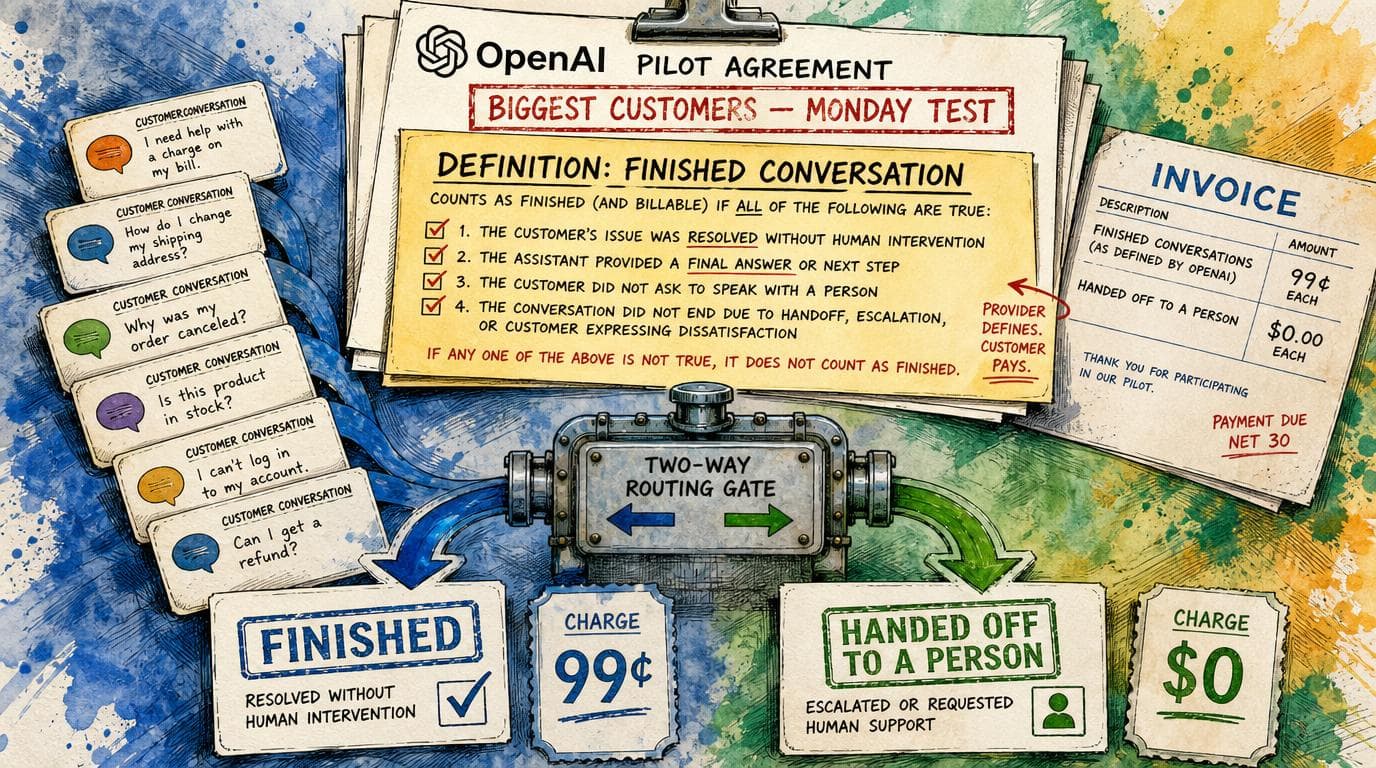
You can buy a customer service agent today that charges you ninety-nine cents when it finishes a conversation and nothing at all when it gives the customer to a person. No seat. No license. No annual commitment for a login that belongs to somebody who quit in March. What that deletes is shelfware, the forty seats you bought and the three people who actually use them, and it is the first pricing change in twenty years that moves risk from you back to the vendor. On Monday the model climbed out of the support desk and into the general-purpose vendors: The Information reported that OpenAI has started letting some of its largest customers pay only when its AI completes the task it was given.
What actually changed
Three things landed close enough together to be one thing.
OpenAI, per Monday's report, is testing task-completion billing with select major accounts. Not tokens. Not seats. Not compute minutes. You get charged when the work is done.
Salesforce said the quiet part on an investor call. Marc Benioff told analysts that enterprise Agentforce customers can now sign customized contracts priced against revenue growth from deals the AI helped close, or against cost savings from service it automated. Same report, same day. Agentforce is at $1.5 billion in ARR and did 3.2 billion Work Units last quarter, so this is not a pilot somebody runs to get a press mention.
And the third thing is already sitting on a pricing page you can read right now. Fin charges $0.99 per outcome, works with Salesforce, HubSpot, Freshworks, Zoho and Gorgias without you switching helpdesks, and carries no seat cost for the agent itself. Salesforce is buying it for $3.6 billion, a deal that closes in Salesforce's Q4, and the press release leads with the number that justifies the check: 76 percent of support volume resolved end to end, across 30,000 companies. Salesforce shipped its own version in June, a packaged Help Agent at two dollars a resolution, with no charge when the customer asks for a human or leaves negative feedback. Oracle, HubSpot and Pegasystems are pitching the same shape.
That is the news. It is not complicated and it is not the interesting part.
The unit of purchase just changed, and nobody sent a memo
For twenty-five years you bought software by the seat. A seat is a beautiful unit. You can count it. It sits in a spreadsheet next to a headcount number that you also control, and when you hire somebody you add one and when somebody leaves you take one away, and the finance person can forecast next year in about four minutes. The seat is bad in exactly one way, which is that it charges you the same whether anyone opens the thing or not. That is where the regret comes from. Roughly six in ten businesses regret a software purchase made in the last eighteen months, and when you actually ask them why, it is almost never that the product was broken. It is that they bought capacity for a version of the company that never showed up.
Outcome pricing fixes that, genuinely and completely. If you are paying for forty seats and three people log in, moving to a per-result meter is strictly better for you, full stop. The vendor now eats the risk that their software is bad. That is a real transfer and it is worth celebrating for about one paragraph.
Here is the paragraph after that one.
A seat is a fact. An outcome is a claim. Somebody has to say what "done" means, somebody has to count how many times it happened, and the number that comes out the other end is your invoice. Read Fin's own definition, because it is refreshingly plain and it will change how you read the price. A billable resolution is "no further help is requested after Fin's last answer." Not "the customer got what they needed." Not "the ticket closed with a satisfied customer." Silence. The bot is paid when the customer stops writing.
Most of the time those are the same event. A person asks where their order is, gets told, and goes away happy. Fine. But they are also the same event when somebody asks a question the bot cannot handle, reads a paragraph of polite nothing, and gives up. That customer churns three weeks later and you paid ninety-nine cents for the privilege. The meter cannot tell those two apart because silence looks identical from the inside.
Fin's page is honest about the rest of it in a way I want to credit. A procedure handoff to a human is billable if you configured the procedure to end that way. A disqualification is billable at ninety-nine cents. A qualification is billable at $9.99, ten times the rate, because the vendor made a judgment about what a qualified lead is worth to you and priced accordingly. And a conversation simply passed to your team with no outcome is free. All of that is written down. Most vendors will not write it down.
Sierra's writeup is the clearest statement of the philosophy anyone has published, and it is worth reading in full because the hedges are where the information is. Escalations: "in most cases, there's no charge." Criteria: "clear, agreed-upon criteria for each outcome upfront." Both true, both good, and both pointing at the same thing. In most cases. Agreed upon. Those are contract terms, and contract terms are negotiated, which means there is a version of the deal where you negotiate badly.
This is now an ops job, and it is your ops person
Here is the part that matters most to anyone who runs revenue operations or is the closest thing their company has to one.
Attribution used to be an internal argument. Marketing says the webinar did it, sales says the SDR did it, you build a model, everyone disagrees politely, and at the end of the quarter nothing about the disagreement changes what leaves the bank account. Under outcome pricing, attribution is the bill. The definition of a resolved conversation, an influenced deal, a saved cancellation, is now the thing your vendor invoices against, and the count is produced by the vendor's own dashboard using the vendor's own definition.
Nobody in a forty-person company has an independent count of that. Nobody has a second system that watches the first system. So the practical answer, and this is the thing to do before the renewal rather than after it, is to build the count yourself before you sign anything.
You do not need engineering for this and you do not need permission. If your helpdesk has a webhook, and it does, you can pipe every conversation into a sheet with three columns: when the AI touched it, whether a human touched it afterward, and whether the same customer came back within seven days on the same subject. That third column is the whole ballgame. It is the difference between a resolution and a customer who quit talking to you. Two hours of work with an AI assistant and a Zapier or n8n flow gets you a number you own. Then at the end of month one you set your number next to the vendor's number and you find out how far apart they are.
If they are within a few percent, you have a good vendor and you can stop worrying about it. If the vendor's count is meaningfully higher than yours, you now have the one thing that has ever worked in a pricing conversation, which is a number of your own. That is what the engineering queue used to be for. It is a Friday afternoon now.
The honest take
Outcome pricing did not replace the seat. Go look at Salesforce's own pricing page and count the models on it. There is a free tier. There is Flex Credits at $500 per hundred thousand credits. There is $2 per conversation. There is $2 per Help Agent resolution. There is a $5 per user per month license that requires Flex Credits on top. There is a $125 per user per month flat add-on that makes usage unmetered. There is Agentforce 1 starting at $550 per user per month. That is seven ways to pay for one product, and the page also tells you that Flex Credits and Conversations "will not be supported in the same org," so you have to pick your meter before you know your volume. Unused Flex Credits do not roll over.
Think about what that actually is. It is shelfware with an extra step. The old failure mode was buying too many seats. The new failure mode is pre-committing to the wrong meter, and it is harder to see coming because you have to forecast a number you have never measured.
Second thing. The version being tested at OpenAI is for "some major customers," and the Salesforce version Benioff described involves negotiating custom terms against your revenue growth. Those are conversations that happen between companies with legal departments. What reaches a forty-person business is the packaged rate, and the packaged rate is set from the average. Ninety-nine cents is not a discovered price, it is a chosen one.
Chosen against what, specifically. Run the arithmetic yourself, because the vendors will not put it in the deck. A support person at $45,000 fully loaded, handling fifteen tickets a day, two hundred and fifty days a year, works out to about twelve dollars a ticket. Ninety-nine cents is eight percent of that. Which sounds like a bargain until you notice that the price was set just under the labor it displaces, and nowhere near what it costs the vendor to run. When inference gets cheaper next year, and it will, the price stays at ninety-nine cents. Outcome pricing does not track the vendor's cost. It tracks your alternative. That is the entire business model and it is a good one, for them.
Who this is genuinely wrong for: anyone with low volume. Fin's minimum is fifty outcomes a month. If you field thirty support conversations, you are paying $49.50 for thirty of them and nineteen dollars and eighty cents for nothing at all, which is a seat with extra vocabulary. Below a couple hundred tickets a month, the honest answer is that a good help center and one person checking an inbox twice a day still wins, and no vendor is going to tell you that.
What breaks in month three: definition drift, and not because anyone is dishonest. These agents are tuned continuously, and the thing they are tuned toward is closing conversations. An agent that gets slightly harder to escalate from closes more conversations. Nobody sets out to build that. It is just what the gradient points at when the gradient is a resolution count. Six months in, your escalation rate is down, your resolution count is up, your bill is up, and your customers are marginally more annoyed in a way that shows up in churn instead of in the dashboard.
And the thing Constellation put its finger on, which is still unanswered: who audits the value? Not the vendor, obviously. Not you, not yet. There is no third party in this market and there is no standard for what a resolution is. Every vendor is grading its own homework and sending you the invoice with the grade attached.
None of which makes this a bad deal. It is a better deal than the seat, for most businesses, most of the time, and the vendors moving to it are taking on real risk that they did not have to take. Just understand what you are agreeing to. For twenty-five years the price was attached to how many people worked at your company. Now it is attached to a sentence in a contract about what finished means, and the only way to know if that sentence is true is to go count it yourself.
The seat was never accurate either. But at least you knew how many people you had.
Sources
Every claim above traces back to one of these. Go read them yourself.
- 01Agentforce pricing
Salesforce / salesforce.com / retrieved Aug 31, 2026
- 02Fin AI Agent pricing
Fin / fin.ai / retrieved Aug 31, 2026
- 03Outcome-based pricing for AI Agents
Sierra / sierra.ai / retrieved Aug 31, 2026
- 04Salesforce Signs Definitive Agreement to Acquire Fin
Salesforce / salesforce.com / retrieved Aug 31, 2026
- 05Salesforce takes a run at outcome-based Help Agent pricing
Constellation Research / constellationr.com / retrieved Aug 31, 2026
- 06OpenAI Reportedly Joins Salesforce, Others In Testing Outcome-Based AI Pricing
Stocktwits / newsable.asianetnews.com / retrieved Aug 31, 2026
Suggested reading
Selected articles based on topic, tags, and skill focus across the library.
AI News
Half the price, and now it wants a login
In four days the cost of having an AI do a unit of work fell by roughly half at two labs, Amazon opened its seller platform to outside agents, and Salesforce said the AI is replacing its interface. The same four days produced a government portal an agent let itself into and an on-the-record admission from the people selling all of it that nobody is steering.
AI News
The week you bought just got shorter
The hundred dollar subscription you build your own tools on holds about a sixth less building per week starting today, at the same price. Anthropic announced it as a 25 percent increase, and it is, against a baseline nobody has seen since May.
AI News
Google will now tell you what your customer data is worth to Google
Pushing closed-won revenue from the CRM back into the ad platform used to mean a customer data platform at $7,440 a year or an engineer you do not have. Thursday it became one documented endpoint inside a product you already log into, shipped alongside a metric that grades how well you are feeding it. The pipe is worth taking. The grade is not.