

You can stop buying Copilot for the people who just write
A forty-person company gets quoted $840 a month to put AI inside Word. Yesterday OpenAI shipped a Word sidebar that does the demo those seats were sold on, free, on every plan. What the seat still buys is worth knowing before you renew.
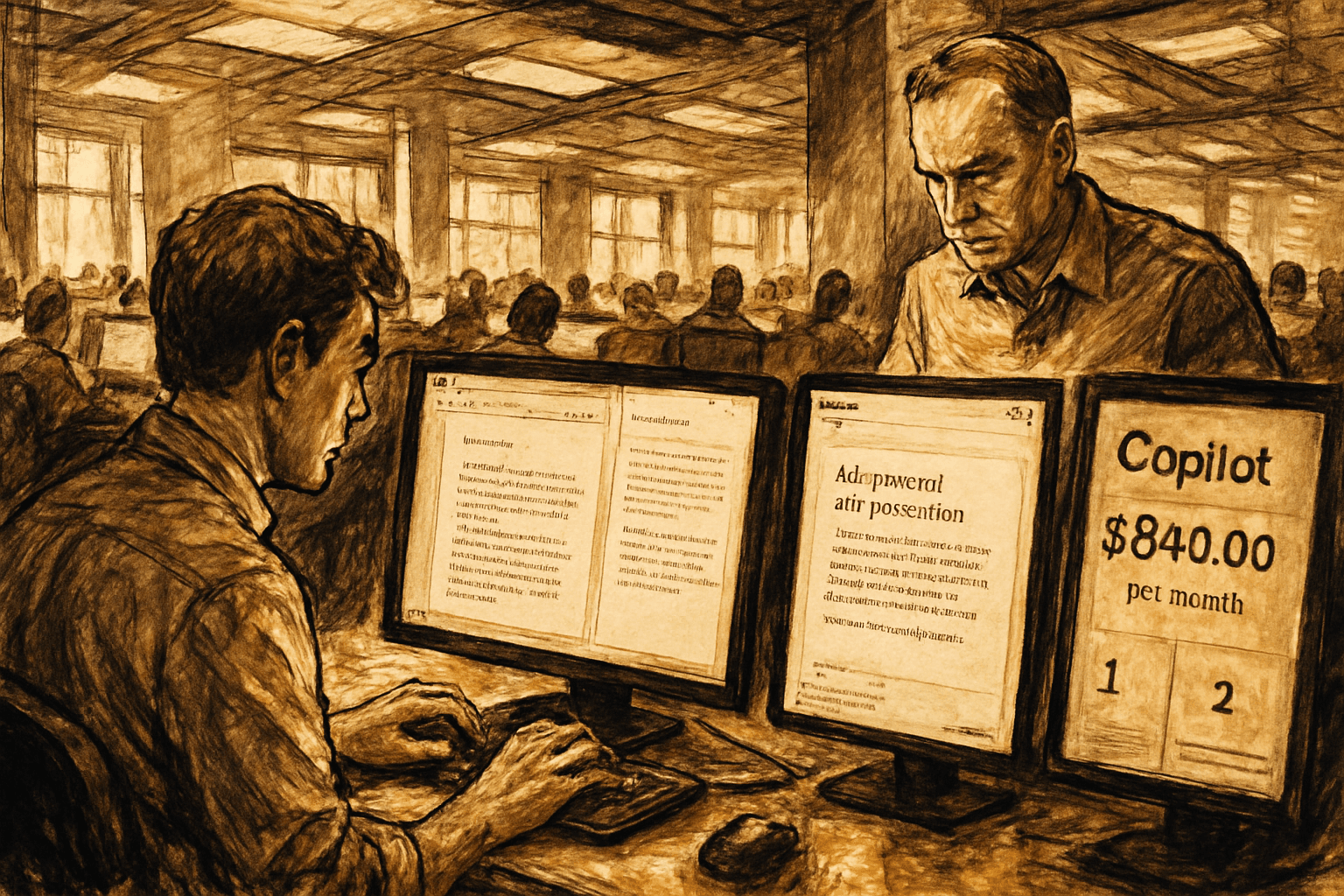
A forty-person distributor gets quoted eight hundred and forty dollars a month to put AI inside Word. That is the Microsoft 365 Copilot Business seat at twenty-one dollars a head, charged on top of the Microsoft 365 licence the company already pays for, and the demo that sells it is nearly always the same one: somebody drops a page of scratchy meeting notes into a document, asks for a clean proposal, and gets one back in about nine seconds. As of yesterday that exact demo runs inside Word for nothing. OpenAI shipped a ChatGPT sidebar into the Microsoft Marketplace, it installs like any other Office add-in, and it works on every ChatGPT plan down to and including Free.
So the Copilot conversation your company is having this quarter just changed shape. It is no longer "is AI in Word worth paying for." It is "which of these forty people need the part that is actually expensive," and for most small companies that number is not forty.
What actually changed
Yesterday's addition is a persistent sidebar that lives inside Word, installed from the Microsoft Marketplace the same way any other Office add-in gets installed. Inside it you can draft from notes, summarize the document you have open, revise a selected passage, and adjust headings and formatting, per OpenAI's release notes. You sign in with whatever ChatGPT account you already have.
Word is the third of the three. ChatGPT landed in Excel in early May and in PowerPoint a couple of weeks after that, through the same add-in package. Word was the conspicuous hole, and it was the conspicuous hole in the one app where small companies do the most work that nobody enjoys doing.
Availability is the part that matters most and is being reported the least carefully. It is on all plans including Free, with your plan's own token limits applying. On the paid tiers, Word usage draws from the same shared allowance that Codex and the other premium features draw from, which means it is free the way the rest of your ChatGPT plan is free: free until you are a heavy user, at which point you were already paying.
For comparison, the thing it sits next to: Microsoft 365 Copilot Business runs twenty-one dollars per user per month for companies up to three hundred seats, currently discounted to eighteen on an annual commitment through the end of September, with the enterprise version at thirty. All of those are add-ons. They require a qualifying Microsoft 365 base licence underneath, which you are also paying for.
The seat count is the whole decision
Here is the thing nobody says out loud in a Copilot pitch. When a small company buys assistant seats, it buys them for everybody, because per-seat software makes partial adoption feel like an administrative headache and because the rep quotes the round number. And then in month four somebody pulls the usage report and finds that eleven people out of forty ever opened it twice.
Go look at what those eleven are actually doing. At a forty-person distributor, a sixty-person agency, a shop with four trucks and an office, the overwhelming majority of the AI work happening in Word is document-shaped and document-local. Turn these notes into a scope of work. Rewrite this warranty paragraph so a homeowner understands it. Shorten this five-page SOP to two. Make the headings in this employee handbook consistent, because four different people wrote four different sections over three years and it shows. Draft a reply to this RFP question using the answer we gave the last three times, which is pasted right here.
Every one of those tasks needs the document and nothing else. None of them needs to know who your customers are, what is in the shared drive, or what got said in the Tuesday Teams call. That is the entire distinction, and it is the distinction the price tag is built on.
What twenty-one dollars buys that a free sidebar does not is grounding in your tenant. Copilot with a paid seat can reach across SharePoint, OneDrive, Outlook and Teams and answer using your company's own material, under your company's own permissions. "Summarize what we agreed with this customer over the last six months" is a Copilot question. "Tighten this paragraph" is not. Microsoft is fairly straight about this boundary, incidentally: Copilot Chat already comes free with an eligible Microsoft 365 subscription and does web-grounded chat, and the reason it does not cost anything is that it cannot see your internal files either.
So the honest arithmetic for a forty-person company looks less like eight hundred and forty dollars a month and more like this. Six to ten people genuinely live on cross-system questions: whoever owns the customer relationships, whoever owns operations, whoever has to reconstruct what was promised. Buy those seats. The rest of the company writes documents, and the document-local part of the job now has a free option that installs in about ninety seconds. Call it eight seats at twenty-one dollars, which is a hundred and sixty-eight a month instead of eight hundred and forty, and roughly eight thousand dollars a year you did not spend to find out that thirty people wanted a writing assistant.
That is not a hypothetical saving. It is the difference between a line item you renew without reading and a line item you sized.
The timing is worth noticing too. Microsoft's discounted eighteen-dollar rate expires at the end of this month, which is twelve days out, and the standard twenty-one holds through the end of the year. Anybody being pushed to commit before the promo closes is being pushed to commit two weeks after the alternative for most of their seats shipped. That is not a conspiracy, it is a calendar. But it does mean the quote in your inbox was priced against a market that changed yesterday.
The honest take
The sidebar is thinner than the coverage suggests, and the thinness is all in the same place: it does not really live in your document, it lives beside it.
Output comes back as text in the panel. You read it, you paste it in, and character-level formatting has a habit of not surviving the trip. There is no tracked-changes mode, so there is no diff, no reviewer's view, nothing your operations lead can accept or reject item by item. You apply edits by hand, one at a time, which is fine for a paragraph and genuinely irritating on a forty-page handbook. And an add-in typically works against the text you have selected rather than the whole file, so on a long document you are feeding it context in slices and getting back suggestions that do not know what section three already said.
For a proposal, a quote cover letter, a policy page, an SOP, that is all perfectly workable. For anything with a real template underneath it, styles, numbering, a legal formatting standard, cross-references, you are going to spend the time you saved putting the formatting back. Anybody who has watched an assistant flatten a numbered clause structure knows exactly the feeling.
The second thing, and this is the one that will actually cause a problem in somebody's building: an add-in that users install themselves is still software with access to your documents. The free path is also the ungoverned path. Microsoft has been steadily tightening third-party app permissions in response to exactly this pattern, and now requires admin consent for apps that want at files or sites. But the document open on somebody's screen is a different surface from the tenant, and a person pasting a client contract into a sidebar on a personal free-tier account is making a data decision on behalf of your company without knowing it. The training-data default is the real line between a personal plan and a business one, and it is not a line most employees have ever been shown.
Which produces the version of this that bites in month three. Half your company on a free personal ChatGPT login inside Word, a handful on Copilot seats, and no policy connecting the two. Two assistants in the same document with different context and different retention rules. Somebody's customer agreement sitting in a consumer chat history. Nobody able to answer, when a client asks, which AI touched the deliverable and under what terms.
The fix is boring and takes an afternoon. Decide who gets a Copilot seat and write down why, in a sentence about cross-system questions rather than a sentence about seniority. Put everybody else on the add-in deliberately rather than by accident, on a ChatGPT Business workspace if you have one so the data terms are yours and not each person's. Say out loud which categories of document do not go into either one. That afternoon is worth more than the software decision it governs, and it is the part every vendor conversation skips, because neither vendor gets paid for it.
There is also a group this is simply wrong for. If you are in a regulated trade, if you carry contractual obligations about where client material is processed, if you have a compliance program that has to be able to show retention and audit trails, a free consumer-tier sidebar is not a cost saving, it is an unbudgeted risk you will pay for later at a much worse rate. Buy the governed seat. The eight thousand dollars is not worth the letter.
What this actually is
Strip the announcement down and it is not a feature release, it is a repricing. The capability that has been the headline of every Copilot pitch for two years, AI that helps you write inside the app where you write, is now table stakes and costs nothing. What remains billable is the boring, unglamorous, genuinely hard part: knowing your company's own material, respecting who is allowed to see what, and answering a question that spans four systems. That was always the expensive part. It just used to be sold underneath something cheap.
Every AI vendor selling a per-seat assistant is going to have this conversation over the next year, because the same thing is happening one product at a time. The feature that justified the seat gets commoditized, and the seat has to justify itself on the thing nobody demos.
Your renewal is the first place you will notice it, and it will show up as a number nobody has looked at yet: how many of your people have ever asked their assistant a question that needed more than the file already open in front of them.
Sources
Every claim above traces back to one of these. Go read them yourself.
- 01ChatGPT add-in for Microsoft 365
Microsoft Marketplace / marketplace.microsoft.com / retrieved Sep 18, 2026
- 02ChatGPT Release Notes
OpenAI / help.openai.com / retrieved Sep 18, 2026
- 03Introducing ChatGPT for Excel and new financial data integrations
OpenAI / openai.com / retrieved Sep 18, 2026
- 04Microsoft 365 Copilot Business: The future of work for small businesses
Microsoft / microsoft.com / retrieved Sep 18, 2026
- 05Introducing Microsoft 365 Business with Copilot: The new standard for small business
Microsoft / microsoft.com / retrieved Sep 18, 2026
- 06ChatGPT Comes to Microsoft Word With New Sidebar Add-In
WinCentral / thewincentral.com / retrieved Sep 18, 2026
- 07Microsoft 365 Copilot Pricing 2026: $21 Business, $30 Enterprise
Justin McKelvey / justinmckelvey.com / retrieved Sep 18, 2026
- 08Discover and govern ChatGPT and other AI apps accessing Microsoft 365 with Defender for Cloud Apps
Microsoft Tech Community / techcommunity.microsoft.com / retrieved Sep 18, 2026
- 09ChatGPT for Microsoft Office: Word, Excel, Outlook and SharePoint Guide (2026)
We Call Shotgun / wecallshotgun.com / retrieved Sep 18, 2026
Suggested reading
Selected articles based on topic, tags, and skill focus across the library.
AI News
Sixteen tools can now spend your ChatGPT allowance
OpenAI spent Tuesday announcing more than twenty things. Two of them change what your subscription is: sixteen partner products can now draw on your ChatGPT allowance, and an always-on agent draws on it too. The same plan holds half as much from October 30.
AI News
Your AI account is now worth stealing
Somebody left a Census Bureau developer key in a public GitHub repository, and an OpenAI research agent went and used it. Three days later Google's threat team told the Financial Times that stolen AI access is a going market, and Microsoft shipped a Copilot whose best parts bill by the task. The same credential sits underneath all three.
Git Articles
Unconfigured stops meaning off on October 22
GitHub added a dropdown to Copilot admin settings on Thursday that does nothing for 28 days. On October 22 it decides whether every Copilot feature nobody at your company ever ruled on is switched on, and GitHub's own documentation says the dropdown already sits on enabled.