

LibraryGit Articles9 min read
Pascal and the floor plan you pay for before you sign
A drafted floor plan runs $500 to $2,000, and the do-it-yourself route is a SketchUp Pro seat at $399 a year. Pascal is an MIT-licensed 3D building editor that opens in a browser tab with one command and takes instructions from the coding agent you already pay for. It also has three contributors and a stable release from June.
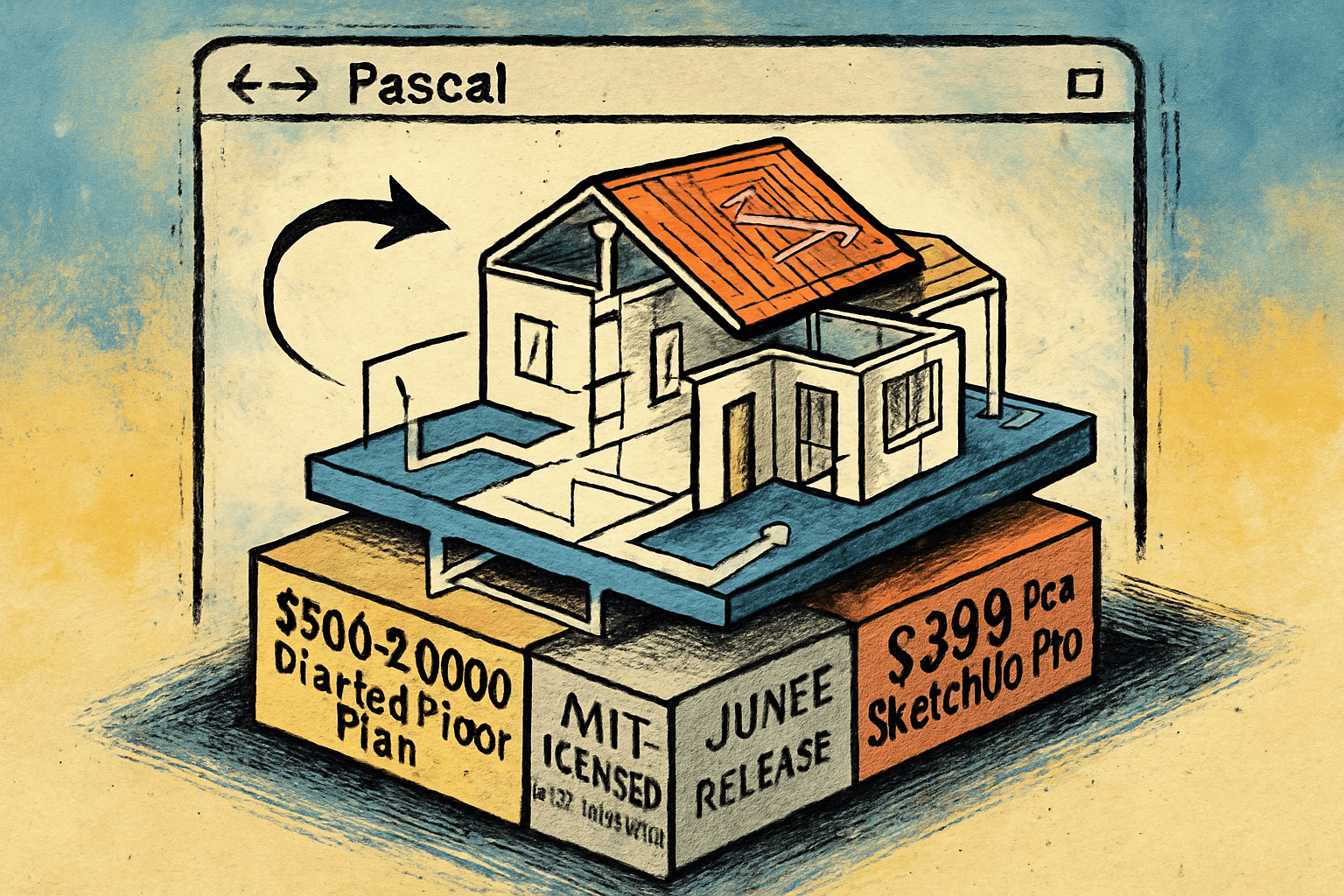
Before a shop signs a lease on a bigger unit, somebody has to answer a deeply boring question. Does the stuff fit. The two lifts, the bench, the racking, the aisle a forklift needs to turn around in, and the twenty two desks the office side is supposed to absorb somewhere. Getting a real answer has meant paying for a drawing. Angi's 2026 cost data puts a professional floor plan at $500 to $2,000, with draftspersons billing $35 to $150 an hour and architects running higher. The do-it-yourself lane is a SketchUp Pro seat at $399 a year plus the weekend you spend learning where the push-pull tool is. Pascal is an MIT-licensed 3D building editor that opens in a browser tab from a single command, stores everything on your own machine, and takes instructions from the same coding agent you already pay for. It crossed 23,000 stars, it has commits from this morning, and it has three contributors and a stable release from June. All of that is the same story.
What the repo actually is
Pascal is a browser-based 3D editor for buildings. Not a general modeling tool, not a game engine with a house tutorial. It is built around the things a building is made of: a site holds buildings, a building holds levels, a level holds walls, slabs, ceilings, roofs and zones, and you place doors, windows and interior items into that. The rendering is React Three Fiber against WebGPU, which is the modern browser graphics path, and it matters here only because it means a mid-range laptop can push a real building around at a usable frame rate without a workstation graphics card.
You start it with one line. npx @pascal-app/cli editor on Node 22.13 or newer, and the editor plus its local service come up on a port it picks for you. No clone, no repository, no build step. Projects land in a database file at ~/.pascal/data/pascal.db on your own disk. There is also a free hosted demo at editor.pascal.app that needs no signup at all, so the honest answer to "is this a self-host job or a hosted option" is that it is genuinely both, and the hosted one is the right way to spend twenty minutes finding out whether you care.
The part that makes this a 2026 story rather than a 2016 one is the agent surface. Pascal ships an MCP server and two published agent skills. pascal mcp connect starts a local server that needs no API key, and from there a coding agent can read and write the scene directly. One skill, pascal-3d, handles the connection and verified scene work. The other, furniture-fit, does exactly the thing the lease question is asking about, and its own description is the most useful sentence in the whole repository: it produces a bounded, evidence-based footprint assessment without claiming unsupported height, swing, or delivery checks. Read that again, because a tool that tells you precisely what it is not checking is rarer than a tool that works.
The license is MIT, copyright Pascal Group Inc. I opened the file rather than trusting the badge. MIT means commercial use, modification and redistribution are all fine, with no obligation to publish anything back. For a business that is the cleanest license there is.
Why an operator should care, and it is not the $399
The SketchUp seat is the obvious number and it is the least interesting one. Four hundred dollars a year is not what stops a 60-person distributor from modeling its own warehouse. What stops it is that nobody in the building knows how to drive the software, and the person who could learn it has a day job.
That is the constraint Pascal actually attacks. You describe the space to an agent and the agent builds it. Not perfectly, and not from nothing, but well enough that the operator is now editing a model instead of creating one from a blank screen. The skill that changed is not modeling. It is describing, and every person reading this has been doing that for two years already in a chat window.
Which puts a specific class of decision back inside the business. Whether fourteen four-tops fit the dining room once you leave legal aisle width. Whether the new CNC clears the bay door and still leaves service access on the side the technician needs. How the racking runs if you turn it ninety degrees and lose one row but gain the turning circle. What twenty two desks look like in a unit you have not signed for yet, which is the only moment that answer is worth anything, because after you sign it is just a fact you live with. None of those are architecture. They are operations questions that happen to need a drawing, and paying $500 to $2,000 for a drawing is why most of them get answered with a tape measure, a hunch, and a bad afternoon in month three.
For the RevOps and ops practitioner reading this, the displaced cost has the familiar shape even though the subject is unfamiliar. It is the request you cannot get prioritized. Facilities has no budget line for a model of the office, so the office move gets planned in a spreadsheet with chair counts in it. This is the same build-it-yourself argument this Library keeps making about software, and the interesting thing about today is that it walked out of software and into physical space.
The honest take
Here is where the free part stops being free.
Setup is not four hours, but it is not zero either. The hosted demo is instant. The local install is one command if Node is already on the machine, and if it is not, installing Node is the real barrier for a non-engineer, worth an hour and a small amount of dread. Learning the editor well enough to produce something you would show a landlord is a solid three to six hours for somebody who has never modeled anything. Call it a day, spread over two evenings. That is still enormously cheaper than a drafted plan. It is not nothing.
Hosting costs nothing, and that is unusual for this series. Most self-hosted alternatives trade a subscription for a server, and then the server bill creeps. This runs on the laptop you already own. The only meter in the picture is the agent you drive it with, and if you are already paying for a coding assistant, driving Pascal with it adds no line item.
What the paid product does that this does not is a long list, and the important item is documents. SketchUp Pro at $399 includes LayOut, which turns a model into dimensioned 2D sheets, and DWG and IFC import and export, which is how a model reaches anybody else's system. Pascal's browser workflow does JSON import and export. That is fine for Pascal talking to Pascal, and useless for handing a file to a contractor's CAD seat, an engineer, or a permit office. So be clear about the boundary: this produces an answer, a layout, and a picture you can argue from. It does not produce construction documents, and it is not the thing you submit to anybody. The moment a permit or a stamped drawing enters the conversation, you are hiring the draftsperson anyway, and the model you built yourself makes that engagement shorter and cheaper rather than unnecessary. SketchUp also carries an enormous library of real manufacturer models and a deep extension ecosystem, and a young project does not have twenty years of that.
Three contributors and 23,300 stars is a ratio worth staring at. The repository has 2,900 forks and 122 watchers. A hundred and twenty two people are actually following development, and twenty three thousand clicked a star. Stars are attention, watchers are intent, and the gap between those two numbers is the most honest traction signal on the page.
The version story undercuts the trending rank, and the project is not hiding it. The last stable release is v0.9.1, dated June 10. Everything since then is a pre-release: the 1.0.0 beta on July 30, then a run of CLI and agent-skill pre-releases on September 8, 9 and 10, eight of them inside four days. On the npm registry the CLI's stable tag sits at 0.1.5, published August 7, with a 1.0.0 beta parked alongside it. Read together, that says a small team shipping hard on the agent surface while the stable channel sits three months behind. Good sign about the effort, bad sign about anything you need to be boring. Do not put a project you are mid-way through on a pre-release CLI and then update it on a Tuesday.
The copyright holder is a company, and the monetization surface is already visible. MIT is irrevocable for the code that has already shipped, so nobody can take today's version away from you. What a company holding the copyright can do is license future versions differently, and the shape of what comes next is right there in the repository: a hosted editor, a pascal-hosted MCP server, Pascal API keys, optional keychain storage. That is not a criticism, it is how open-source companies eat. It is a planning input. If Pascal Group stops, you keep an MIT codebase that three people understand, and the honest answer to who maintains it then is nobody.
Your data stays put unless you decide otherwise. Local mode keeps scenes in the SQLite file in your home directory and IndexedDB in the browser, with no account and no API key. That is a real answer to the question a shop should ask before modeling its own premises, its equipment positions and its access points into somebody's cloud. Opt into hosted projects and that changes, on purpose, with you deciding it.
What this actually is
Strip out the stars and the demo and it is a small, fast-moving tool that turns a $500 question into a free afternoon, produces something that is not a legal document, and is maintained by three people inside a company that will eventually want money for the hosted half.
That is a fine trade for a lease decision and a bad trade for a building permit, and knowing which of those you are doing is the entire evaluation.
For about thirty years the ability to see a space before you commit to it was gated behind a professional, and the gate was never really the software license. It was that drawing is a skill and describing is not. Software has spent two years learning that lesson about itself. The surprise is how quickly it turned around and applied it to the room you are standing in.
Sources
Every claim above traces back to one of these. Go read them yourself.
- 01Pascal, open-source 3D architectural editor
Pascal Group Inc. / github.com / retrieved Sep 11, 2026
- 02Pascal Editor releases, v0.9.1 through the 1.0.0 pre-releases
Pascal Group Inc. / github.com / retrieved Sep 11, 2026
- 03Pascal Editor LICENSE (MIT)
Pascal Group Inc. / github.com / retrieved Sep 11, 2026
- 04@pascal-app/cli on the npm registry
npm / npmjs.com / retrieved Sep 11, 2026
- 05SketchUp plans and pricing
Trimble / sketchup.com / retrieved Sep 11, 2026
- 06How much does a floor plan cost, 2026 data
Angi / angi.com / retrieved Sep 11, 2026
- 07How much does a draftsperson cost to hire, 2026 data
Angi / angi.com / retrieved Sep 11, 2026
Suggested reading
Selected articles based on topic, tags, and skill focus across the library.
Git Articles
SnapOtter and the file you upload to a stranger
The 240 MB walkthrough video that will not attach to an email and the scanned lease nobody can search get handled the same way in most small companies: whatever free converter site came up first. SnapOtter runs 200 of those tools on one container inside your own network, and the honest cost is not the subscription you cancel.
Git Articles
OpenMAIC and the authoring seat you use twice a year
Turning the safety manual into actual training costs $1,749 a year for one Articulate seat that somebody opens twice, or five figures if you hand it to a course shop. OpenMAIC takes the PDF and builds the course, MIT licensed, and it shipped a release yesterday.
Git Articles
AutoClip and the minute you pay for either way
A clipping subscription charges one credit per minute of footage you upload, whether it finds anything worth keeping or not. AutoClip runs the same pipeline on the laptop you already own, MIT licensed, and as of Sunday it installs by double-clicking a file.