

LibraryVibecoding News and Updates8 min read
October 2026: Coding agents moved into the workflow
October’s coding tools spread across models, IDEs, repositories, and longer-running work. The useful question for November is how you’ll check what they do, not how much code they can produce.
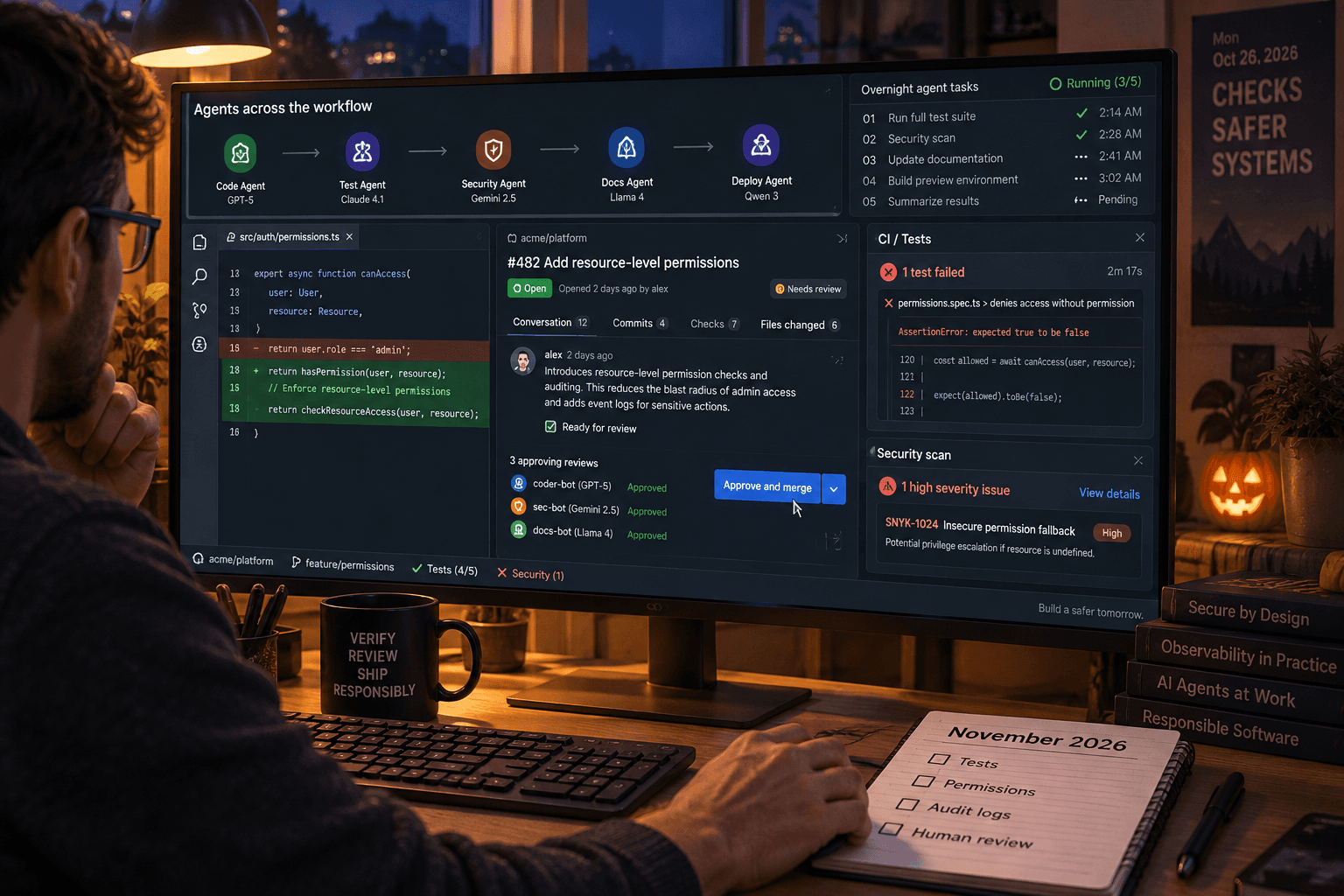
October’s coding tools started to look less like a prompt box beside an editor and more like a layer spread across the development process. Agents can move between models, repositories, and tools; some can carry context across sessions. That makes the practical question for November less “Can it write this?” and more “Can I see what it did, check it, and own the result?”
This review covers October 2026. It builds on this month’s Library updates about Copilot’s assisted permission decisions, Xojo’s compiler feedback loop, and proposed workflows for checking a pull request against documentation. The monthly picture is broader than any one feature: the agent is moving into more of the workflow, while evidence about the quality of the finished work remains limited.
The agent is becoming a layer across tools
The clearest October pattern was integration. GitHub described Copilot as an “agentic software delivery” system, with an app for directing work, projects that run sessions across repositories, and session continuity across the app, VS Code, CLI, and web. Its Copilot Fusion feature routes work across one or more models. The official announcement frames these as connected parts of a delivery system, rather than a single code-completion feature.
Android Studio moved in a different direction. Its stable Rabbit 2 release lets developers choose from more than 40 coding agents, including Claude Agent, Codex, and Antigravity, and gives them access to Android Studio tools such as the emulator, build systems, and Logcat. That’s a choice of agents inside a development environment, rather than one vendor trying to own the whole flow. The Android Studio release announcement also describes tools for managing skills and reviewing changes.
These are meaningful product changes, but their announcements don’t tell us whether they make software better or cheaper to ship. GitHub’s Fusion benchmark comparison is vendor-published, even though it references the independent Artificial Analysis Coding Agent Index. Android’s “40 agents” figure describes available integrations, not 40 agents with equivalent capabilities or support. The independent coverage of GitHub Universe confirms the broader packaging shift and repeats GitHub’s claims, but it is not an independent evaluation of real customer work.
For a practitioner, the operational issue is that one task may now pass through more components: an orchestrator, several models, a repository memory, an IDE, and remote sessions. That can reduce the amount of manual copying and re-briefing. It also creates more places to check: which model handled the sensitive step, what context it could read, and where its changes ended up. A polished handoff between tools is useful only if you can still trace the work.
More work starts with delegation, but the numbers need context
GitHub’s October Octoverse report says more than 40% of pull requests on GitHub started with an agent draft by September, up from 17% in March. It also says 61% of Copilot users who chose their own model used more than one model in September. These figures suggest agents and model choice are becoming routine on GitHub.
They don’t tell us how many drafts were accepted as-is, how much review they needed, whether the code improved the product, or how representative GitHub is of development outside its platform. The figures are GitHub’s own telemetry, with its own definitions and ability to detect agent activity. More agent-started pull requests are evidence of changed workflow behavior, not evidence that the same fraction of work became easier or more reliable.
The business-facing version of this pattern also appeared in Google Cloud’s October announcement of a Gemini agent for work that includes coding. TechCrunch’s report describes the company’s plan to bring coding alongside other business tasks in a unified agent. The offering is aimed at Google Cloud customers; it is not proof that a general-purpose workplace assistant can safely build and maintain production software without developer oversight.
Taken together, the releases suggest that coding agents are being sold as part of a wider operating environment, not just as a way to autocomplete a function. That may help a practitioner who needs to connect an idea with an existing repository, tests, and tools. It also means a tool evaluation should include its permissions, data access, output history, model behavior, and exit path, not just the quality of a code sample.
The evidence still points back to the person checking the work
October also brought more realistic research questions. A preprint introducing SWE-Journey argues that typical benchmarks miss the length and back-and-forth of real coding tasks. In its experiments, models passed more than 75% of tests for requested functionality with a software-architect persona, but fewer than 25% with a non-coder persona. Those are results on the paper’s benchmark and simulated interactions, not a forecast for every user. They do challenge the idea that natural-language access alone makes reliable software building equally available to everyone.
Another preprint, InfraDev, evaluated six coding agents on tasks involving AI infrastructure. Its best model resolved 38.9% of the tasks. The authors also report that hidden probes rejected 32% of submissions that passed all official tests. In the traced runs, agents rarely wrote assertions about resource constraints such as memory, time, or traffic. This is a specialized benchmark, but it shows why “tests passed” may still leave important requirements unchecked.
Those findings put a useful limit around the product story. Agents can write more code, work across more files, and operate for longer, but the quality of the result still depends on what the task says, what context the agent has, and what the checks cover. The best evidence in these papers is not “agents cannot code.” It is that success changes with the task, the user’s ability to specify it, and the verification method. Both papers are preprints, so their findings deserve replication and should not be treated as settled estimates of industry-wide performance.
This also makes review work part of the economics. If an agent saves time producing a first draft but adds time to understand and verify a larger change, the useful number is the whole task, including review and rework. A quicker first response is not the same as a faster accepted change.
What I’d prioritize in November
A small team does not need to adopt every new agent surface to learn from October. I’d start by choosing one task where the current process is tedious and the outcome can be checked. Keep the experiment small enough that you can compare the agent’s result with the existing way of doing the work.
- Write down what “done” means. Name the behavior the change must preserve, the files or systems it may touch, and the conditions that would make the result unacceptable. If requirements are unclear to the person assigning the task, an agent’s fast implementation won’t resolve the ambiguity.
- Limit access to what the task needs. Start with a branch or disposable project, scoped credentials, and a clear boundary around commands or services the agent may use. The October update on Copilot’s assisted permissions is a reminder that permission automation is itself a decision point. Review the access model before you rely on it.
- Check behavior beyond the happy path. Run the tests already used for the task, then consider what they miss: empty data, permissions, state changes, resource limits, and recovery after failure. If the agent writes tests, inspect what they actually assert. The InfraDev results show why an all-green test run can still miss a constraint.
- Count the review. Track how long setup, prompting, correction, review, and rework took. Also record whether the change was accepted and what was adjusted. A single attempt is a useful observation, not proof that the workflow will save time every time.
- Decide where the work and evidence live. If sessions span models, IDEs, and cloud agents, identify where your team can inspect the change, its context, and its checks later. Keep a manual path to stop or recover the work. Don’t give a new system broad permissions just because it remembers a project or offers more integrations.
There’s a fair reason to wait. If the task is infrequent, low-cost to do by hand, or hard to verify, adding an agent can create another tool to manage without solving a real bottleneck. If a change touches production data, customer access, or a critical service, the review and recovery burden may outweigh faster drafting. A simple editor assistant with narrow permissions can be a better fit than a multi-agent workflow.
The decision is about the whole work loop
October’s direction is clear enough: coding agents are spreading across more of the software workflow, with model orchestration, persistent context, longer-running sessions, and broader IDE support. The evidence is less conclusive about the results. Vendor activity and performance claims show momentum, while early research exposes gaps in task clarification and verification.
So the November priority isn’t to maximize agent usage. Pick one task, set the access boundary, define a check that matters, and measure the time through acceptance. Keep the agent in the loop if the complete job improves and you can explain why the result is safe to use. Otherwise, the manual workflow is still giving you something valuable: a result whose limits you already understand.
Sources: GitHub Octoverse 2026, GitHub Universe 2026, Copilot Fusion announcement, Android Studio Rabbit 2 announcement, SWE-Journey, and InfraDev.
Sources
Every claim above traces back to one of these. Go read them yourself.
- 01Octoverse: Commits, pushes, reach new highs in 2026 as developers build with agents
GitHub / github.blog / retrieved Nov 03, 2026
- 02GitHub Universe 2026: Evolving every layer of the stack
GitHub / github.blog / retrieved Nov 03, 2026
- 03Route and orchestrate models with GitHub Copilot Fusion
GitHub / github.blog / retrieved Nov 03, 2026
- 04Your favorite agents are now integrated in Android Studio
Android Developers / developer.android.com / retrieved Nov 03, 2026
- 05SWE-Journey: Towards More Realistic Evaluation of Coding Assistants through Long-Horizon, Multi-Turn Interaction
arXiv / arxiv.org / retrieved Nov 03, 2026
- 06InfraDev: Can Coding Agents Develop AI Infrastructure, and How Can We Tell?
arXiv / arxiv.org / retrieved Nov 03, 2026
- 07GitHub launches Copilot Fusion as agents start 40% of pull requests
The Next Web / thenextweb.com / retrieved Nov 03, 2026
- 08Google brings agentic AI to Gemini, starting with businesses
TechCrunch / techcrunch.com / retrieved Nov 03, 2026
Suggested reading
Selected articles based on topic, tags, and skill focus across the library.
Vibecoding News and Updates
Turn merged pull requests into a release note draft
A coding agent can help turn a selected set of merged changes into a release note draft. Keep the source links, verify what users will notice, and leave publication with a person.
Vibecoding News and Updates
VS Code local agent automations get custom schedules
VS Code 1.145 adds custom cron schedules and workspace custom agents to local automations. Check where the task runs and what permissions it has before scheduling it.
Vibecoding News and Updates
Copilot cloud sessions follow you across clients. Check where the work runs.
GitHub connected Copilot cloud sessions across VS Code, mobile, the CLI, and other clients. Before handing off a task, check whether it runs on GitHub’s cloud or a machine you need to keep online.