

Google will now tell you what your customer data is worth to Google
Pushing closed-won revenue from the CRM back into the ad platform used to mean a customer data platform at $7,440 a year or an engineer you do not have. Thursday it became one documented endpoint inside a product you already log into, shipped alongside a metric that grades how well you are feeding it. The pipe is worth taking. The grade is not.
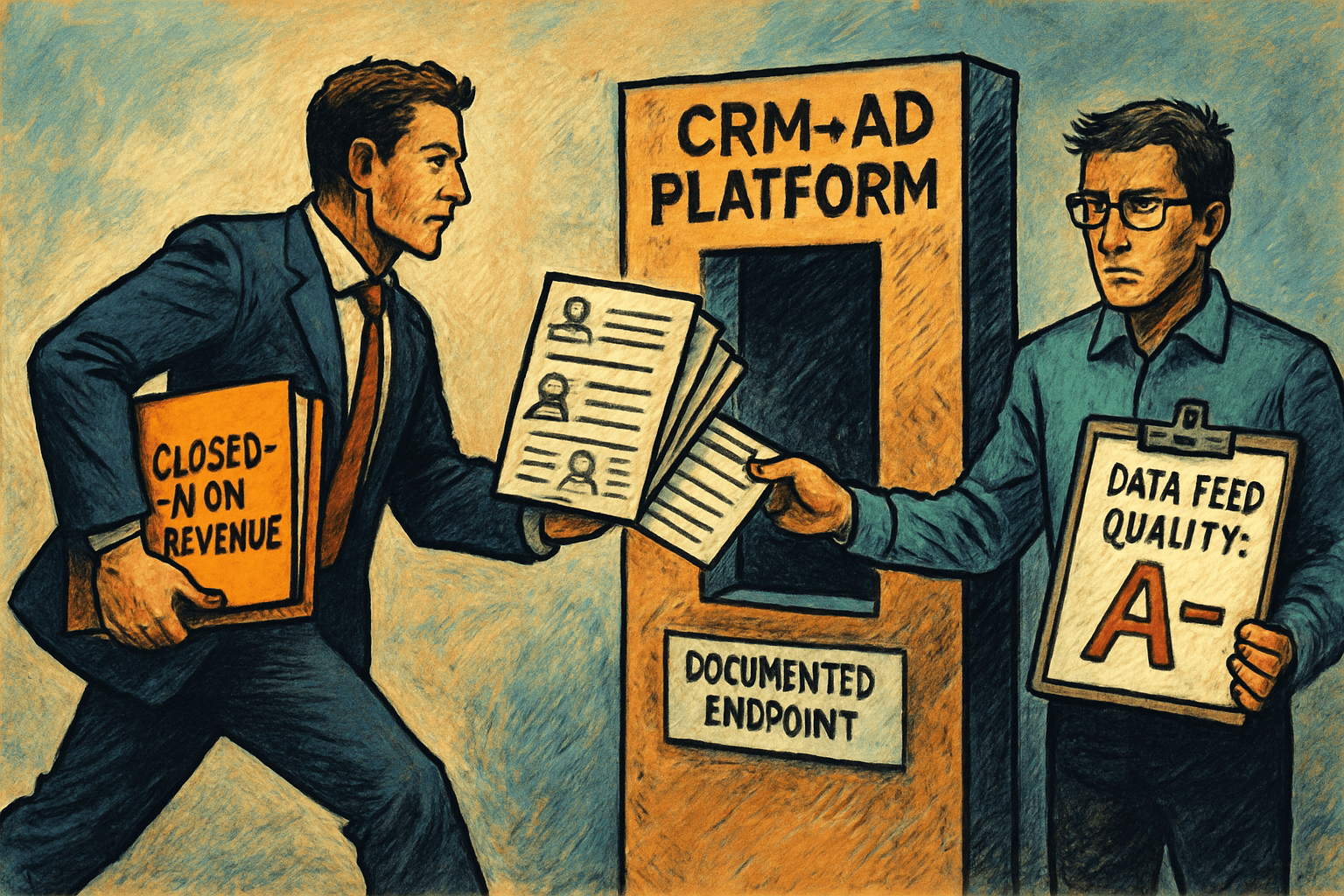
A twelve-person marketing team can, as of Thursday, push closed-won revenue out of the CRM and into Google Ads, Google Analytics and Display & Video 360 through one documented endpoint, from inside a product they already log into, with no customer data platform underneath it and no ticket filed with anybody. The cheapest honest version of that plumbing on Wednesday was a customer data pipeline: Twilio Segment's Connections Team plan starts at $120 a month with ten thousand visitors included and charges ten dollars for every additional thousand, which is $620 a month at sixty thousand monthly visitors, or $7,440 a year to move rows from one system into another. Google shipped the pipe, standardized the shape of what it carries, and in the same post shipped a number that scores how well you are filling it.
Take the pipe. The score is a different conversation, and it is the one worth having.
What actually changed
Google's announcement on Thursday is four things stacked in one post. Data Manager, the tool that connects your customer data to Google's advertising systems, now plugs directly into Google Analytics and Display & Video 360 instead of living mostly on the Google Ads side. Enhanced conversions, which matches a hashed email or phone number against a Google account so a sale gets credited to the click that caused it, launched in both of those products too.
The Data Manager API is now what Google calls universal, built on the IAB Tech Lab's Event and Conversion API specification, a version 1.0 standard finalized in May of this year by a working group that included Google, Meta, Walmart, TikTok, Roku, NBCUniversal and Paramount. Data Manager also picked up built-in diagnostics that flag data problems before a campaign eats them.
Then the new number. Google Ads now carries a Data Strength Uplift Metric, which Google describes as calculating the additional conversions recovered by your first-party data setup. Alongside it, Meridian, Google's open-source marketing mix model, got agentic features that audit your data and walk you through building the model, the ability to include branded search query volume as a signal, and general availability for Meridian GeoX, its library for running geographic holdout experiments.
That is the reporting. Now the part that matters.
Why this lands on a small operator's desk
Here is the thing most people running ads never quite get told out loud: the automated bidding is the AI, and it optimizes toward whatever event you reported. Not toward revenue. Not toward the customers you liked. Toward the thing you called a conversion.
So picture a commercial plumbing company running search ads on emergency repair terms. Four hundred form fills a month. Fifty of those turn into a site visit, nine become booked jobs, average ticket about fourteen thousand dollars. If the only signal going back to Google is "form submitted," the bidding spends the entire budget getting better at producing form fills, and form fills are cheapest from exactly the people who were never going to sign anything. The system is working perfectly. It is winning the game you set up.
Feeding the outcome back changes the game. Report "job booked" with the dollar value attached and the bidding starts hunting the nine instead of the four hundred. That is not a marginal tuning exercise. It is the difference between buying attention and buying revenue, and it has been available in principle for years.
In principle. In practice it took one of four things, and every one of them was a wall for a company under two hundred people. A customer data platform, priced above. A paid connector service sitting between the CRM and the ad account. An engineer writing and maintaining an integration against an API that changes. Or the fourth option, which is what most companies actually do: somebody exports a CSV on the third of the month, uploads it by hand, and forgets in August.
What changed Thursday is that the wall got shorter. The plumbing is in the product. The payload has a published shape that somebody other than Google agreed to. The diagnostics tell you when it breaks instead of letting a campaign quietly optimize against three weeks of missing rows.
The work that remains is not code, and this is the part to be clear-eyed about before anyone promises a two-week rollout. You need a stable identifier captured at the moment the lead arrives, usually a normalized email address or phone number. You need that identifier to survive the trip through the CRM without a rep retyping it into a different field. And you need the outcome, with its value, written back against it when the deal closes. That is contact hygiene and pipeline discipline, which is unglamorous, which is why it never gets funded, and which is now the only thing standing between a small operator and the same feedback loop the big spenders have had.
If your CRM has four different spellings of the same customer's email, none of this works, and the diagnostics will tell you so in a tone that suggests it is your fault. It is.
The honest take
Now the grade.
The Data Strength Uplift Metric is a number, computed by Google, displayed in Google Ads, that estimates how many additional conversions you got because you gave Google more of your customer data. Read that sentence again slowly. This is the company selling you the media, grading your willingness to hand over the inputs, in the interface you open every morning. It is not fraud and I am not suggesting it is. It is a conflict, it is structural, and it is the kind of conflict you would never accept from a contractor grading their own inspection.
The supporting numbers deserve the same squint. Google says advertisers connecting offline and app data to Data Manager see an average 26 percent increase in incremental return on ad spend, and the footnote scopes that to Google's own global measurement data from April 2025 to April 2026, based on search campaigns bidding to conversion value. It says enhanced conversions deliver an average 11 percent increase in search conversions, footnoted to Google internal data covering January 1 to January 14, 2026. Fourteen days. It says Google tag gateway produces a 14 percent conversion uplift, footnoted to internal finance data comparing July through December 2024 against January through June 2025, which is to say it compares the back half of a year against the front half of the next one and calls the difference a result. And the 20 percent uplift for Demand Gen campaigns runs on a June 3 to June 17 window. Also fourteen days.
Every headline figure in that post is Google's own data, unpublished sample sizes, no competitor benchmark, and half the windows are two weeks long. Use them to decide whether to try this. Do not use them in a budget model.
Then there is the word universal, which is doing heavy lifting. The standard is genuinely open and genuinely cross-industry. What arrives at the other end is not. Google's own ECAPI mapping documentation publishes a column headed "No equivalent," and it is long. Street, city and state from the address object: not supported. Global Privacy Platform consent strings: not accepted, consent has to be re-expressed in Google's own object. The structured identifier array: no equivalent. Age range and gender: no equivalent. Even the deduplication key changes names on the way in, from the standard's event id to Google's transaction id. Universal describes the envelope you write, not the contents that survive the trip. Every platform will keep what it wants and drop the rest, and the integration work you thought you were doing once you will do once per destination anyway, just faster.
Two more things that break in month three. First, if you use consent mode, Google's own setup instructions tell you to turn off automated script installation, which means somebody hand-edits tags on every page. Second, on the self-service tag gateway path, the documentation says plainly that if you skip re-tagging your pages the browser keeps requesting scripts directly from Google and bypasses the gateway entirely. The status screen will still say active. You will still see domains listed. And the 14 percent you budgeted against will not be there, because the thing that produces it is not running on the pages that matter.
Who is this genuinely wrong for? Anyone whose purchase happens in one session with no human in between. A shop selling forty-dollar goods off a product page already has a pixel that sees the sale as it happens; there is nothing offline to recover and no lag to close. The gains here scale with the gap between the click and the money, which means long sales cycles, quotes, site visits, and anything where a person decides. If your gap is four minutes, spend the effort elsewhere.
And the thing actually worth taking from Thursday is the one that did not get a metric in the Ads interface. Meridian GeoX went generally available the same day: open source, runs across any advertising platform, and holds out a set of geographies to see what happens when you stop spending there. That is a real experiment. It can come back and tell you the money did nothing. Nothing else in the announcement can.
Feed the pipe. It is free, it is better than the CSV nobody remembers to upload, and the feedback loop it closes is the thing most small advertisers have never turned on and would gain the most from. Just notice where each number in that post lives. The one that grades how much data you handed over sits in the interface you check daily. The one that can come back and say the spend was worthless sits in a Python library you have to go install yourself.
Sources
Every claim above traces back to one of these. Go read them yourself.
- 01Drive profitable growth with new data and measurement tools
Google / blog.google / retrieved Sep 11, 2026
- 02ECAPI specification mapping, Data Manager API
Google for Developers / developers.google.com / retrieved Sep 11, 2026
- 03ECAPI (Event and Conversion API) specification
IAB Tech Lab / github.com / retrieved Sep 11, 2026
- 04Connections pricing
Twilio Segment / segment.com / retrieved Sep 11, 2026
- 05Set up Google tag gateway for advertisers in the Google tag with Cloudflare
Google Ads Help / support.google.com / retrieved Sep 11, 2026
- 06Meridian, open-source marketing mix modeling
Google for Developers / developers.google.com / retrieved Sep 11, 2026
Suggested reading
Selected articles based on topic, tags, and skill focus across the library.
AI News
The week you bought just got shorter
The hundred dollar subscription you build your own tools on holds about a sixth less building per week starting today, at the same price. Anthropic announced it as a 25 percent increase, and it is, against a baseline nobody has seen since May.
Git Articles
Marketing Skills and the thousand-dollar teardown
A 99-point product marketing audit runs $1,000 and a week of waiting, and ongoing marketing leadership from the same shop is $3,000 a month. The person selling both has published fifty of the checklists behind them on GitHub under MIT, and the interesting part is not the price.
AI News
Your email subscription just grew a webhook
Zapier puts webhooks behind its $19.99 Professional plan and counts every step your automation takes against a task allowance. On Monday the same outbound webhook, plus connectors to HubSpot, QuickBooks, Salesforce and Slack, started showing up inside Google Workspace with no second bill and no meter. The tier that can restrict where those webhooks point is not the tier most small businesses are on.