The workflow came prebuilt. Your data did not.
Anthropic shipped 43 ready-to-run small business workflows yesterday, including one that answers an after-hours web form, qualifies it, books it, and logs it. The connector counts underneath each one are the real story, and so is the input nobody mentions.
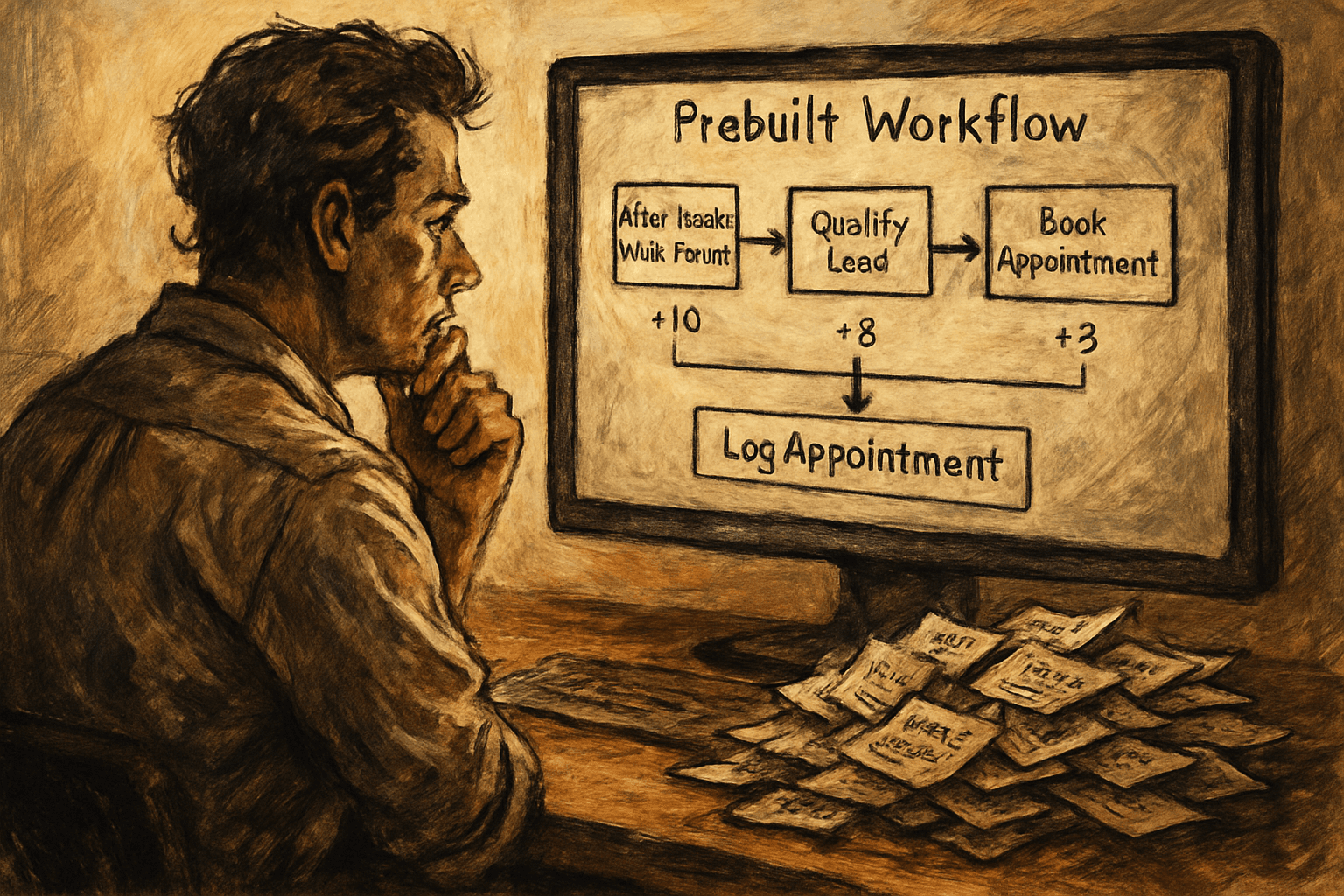
The web form fills out at 8:12 on a Thursday night. Somebody wants a quote on a rooftop unit, and in most shops that lead sits in an inbox until 7:30 the next morning, which is plenty of time for the same person to fill out two more forms on two other websites. The standard fix for this is an answering service, which runs $150 to $500 a month for a small business and only catches the phone calls, not the forms. As of yesterday there is a prebuilt workflow that answers that form at 8:14, qualifies it against questions you wrote, checks the calendar, offers a real slot, and writes the whole thing into the CRM, and it costs nothing on top of a Claude subscription somebody in the building is probably already paying for.
What actually shipped
Yesterday Anthropic expanded its small business package to 43 ready-to-run workflows and 27 new app integrations. The new connections include Shopify, Square, Stripe, Xero, Gusto, Salesforce, Zoom, Atlassian, TikTok, and Zapier, which join the ones already there: QuickBooks, HubSpot, PayPal, Canva, Docusign, Google Workspace, and Microsoft 365. The package itself launched back in May and the company says it has been installed north of 900,000 times since.
It runs inside Cowork, the desktop app where Claude works against your actual files and your connected accounts rather than inside a chat window. Every workflow starts in approval mode by default: Claude drafts the thing and stages it, then stops and waits for a person before anything sends, posts, or pays.
The workflow list did not come out of a product roadmap. Anthropic says it was built from feedback gathered from more than a thousand small business owners across ten cities, which shows in what got built. This is not a list of things that demo well. It is lead response, proposal writing, campaign staging, and month-end close.
Fifteen connectors is the number that matters
Skip the count of workflows. The interesting number is published underneath each one, and it is the count of connectors that workflow touches.
- Intelligent Lead Response: 15 connectors
- Intelligent Proposal Generation: 17 connectors
- Plan and stage a marketing campaign: 16 connectors
- Close the books at month end: 14 connectors
Sit with that for a second, because it is the whole displaced cost in one figure. When a RevOps manager or an ops lead has tried to build after-hours lead response themselves, the work was never the logic. The logic is four sentences long. The work was the fifteen places the data had to move: the form provider, the chat widget, the enrichment lookup, the calendar, the CRM object, the deal record, the notification, the owner assignment, the fallback when the calendar is full. Each one is an authentication, a field mapping, and a failure case. That is the part that turns a Friday afternoon idea into a six-week ticket, or into a quote from an automation shop that comes back somewhere in the low five figures for exactly this build.
Fifteen connectors, prewired, is a different proposition than fifteen connectors you wire. Not because the wiring was hard, but because it was boring, and boring is what actually kills these projects inside a small company. Nobody gets budget to finish the boring part.
The proposal workflow is the one I would look at first if I ran a trades business. The pitch is that somebody walks a job, records a voice memo on the way back to the truck, and a branded proposal comes out the other side priced off what similar work went for before. The quoting lag at a 40-truck shop is usually two to four days and it is almost never a skill problem. It is that the person who can price the job correctly is also the person driving between jobs.
Approval mode is an adoption feature, not a safety feature
Anthropic frames approval mode as a guardrail, and it is one. But the reason it matters for this reader is different, and it is worth naming.
The thing that stops a ten-person company from turning on automation is not a risk assessment. It is that one person on the team, usually the one with the most institutional memory, has decided that the machine is going to embarrass them in front of a customer. That person is not wrong to worry and they are not going to be argued out of it. Approval mode gives them a way to say yes without saying yes: the thing drafts, they read it, they press the button. After about two weeks of pressing the button on drafts that were fine, the objection dissolves on its own.
That is the actual mechanism here, and it is why the default matters more than the feature. A vendor that ships this switched off has decided that the fastest path to adoption runs through the skeptic on your team rather than around them. That is a better read of how small companies work than most automation products manage.
It also means the first month of this is not labor savings. It is a person reading drafts. Budget the time honestly or the pilot dies in week three when somebody decides reviewing is slower than doing.
What the announcement does not price
Here is the part every write-up skipped, and it is the part that decides whether any of this runs.
The proposal workflow needs historical pricing data. Not a vibe about what you usually charge. Structured records of what similar jobs went out at, in a place a connector can read. Most shops under two hundred people have that in three places: a folder of PDFs, the estimating software nobody fully migrated to, and one person's head. The workflow does not fix that. It reads whatever is there, and if what is there is thin, you get a professionally formatted proposal with a number on it that somebody made up. That is worse than a slow quote.
Month-end close touching 14 connectors is the one to slow down on. Fourteen connectors into your books is a lot of surface area pointed at the part of the business where a wrong mapping is expensive and quiet. Run that one in approval mode for a full quarter, and have whoever actually reconciles your accounts be the person approving it, not the owner skimming on a phone.
The plan gate is not settled. Anthropic charges nothing extra for the package itself, which is the headline and it is true. What rides underneath it is a Claude subscription, and reporting on where the small business toggle actually lives has been inconsistent enough to check before you budget: some coverage puts it on any paid plan starting at $20 a month, some puts the workflow toggle specifically on Team or Enterprise, where the floor is two seats and lands nearer $40 to $60 a month. That is not a large number either way. It is a number you should know before you tell the team it is free.
900,000 installs is an install count. It is not a usage count and Anthropic has not published one. Installing a plugin takes eleven seconds and tells you approximately nothing about whether a business changed how it works. This audience already knows the shape of that gap: most small companies are already paying for software they do not fully use, and roughly three in five regret a software purchase they made in the last year and a half. An install number is the metric you publish when the retention number is not ready.
The testimonials are doing heavy lifting. One owner quoted a task going from 120 hours to five minutes. Another credited the proposal workflow with $20,000 in six weeks. Both might be completely true. Neither tells you what shape their data was in when they started, and that is the only variable that separates the businesses where this works in an afternoon from the ones where it works in March.
And then there is the tell. Alongside 43 prebuilt workflows, Anthropic funded a ten-city workshop tour, more than 150 approved trainers, over 750 community workshops, and webinars from fourteen of its integration partners. A product that genuinely runs itself does not need 750 workshops. That spend is an honest admission about the distance between installing a workflow and operating one, and it is the most useful thing in the announcement, because it is the vendor agreeing with the skeptic on your team.
Who this is genuinely wrong for
If your process is not written down anywhere, a prebuilt workflow will not discover it. The businesses where this lands badly are the ones where the thing being automated is actually three people improvising in a group chat and correcting each other in real time. That is not a workflow. That is a culture, and a connector cannot read it. Write the process down first, in ordinary sentences, and if you cannot get it to fit on one page then you have found your actual project and it is not an AI project.
It is also wrong for anyone who was hoping to skip the CRM hygiene. Lead response writes into your CRM, which means it inherits every required field somebody added in 2023 and every picklist with four spellings of the same value. It will keep writing anyway. You will find out in month three, when a report you trusted stops matching reality and nobody can say when it started.
The reader this is built for is narrower and more real: an operations person at a company between twenty and two hundred people who already knows exactly which four workflows are eating the week, has the data for at least two of them in a system rather than a folder, and has been quoted a number by an agency to build one of them. For that person, yesterday moved a five-figure quote into a subscription line they already carry, and moved the work from a queue into an afternoon.
For everyone else, the honest sequence has not changed. Pick one workflow. Pick the one where the data is already clean, not the one where the pain is loudest, because those are rarely the same workflow and starting with the second one is how these pilots die. Run it in approval mode until the drafts stop surprising you. Then go back for the ugly one.
Forty-three workflows arriving at once is not forty-three decisions. It is one: which single thing in your business is documented well enough that a stranger could do it tomorrow. Everything in that catalogue works on that thing and nothing in it works on the rest, and the gap between those two piles was never a software problem, which is exactly why no amount of software has closed it yet.
Sources
Every claim above traces back to one of these. Go read them yourself.
- 01Claude for Small Business launches new workflows, integrations, and training programs
Anthropic / claude.com / retrieved Sep 16, 2026
- 02Introducing Claude for Small Business
Anthropic / anthropic.com / retrieved Sep 16, 2026
- 03Anthropic Adds 43 Workflows, 27 Integrations to Claude for Small Business
Unite.AI / unite.ai / retrieved Sep 16, 2026
- 04Anthropic brings Claude workflows to small businesses
TechInformed / techinformed.com / retrieved Sep 16, 2026
- 05Claude for Small Business Pricing: New Plan or a Free Toggle?
FindSkill / findskill.ai / retrieved Sep 16, 2026
- 06How Much Does an Answering Service Cost? 2026 Guide
Housecall Pro / housecallpro.com / retrieved Sep 16, 2026
Suggested reading
Selected articles based on topic, tags, and skill focus across the library.
Foundational AI: Do's and Don'ts
Your Automations Are Logged In As A Person
The ops lead left in July and the Monday invoice chase stopped in August, quietly, with no error and no alert. The handover doc was never the deliverable. The list of what runs under their name was, and three of the four platforms you use will not tell you it exists.
AI News
Your email subscription just grew a webhook
Zapier puts webhooks behind its $19.99 Professional plan and counts every step your automation takes against a task allowance. On Monday the same outbound webhook, plus connectors to HubSpot, QuickBooks, Salesforce and Slack, started showing up inside Google Workspace with no second bill and no meter. The tier that can restrict where those webhooks point is not the tier most small businesses are on.
AI News
The week you bought just got shorter
The hundred dollar subscription you build your own tools on holds about a sixth less building per week starting today, at the same price. Anthropic announced it as a 25 percent increase, and it is, against a baseline nobody has seen since May.