LibraryRepo of the day10 min read
Macro and the forty-dollar stack
Ten people on Superhuman and Linear alone costs $5,880 a year, and all it buys is an inbox and a task board. Macro does email, chat, docs, tasks, calls and CRM out of one app for $40 a seat, and it moved to the AGPL in May, which means the escape hatch is written into the license.
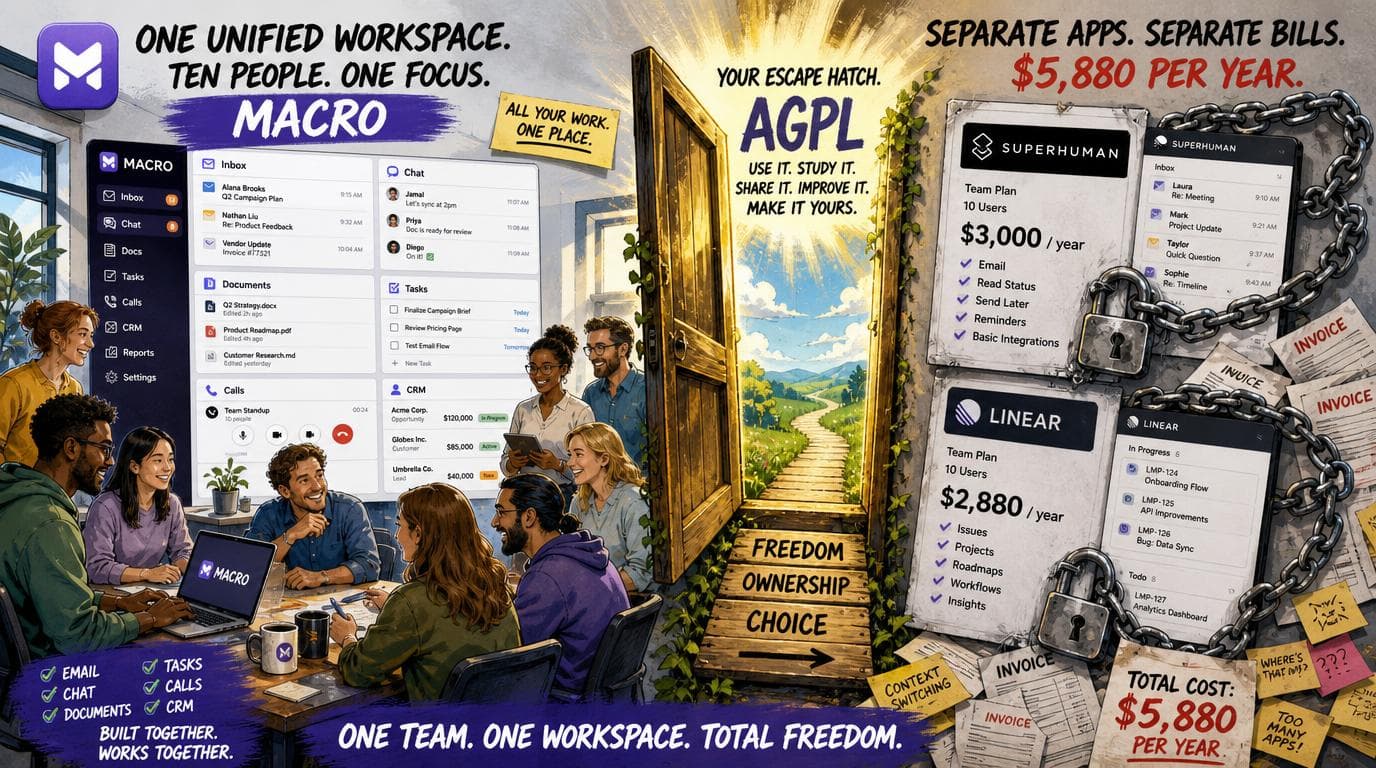
A ten-person team running Superhuman for email and Linear for its task board is spending $5,880 a year, and that is all it buys. An inbox and a list of tickets. No chat, no docs, no CRM, no calls, and no connection between any of them beyond whatever somebody copies and pastes. Superhuman's Business plan is $33 per member per month billed annually and Linear's Business plan is $16 per user per month billed yearly, so that is $588 a year per person for two tools. Macro is an open-source workspace that does email, messages, docs, tasks, calls and CRM in one app, and the hosted version is $40 a seat a month. Ten seats, $4,800 a year, for six things instead of two. The repository has been sitting near the top of GitHub trending on the back of roughly twelve hundred stars in a single day.
What is actually in the repository
macro-inc/macro is the whole product, not a client or a plugin or a demo. It is written in Rust with a SolidJS front end, it carries something over five thousand commits, and the release history reads like a build server: v2026.8.12.0 on the twelfth, v2026.8.11.0 on the eleventh, v2026.8.10.0 on the tenth, with the most recent commits landing yesterday. Whatever else is true about this project, nobody has walked away from it.
The licensing is the part that matters more than the star count. Macro was under the Business Source License, which is the "source available, but you may not compete with us" arrangement that has become the default hedge for venture-backed infrastructure companies. On 31 May 2026 they dropped it and moved to the GNU Affero General Public License v3.0. Their own FAQ is blunt about what that means: "fully open source, not 'open core'," and derivative works have to be open source too. If you want to build a closed product on top of it, you email them and buy a different license. That is a real relicense in the direction nobody expects, because the usual drift is the other way.
The feature list is the interesting bit for anybody who has ever tried to run a small company out of five tabs. Email is a multi-account unified inbox that syncs with Gmail. Messages are channels and DMs. Tasks are, by their own description, "Linear-inspired." Docs are collaborative markdown built on CRDTs. There is a CRM with contact and company objects, custom properties and email sync. And sitting across all of it is what they call team-level memory: agents that can see the emails, the tasks, the docs and the calls at once, because all of it lives in the same database rather than behind five different APIs.
That last point is the actual product. Everything else is table stakes.
The thing you are really paying five vendors for
Here is the argument, and it holds whether you are an owner-operator or the RevOps person who keeps getting told the integration is not this quarter's priority.
You do not pay Slack, Notion, Linear, HubSpot and Superhuman for five pieces of software. You pay them for five pieces of software and then you personally, in your own working hours, perform the integration between them. The deal thread lives in email. The decision about that deal lives in a Slack channel. The scope of work lives in a Notion doc. The work itself lives as tickets. The account record lives in the CRM and is out of date because updating it is somebody's fourth priority. Every one of those systems has an API and a Zapier connector and a "powerful integration ecosystem," and none of that changes the fact that the connective tissue is a human being copying context from one box into another box all day.
Now put an AI agent on top of that arrangement. This is where it gets expensive in a way the invoice does not show. An agent that can only see your task board is a task board with a chat window. Ask it why a customer churned and it cannot answer, because the answer is distributed across an email thread it cannot read, a call it was not on, and a Slack channel it has no access to. The vendors all know this, which is why every one of them is shipping connectors and MCP servers as fast as they can. But a connector is a straw. You are asking one system to sip context out of another system through an API that was designed for syncing records, not for understanding a situation.
Macro's bet is that the only way an agent gets real context is if the context was never split up in the first place. Same database, same permissions model, same search index. When you @-mention someone on an email thread, they get the thread and the tasks and the doc it references, and so does the agent. Their pricing page puts it plainly: give your agents unified context "instead of scattering it across Slack, Notion, email, and drives."
For the practitioner reader, that reframes what this repo displaces. It is not really a subscription. It is the six-week ticket that says "can we get the CRM to show the support history and the last three emails on the account page," which has been sitting in somebody's backlog since spring, and which you now do not need because those records were never in separate systems.
What it honestly costs
Now the part the star count does not tell you, and this is a series where "free and open source" gets treated as an opening claim rather than a conclusion.
Self-hosting is not a weekend project, and it is not for a non-engineer. The repo's own local setup guide is the honest document here. You need the Nix package manager and Docker with Compose v2. The stack it brings up runs Postgres, Redis, LocalStack, OpenSearch, Kafka, FusionAuth and Mailpit. That is seven backing services, including a search cluster and a message broker, before you have sent a single email. The guide also warns you about macOS reserving ports 8080 and 8090, which tells you roughly how much of a fight this can be on a laptop. This is not the class of thing where you paste one Docker command and walk away. Set aside a real day if you know what a Nix flake is, and do not start at all if you do not.
Hosting it yourself is not twelve dollars a month either. OpenSearch and Kafka are both memory-hungry by design. I have not run this stack for a month and I am not going to pretend I have, so treat this as a reasoned estimate rather than a measurement: you are looking at a 16GB machine at minimum, which is somewhere in the range of $80 to $150 a month on a normal provider once you add backups and storage, plus whoever on your team is now responsible for keeping a Kafka broker alive. Against $40 a seat, the self-hosted version stops being cheaper somewhere around the third or fourth employee, and that is before you value your own time at anything.
Gmail only, right now. Macro Mail is an email client, not an email server. It connects to Gmail or Google Workspace, and their FAQ lists Outlook and custom IMAP as "a popular request" that is "coming soon." If your business runs on Microsoft 365, and an enormous number of small businesses do, this is not a tool you can adopt today. That is a hard stop, not a caveat, and no amount of momentum on the repo changes it. It also means you are not cancelling Google Workspace. Macro sits on top of it.
There is no free plan for teams. The free tier is for personal use, it stamps "Sent with Macro" into your email signature, and it limits storage and AI. The moment you add a second person you are on the $40 seat, billed monthly. Compare that honestly: if all you actually need is chat, Slack Pro is cheaper and always will be. The forty dollars only makes sense if you genuinely cancel three or four other things, and "we will consolidate later" is the exact promise that has been breaking software budgets for twenty years. If you are not prepared to turn off Notion within ninety days, you are not saving money, you are adding a sixth tool.
Your email gets copied. Macro pulls your mail into its own database so that search and AI context are not throttled by Gmail's API. That is the right engineering call and it is also a thing you should know before you connect an executive's inbox. On the hosted version that database sits on AWS under a SOC 2 Type II audit with, per their own claim, zero data retention at the model providers. If that arrangement is not acceptable for your industry, the self-host route is genuinely available, which is more than most of the tools it replaces can say. It just costs you the Kafka broker.
And somebody is funding this. Macro is a company, an a16z general partner is quoted on their migration page, and the open source is visibly the distribution strategy. That is not a scandal, it is a business model, and it is the same one that has produced a lot of software people are happy to run. But it is worth being clear-eyed about the failure mode: if the company gets acquired or runs out of road, the AGPL means the code is still there and you can still run it. What it does not mean is that running it will be easy. The escape hatch exists. It opens onto seven containers.
What I would actually do
If you are three to fifteen people, already on Google Workspace, and currently paying for some combination of Slack, Notion, Linear and a CRM you do not love, this is worth a real trial on the hosted plan. Not a self-host. Connect one seat, run your own email through it for two weeks, and see whether the unified inbox and the agent context change how you work or just move your icons around. Two weeks of one seat costs you twenty dollars and tells you more than any comparison table.
If you are on Microsoft, wait. If you are fifty people with an established stack and real migration history, wait longer, because the cost of moving five tools' worth of institutional memory is the number nobody puts on the slide.
And if you are the RevOps or ops person who has been quietly building your own tooling because the queue is six weeks deep, the repo is worth reading even if you never deploy it. Somebody built a working CRM, a working email client, a working issue tracker and a working docs system into one Rust codebase and put the whole thing on the internet under a copyleft license. Whatever you think of the product, that is a fairly direct statement about how much of what you are currently paying for is genuinely hard.
Every tool in that stack of five was designed so that leaving would cost you your history. This one was designed so that leaving costs you a bad weekend and a server bill. Vendors do not usually hand you that on purpose, and the question worth chewing on is what they think they get back for it.
Sources
Every claim above traces back to one of these. Go read them yourself.
- 01macro-inc/macro on GitHub
Macro / github.com / retrieved Aug 14, 2026
- 02Macro pricing and licensing FAQ
Macro / macro.com / retrieved Aug 14, 2026
- 03Running Macro locally
Macro / github.com / retrieved Aug 14, 2026
- 04Superhuman pricing
Superhuman / superhuman.com / retrieved Aug 14, 2026
- 05Linear pricing
Linear / linear.app / retrieved Aug 14, 2026
- 06Macro releases
Macro / github.com / retrieved Aug 14, 2026
Related reading
Nearest neighbours by meaning, drawn from the whole library rather than from matching tags. Some of these are from a different series on purpose.
Operator answers
Your Software Just Added AI. Do You Pay For It?
Three renewals this quarter, three new AI lines, priced anywhere from twenty nine dollars flat to a hundred and twenty five per seat. Which ones to pay for has almost nothing to do with how good the AI is.
Repo of the day
Twenty and the data model you were renting
A ten-person sales team on Salesforce list pricing pays about $21,000 a year, and the thing they are actually renting is not the software. It is the shape of their own business. Twenty puts that shape in a repository you own, and it shipped four releases in two days.
Repo of the day
Open Design and the seat everybody waits on
A Figma Full seat costs $16 a month for every person allowed to make something instead of just look at it, and the queue behind the one person who has it is worse than the bill. Open Design is an Apache-2.0 desktop app that hands the making part to a coding agent you already pay for, and it shipped again yesterday.