LibraryOperator answers10 min read
What Actually Decides Whether ChatGPT Recommends You
Two of last month's calls said they found you by asking an assistant. The settings that decide whether your name can appear at all are free and take an afternoon, and the thing being sold to you as the fix is documented by Google as not being a requirement.
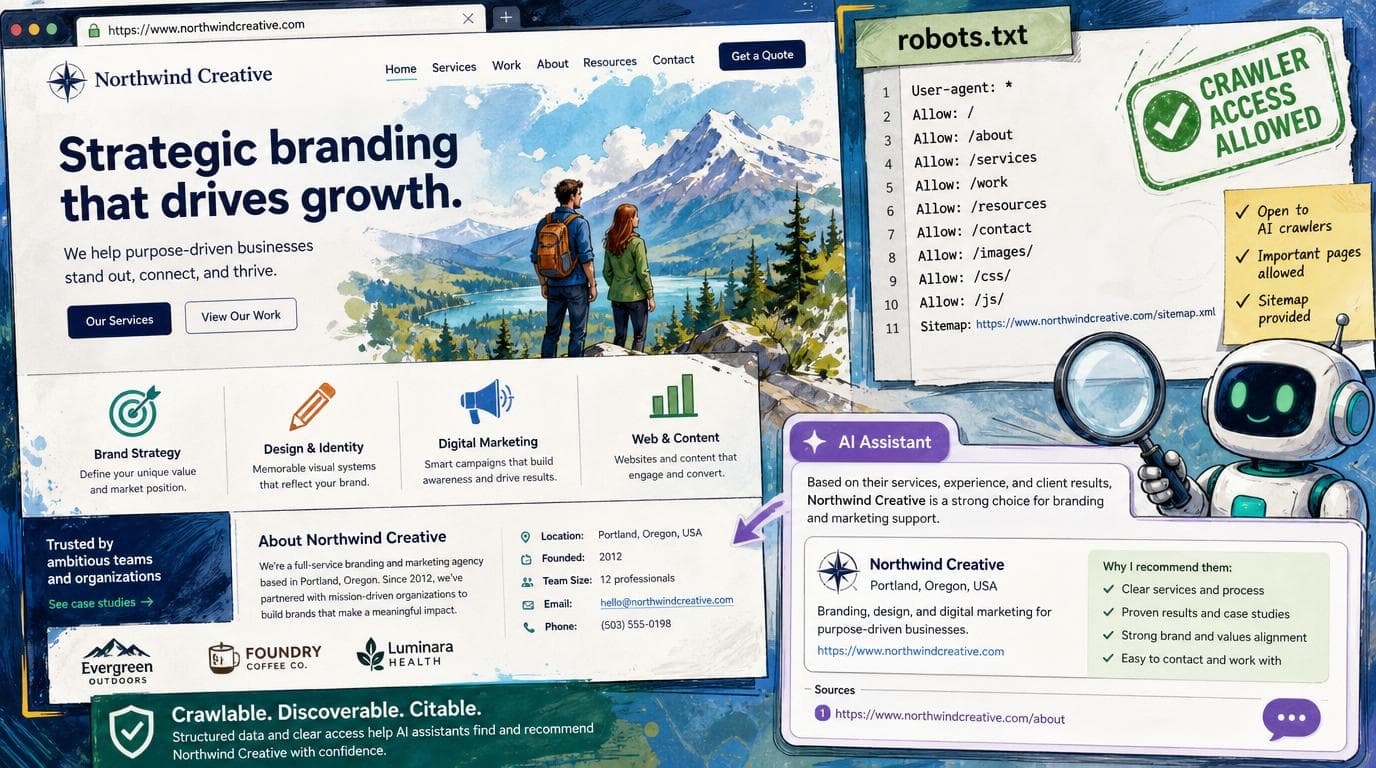
A customer can ask an assistant for a commercial HVAC contractor in your county and get three names back, with hours, a service radius, and a sentence on what each one is good at. Getting your name onto that list is free and takes about an afternoon. Finding out whether you are on it starts at $199 a month, which is Semrush's cheapest plan that puts an actual number on how many prompts it will watch for you (fifty a day, one domain), and the watching is what the whole industry is selling right now. The thing that decides the answer is a text file on your web server that nobody at your company has opened in three years.
The short answer
Three things decide whether an assistant names you, in this order.
First, whether you are eligible at all. That is a crawler question, and it is the only one of the three where you can be sitting at zero without knowing it.
Second, whether the facts about your business exist in a form a machine can lift without guessing. Hours, phone number, service area, price band. Not in an image in your footer. In text, in structured data, and in your Business Profile, all saying the same thing.
Third, whether anyone other than you describes what you do. That one is slow, it is not purchasable, and it is the same work it has always been.
What does not decide it: rewriting your page copy to sound more like an answer. There is a whole category of retainer being sold on that premise, and Google's own documentation says in plain words that there is no additional technical requirement to appear in its AI features. That sentence is worth the rest of this piece.
There is no such thing as "the AI bot"
This is where the free money is, and it is free because almost nobody has looked.
OpenAI runs several separate crawlers and documents them individually. GPTBot collects content that may be used to train models. OAI-SearchBot is the one that surfaces sites in ChatGPT's search features. ChatGPT-User is what shows up when a person in ChatGPT asks about you specifically and the product goes and fetches your page. The settings are independent, and OpenAI is blunt about what each one costs you: "Sites that are opted out of OAI-SearchBot will not be shown in ChatGPT search answers." Blocking GPTBot carries no such penalty. There is now a fourth agent, OAI-AdsBot, which visits landing pages submitted as ads on ChatGPT, which tells you something on its own about where that surface is heading.
Anthropic is built the same way. ClaudeBot, Claude-User, and Claude-SearchBot, with the same three-way split: one for training, one for user-initiated fetches, one for search indexing. Disabling the search one, in Anthropic's own words, "prevents our system from indexing your content for search optimization, which may reduce your site's visibility and accuracy in user search results."
So there are two doors per vendor, and they open onto different rooms. Keeping your content out of training data is a defensible position and it costs you nothing in visibility. Keeping it out of search removes you from the answer entirely. Those are not the same decision, and they get made with one checkbox all the time, because the checkbox is labeled "block AI bots."
Go look. Type your domain followed by /robots.txt into a browser. If you find a blanket disallow, or a block that names every AI user agent somebody could think of in one list, then both decisions got made at once, probably in 2024, probably to stop scraping, and probably without anyone reading the table. If your site sits behind Cloudflare, check AI Crawl Control too, where allow and block are set per crawler and the crawlers are categorized as crawler, assistant, or archiver. Blocking there writes a firewall rule rather than a robots.txt line, so it will not show up in the file at all. That is the version of this mistake that is hardest to find and the one I would check second.
The fix takes minutes. OpenAI says it can take roughly 24 hours from a robots.txt change before their systems adjust, so this is a same-week outcome, not a same-quarter one.
Google is a different shape, and its own documentation deflates the pitch
Google did not build separate doors. AI Overviews and AI Mode run off Googlebot, the same crawl that has always fed search. There is nothing extra to allow.
Which produces the sentence. From Google's guidance on AI features and your website: to be eligible as a supporting link in AI Overviews or AI Mode, a page must be indexed and eligible to be shown in Google Search with a snippet. "There are no additional technical requirements."
Read that again with a proposal open in front of you. If somebody is quoting a monthly retainer for a technical method of getting you into AI Overviews, the company that operates AI Overviews has published that no such method exists to be sold. What that vendor can genuinely do for you is the same content and technical work search has always required, which is fine and often worth paying for, and which should be priced like search work rather than like a new discipline with a new acronym on the invoice.
The controls that take you out, on the other hand, are real, and worth an audit. Google names four: nosnippet, data-nosnippet, max-snippet, and noindex. If anyone on your team added a snippet limit at some point to keep your content from being summarized, it worked, and the cost of it working is that you are not in the summary either.
Buried in that same page is the least glamorous and most useful instruction of the lot. Google lists, as a best practice for AI features, checking that your Merchant Center and Business Profile information is up to date. That is not optimization. That is admin, and it is free, and it is sitting undone at most of the companies I talk to.
The facts have to exist somewhere a machine can lift them
Here is the part that surprises people who have been quoted for a schema implementation.
Google's LocalBusiness structured data documentation lists exactly two required properties. Name and address. Everything else is recommended, and the recommended list is the actual job: telephone, opening hours, price range, geographic coordinates to at least five decimal places, and the URL of the specific location. If you run more than one trade you declare them as an array, so an electrician who also does locksmithing says both in one line rather than picking a lane.
That is an afternoon inside whatever CMS you already pay for, and half the plugins you already have will write most of it for you. It is not a growth lever and nobody should sell it as one. It is the difference between a machine reading your hours and a machine inferring your hours from a directory listing that scraped you in 2023.
Which is the actual failure I keep running into. A shop has three sets of hours loose in the world: the footer of the website, the Business Profile, and a listing on some aggregator nobody has logged into since the last office manager left. They disagree. An assistant asked whether you are open Saturday picks one of them. You never find out which, because the customer who got the wrong answer does not call to complain. They call the next shop.
Google's guidance includes one more line worth pinning up: make sure your structured data matches the visible text on the page. This is not a place to be clever. Everything about this channel rewards being boringly consistent and punishes being creative, which is roughly the reverse of how the last twenty years of the web worked, and I think that inversion is why so many people are struggling to price the work.
What this does not do, and what it costs
The honest edges, which matter more than the checklist.
You cannot control the output. You can control your eligibility and your facts, and that is where your influence stops. The answer is generated fresh, it varies between runs, it varies by who is asking and where they are asking from, and there is no position three to occupy. Anybody selling you a rank in an AI answer is selling you a number that does not hold still. A report showing you "ranked second across eleven prompts" is a weather reading, not a scoreboard.
The measurement is expensive relative to what it tells you. Semrush's Starter tier runs $199 a month, or $165.17 if you commit to a year, for fifty tracked prompts a day on one domain. A hundred prompts a day is $299, two hundred is $549, and every extra login on top of that starts at $45. The metered open-source route runs about a dollar a check, which is reasonable at twenty prompts a week and absurd at thirty a day. Either way you are buying a sample of a system that does not repeat itself. Check it quarterly, after you have changed something, and put the rest of that money into the changing.
Google, meanwhile, folds AI Overviews and AI Mode traffic into the ordinary "Web" bucket in Search Console. It is already in your numbers and you cannot pull it out. So the honest measurement plan is the old one: watch total organic, watch inbound calls, and ask people how they found you. That last one has quietly become the highest-value question on your intake form again.
The third factor, whether anyone other than you describes your business, is the one none of this touches. If nothing outside your own domain says what you do, a model has one source and no corroboration, and no amount of markup fixes that. Getting named on a supplier's partner page, in a trade association directory, in a local news story, in a real review with specifics in it: that is the same unglamorous work it was in 2010, and it is now doing double duty.
And if you sell to eleven accounts by relationship and always have, none of this is your afternoon. This is a channel for businesses whose customers arrive by looking.
What is arriving, and why it is the same job
Being described is the current game. Being transactable is the next one, and it is already specified.
OpenAI's Agentic Commerce Protocol asks merchants for a structured product feed: identifiers, titles, descriptions, images, price, availability. The recommended shape is the entire feed once a day by file upload with updates through the day by API, and promotions only by API. Feed onboarding is currently limited to approved partners, and there is a prohibited-products policy that excludes whole categories outright, so this is not something most small businesses can join this month.
That is not the point. The point is the shape of it. Visibility is moving from a page to a feed. A page is written for a person and inferred by a machine. A feed is a statement, refreshed on a schedule, of what you sell and what it costs and whether you have it, and you are the one on the hook for it being true.
Which means the qualifying question in a couple of years is not going to be whether your copy is optimized. It is going to be whether your operational data is accurate enough to publish daily. If your prices live in a PDF from March, if availability lives in one person's head, if two systems disagree about what a job costs, you cannot participate, and no agency can fix it for you, because the problem is not on your website. That is the same wall the spreadsheet question runs into from the other side, and it is why the internal cleanup keeps turning out to be the marketing work.
The web spent twenty years rewarding whoever described themselves best. The stretch we are walking into rewards whoever describes themselves most accurately, on a schedule, and that turns out to be a much harder thing to fake.
Sources
Every claim above traces back to one of these. Go read them yourself.
- 01Overview of OpenAI Crawlers
OpenAI / platform.openai.com / retrieved Aug 11, 2026
- 02Does Anthropic crawl data from the web, and how can site owners block the crawler?
Anthropic / support.anthropic.com / retrieved Aug 11, 2026
- 03AI features and your website
Google Search Central / developers.google.com / retrieved Aug 11, 2026
- 04Local business (LocalBusiness) structured data
Google Search Central / developers.google.com / retrieved Aug 11, 2026
- 05Manage AI crawlers
Cloudflare / developers.cloudflare.com / retrieved Aug 11, 2026
- 06Semrush plans and pricing
Semrush / semrush.com / retrieved Aug 11, 2026
- 07Get Started with the Agentic Commerce Protocol
OpenAI / developers.openai.com / retrieved Aug 11, 2026
Related reading
Nearest neighbours by meaning, drawn from the whole library rather than from matching tags. Some of these are from a different series on purpose.
Operator answers
Your Software Just Added AI. Do You Pay For It?
Three renewals this quarter, three new AI lines, priced anywhere from twenty nine dollars flat to a hundred and twenty five per seat. Which ones to pay for has almost nothing to do with how good the AI is.
Operator answers
You Built The Tool. Where Does It Actually Live?
The build took a Friday afternoon. The part nobody warned you about is the two decisions that come after it, and neither one is code: who can open the thing, and whether it is allowed to be the only place a number lives.
Vibe coding weekly
Nothing went red for sixteen days
As of today the approval prompt is off by default, which finally lets a non-engineer hand an agent a job and walk away. This week I found three pipelines on my own site that had been failing without producing a single error, one of them for sixteen days, and the thing that hid the worst one was a code comment claiming a number had been measured when nobody ever measured it.