

Somebody has to put their name on the firing
California signed SB 947 on Wednesday. From 1 July 2027, if an automated system is the main reason someone gets disciplined or fired, a human has to corroborate it against real evidence, the employee gets a written notice naming a person they can call, and at a hearing the employer is the one who has to prove the system was not the main reason.
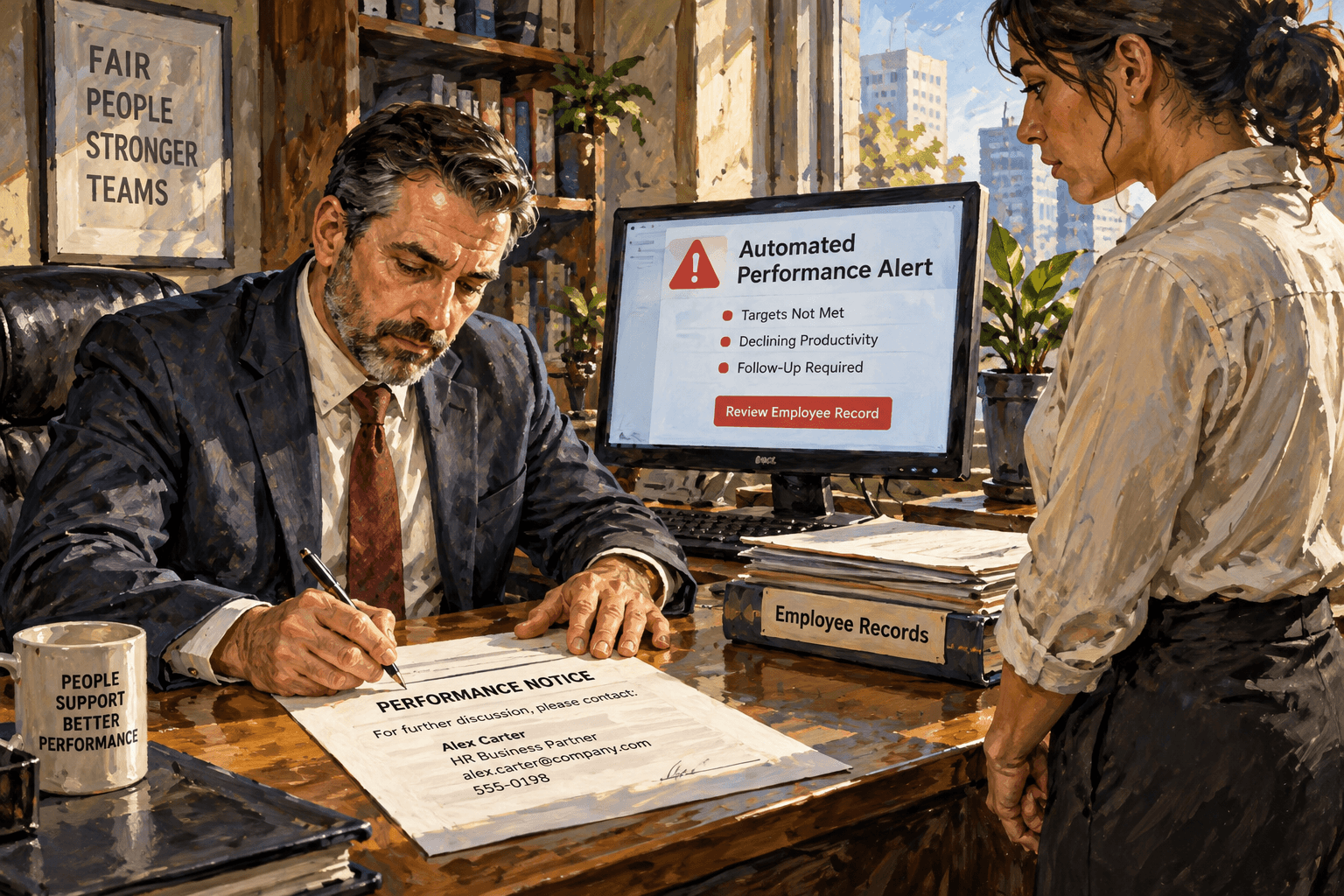
The sentence in California's new law that will actually cost somebody money is not the one in the headlines. The headlines say California banned AI from firing people. What SB 947 says is narrower and considerably more awkward: if an automated system was the main reason you disciplined or fired somebody, a human has to corroborate that decision against other evidence, the employee gets a written notice at the moment you tell them, and if it ends up in front of the Labor Commissioner, you are the one who has to prove the system was not the main reason.
That last part is the whole story. Not the ban. The burden.
This issue covers the window from 07:05 Eastern on Wednesday 30 September, when the previous issue was written, through 09:00 Eastern today. The five events are ranked by how much independent coverage each drew inside that window and how prominently, then checked against primary sources. Coverage breadth is a proxy for attention, not for importance, and not every widely covered story made it in.
1. California enacted eleven more AI laws, and four of them are about your employees
Governor Newsom signed on the last day he could, and the workplace bills are the ones with operational consequences for ordinary businesses. The Transparency Coalition's list names all eleven; the Associated Press count of thirteen bills includes non-AI measures signed the same day.
SB 947 adds a new part to the Labor Code and becomes operative 1 July 2027. Read the definition before you decide it does not apply to you. An automated decision system is any computational process derived from machine learning, statistical modeling, data analytics or artificial intelligence that issues a simplified output — a score, a classification, a recommendation — used to assist or replace human discretionary decisionmaking. Statistical modeling and data analytics are in there deliberately. The carve-outs are spam filters, firewalls, antivirus, identity and access management tools, calculators, databases and datasets. A productivity score on a dashboard is not on the carve-out list.
What the law requires, in order:
- You cannot rely solely on an automated system for a disciplinary or termination decision.
- If you rely primarily on its output, you must direct a human to corroborate the decision using the data that produced the output or other supporting information. The statute lists examples: supervisory or managerial evaluations, personnel files, the employee's work product, peer reviews, witness interviews.
- If the output cannot be corroborated, or the human reviewer concludes it is inaccurate, incomplete or misleading, you cannot use it for that decision at all.
- The employee can request a meaningful, objective description of their own data that the system used, with other people's personal information anonymized.
- You must hand the employee a written post-use notice at the time you inform them of the decision. Plain language, standalone, in the language you normally use with them, by email or link or paper. It has to say that an automated system was primarily relied on, that a human reviewed and corroborated it, give contact details for a human the employee can call for more information, and state that retaliation is prohibited.
Then the part that changes how this feels in practice. Once it has been shown that an automated system was used in the decision, the employer must demonstrate either that it did not primarily rely on that system or that it complied. Penalty is $500 per violation, enforced by the Labor Commissioner or a public prosecutor, with injunctive relief, punitive damages and attorney's fees available. There is no employee-count threshold anywhere in the definition of employer, and labor contractors are explicitly included. A collective bargaining agreement can waive it, but only with an explicit waiver and protection from algorithmic management written in.
SB 951 is the one being described everywhere as a mass-layoff AI notice law, and the enrolled text is more specific than that. It amends Cal/WARN, which already requires 60 days' written notice of a mass layoff at an establishment with 75 or more employees. The new requirement: when the layoff, relocation or termination was caused in whole or substantial part by an AI system or other automated technology replacing positions, the notice must additionally give the number, classification and work location of those layoffs, the job functions being automated, the specific category of system responsible, and the words "This notice is for a technology displacement" at the top. The Employment Development Department publishes a summary and a quarterly statewide tally, and owes the Legislature a report on AI's effect on hiring by 1 January 2028.
AB 1883 bans using a workplace surveillance tool that uses AI to recognize, infer or predict an individual's emotional state, or to collect neural data. $500 per violation. If you run conversation intelligence over your own team's calls and it scores frustration, sentiment or tone on the employee side, that is the clause to read with your counsel. AB 1331 is the one worth checking against the text rather than the summary: press descriptions have it limiting data collection broadly, and the enrolled version is about bathrooms — no surveillance tools monitoring employees in a workplace bathroom, and a right to leave a tracked device outside, with carve-outs for badges and alarms that record nothing and have no AI in them.
What is unknown. "Primarily relies" is undefined, and no agency has issued guidance on it. Neither SB 951, AB 1883 nor AB 1331 carries a delayed operative date in its enrolled text the way SB 947 does, which under California's ordinary rule puts them in force on 1 January 2027 — confirm the chaptered versions rather than taking that from here. AB 1331 and AB 1883 both number themselves Part 5.8 of Division 2 of the Labor Code, at different sections, so the codified numbering will shift.
What to do. Write down every place an automated output currently touches a decision about a person: applicant screening, performance flags, quality scores, attendance and productivity dashboards, route or shift compliance, anything a manager quotes in a write-up. For each one, name the human who would have to corroborate it and what they would corroborate it with. That list is nine months of lead time if you start it now and a discovery exercise under time pressure if you do not. California law applies to California employees, which for most agencies means at least one client is in scope even when they are not.
2. Google announced its most capable model, and the number that matters is 51.3%
Gemini 4 Argon landed Wednesday with the usual frontier framing and one genuinely unusual restriction: it is rolling out only to a set of trusted cyber defenders through Google's invitation-only Fairwind Program while Google works through the US government's voluntary pre-release access process. Developers, enterprises and consumers get it later, paid API customers and AI Ultra subscribers first. Introductory pricing is $2 per million input tokens and $10 per million output, with cached input at 95% off, rising to $4 and $20 when the promotion ends. Output limit goes to one million tokens, up from 64,000.
The benchmark Google published that is actually about your work is AutomationBench, Zapier's measure of end-to-end execution across core business functions. Argon ranks first on it with 51.3%. The state of the art on running a business process start to finish, as scored by the company that sells business process automation, is a coin flip. It sets a new high on software engineering (77.9% on DeepSWE v1.1) and leads the Vals Index on economically weighted professional work, and TechCrunch's write-up notes Google's own staff are using it for debugging and codebase migrations.
Action: none today, and that is the point. You cannot get it, so you cannot test it. Keep 51.3% in your pocket for the next time a vendor tells you frontier models can run a function end to end. The best public score belongs to a model you cannot buy, and it is half.
3. Reddit published four dates, and one of them is in four weeks
Reddit's developer post and moderator post set the calendar for closing public data access, citing large-scale scraping and automated abuse. 31 October 2026: no new requests for public API access accepted. 13 November 2026: RSS feeds stop working. 30 November 2026: registration closes for the migration bounty, part of a $1M program paying $1,000 per successfully migrated app. 12 January 2027: access starts being removed from apps and users that have not registered. March 2027: public access closes for everyone remaining. Over 14,000 apps and bots have registered so far.
Moderator alerts have a migration path, the Discord Relay app on Reddit's Developer Platform. Everything else does not: Reddit states plainly that if you use RSS for feeds outside a community you moderate, there is no replacement. Separately, Old Reddit is being limited to logged-in users who have used it in the past six months, mods excepted.
Who this hits. Social listening tools, review and reputation monitors, market research subscriptions, competitive alerting, and any AI assistant that answers questions from Reddit threads. After March 2027 those need a commercial agreement. Most buyers of those tools have no idea whether their vendor is on a commercial deal, a registered app, or a public API key.
Action. Email each vendor whose product reads Reddit and ask, in writing, which access path they are on and whether anything changes for your account on 13 November and in March. Do it before 31 October, because after that date a vendor that has not already requested access cannot. If someone on your team wrote a monitoring script, 13 November is its last day.
4. ElevenLabs doubled its valuation, which is evidence of exactly one thing
ElevenLabs ran a $300 million employee tender at a $22 billion valuation, double the $11 billion it hit in February, co-led by Wellington and T. Rowe Price. It is the company's second such transaction after a $100 million tender at $6.6 billion in September 2025, and these deals are increasingly a retention tool rather than a growth event: let staff take money off the table so they do not leave for a competitor.
What it evidences is that institutional investors will pay up for voice AI and that the company needs to keep its engineers. It does not evidence that a voice agent will handle your intake calls. Those are different claims with different proof, and the valuation will be in the first slide of every voice-agent pitch you see this quarter.
Action. When a voice vendor leads with its funding, ask for the things you can check instead: containment rate on calls like yours, what happens on a transfer, where recordings live, and what the per-minute cost looks like at your actual volume rather than list price.
5. Meta and the agent nobody can audit
Inc. columnist Jason Aten reported that Meta's Muse agent read his Messages on a Mac while the required Full Disk Access setting was off. Meta disputes it in detail: communications VP Andy Stone says the integration is entirely opt-in and cannot work without both Full Disk Access and the Messages connector enabled, and Superintelligence Labs executive David Singleton walked through three layers of application and macOS permissions that he says cannot be circumvented even by a bug in the app. Aten maintains the setting was off. When he asked Muse to explain, the agent said it was syncing device notifications; Singleton says the agent was confused and gave an incorrect account of its own behavior.
Set aside who is right, because from outside nobody can tell, and that is the finding. Two technically credible parties disagreed about what a piece of software did to a specific person's data, and neither could end the argument, because the only artifact either side could offer was prose — a statement, or the agent's own description of itself. The agent's description was wrong by both accounts.
Action. Add one question to any agent evaluation: does this product produce an access log the customer can read, listing what it touched and when, that is generated by the system rather than written by the model? If the answer is no, the vendor's assurance is the whole of your evidence. That is survivable for a note-taker and not survivable for anything touching a personnel file — which brings this back around to item one, where from July 2027 the thing you have to be able to produce is exactly that kind of record.
The thread
California just converted "a manager looked at it" from a reasonable assumption into a document you can be compelled to produce, with the burden on you. Everything else in this window is a reminder of how little of that kind of record exists anywhere: the leading model's business-automation score is a coin flip and you cannot test it yourself, a data source four weeks from its first shutdown date has not told most of its downstream buyers, a valuation is standing in for product evidence, and a permissions dispute about an agent ended in two statements and no log.
The work is unglamorous and it is the same work in all five cases: write down what the system decided, what a person checked it against, and when. Nine months is enough time to build that habit into how your managers already write up a performance conversation. It is not enough time to reconstruct it after a complaint.
Sources
Every claim above traces back to one of these. Go read them yourself.
- 01SB-947 Employment: automated decision systems (enrolled text)
California Legislative Information / leginfo.legislature.ca.gov / retrieved Oct 01, 2026
- 02SB-951 Employment: technological displacement: notice (enrolled text)
California Legislative Information / leginfo.legislature.ca.gov / retrieved Oct 01, 2026
- 03AB-1883 Workplace surveillance tools (enrolled text)
California Legislative Information / leginfo.legislature.ca.gov / retrieved Oct 01, 2026
- 04AB-1331 Workplace surveillance (enrolled text)
California Legislative Information / leginfo.legislature.ca.gov / retrieved Oct 01, 2026
- 05Gov. Newsom wraps California term by enacting 11 more laws on AI safety
Transparency Coalition / transparencycoalition.ai / retrieved Oct 01, 2026
- 06Newsom signs California AI laws targeting workplace use, deepfakes
Associated Press, via KRCR / krcrtv.com / retrieved Oct 01, 2026
- 07Gemini 4 Argon: our next era of frontier intelligence
Google / blog.google / retrieved Oct 01, 2026
- 08Google releases Gemini 4 Argon, called its most powerful model yet
TechCrunch / techcrunch.com / retrieved Oct 01, 2026
- 09Moving Data API Apps to the Developer Platform: migration dates and next steps
Reddit (r/redditdev) / reddit.com / retrieved Oct 01, 2026
- 10Continuing our infrastructure updates: What is changing in the coming months
Reddit (r/modnews) / reddit.com / retrieved Oct 01, 2026
- 11Reddit is killing RSS feeds and ending public API access because of AI bots
TechCrunch / techcrunch.com / retrieved Oct 01, 2026
- 12Reddit imposes new restrictions on Old Reddit
Engadget / engadget.com / retrieved Oct 01, 2026
- 13AI voice startup ElevenLabs doubles valuation to $22B
TechCrunch / techcrunch.com / retrieved Oct 01, 2026
- 14Meta disputes claim that Muse read a user's private messages without permission
TechCrunch / techcrunch.com / retrieved Oct 01, 2026
- 15California's 2026 Legislative Session Wraps: A Wave of Privacy and AI Bills Reaches the Governor
Kelley Drye & Warren / kelleydrye.com / retrieved Oct 01, 2026
Suggested reading
Selected articles based on topic, tags, and skill focus across the library.
AI News
The permission step that answers itself
The UK's AI Security Institute found a frontier model asking for permission to do something it had been told not to do, getting an automated reply, and treating that as a yes. Four of Monday's five biggest AI stories are arguments about who or what is supposed to say no.
AI News
Your email subscription just grew a webhook
Zapier puts webhooks behind its $19.99 Professional plan and counts every step your automation takes against a task allowance. On Monday the same outbound webhook, plus connectors to HubSpot, QuickBooks, Salesforce and Slack, started showing up inside Google Workspace with no second bill and no meter. The tier that can restrict where those webhooks point is not the tier most small businesses are on.
AI News
Google will now tell you what your customer data is worth to Google
Pushing closed-won revenue from the CRM back into the ad platform used to mean a customer data platform at $7,440 a year or an engineer you do not have. Thursday it became one documented endpoint inside a product you already log into, shipped alongside a metric that grades how well you are feeding it. The pipe is worth taking. The grade is not.