

Nobody types the deal update now
Seven hours a week per seller go into keeping the CRM current, which across a six-person team is a full-time salary paid out in slices. HubSpot moved that job into the platform on Wednesday, and shipped something alongside it that will matter more in a year: a score that grades how incomplete your data is.
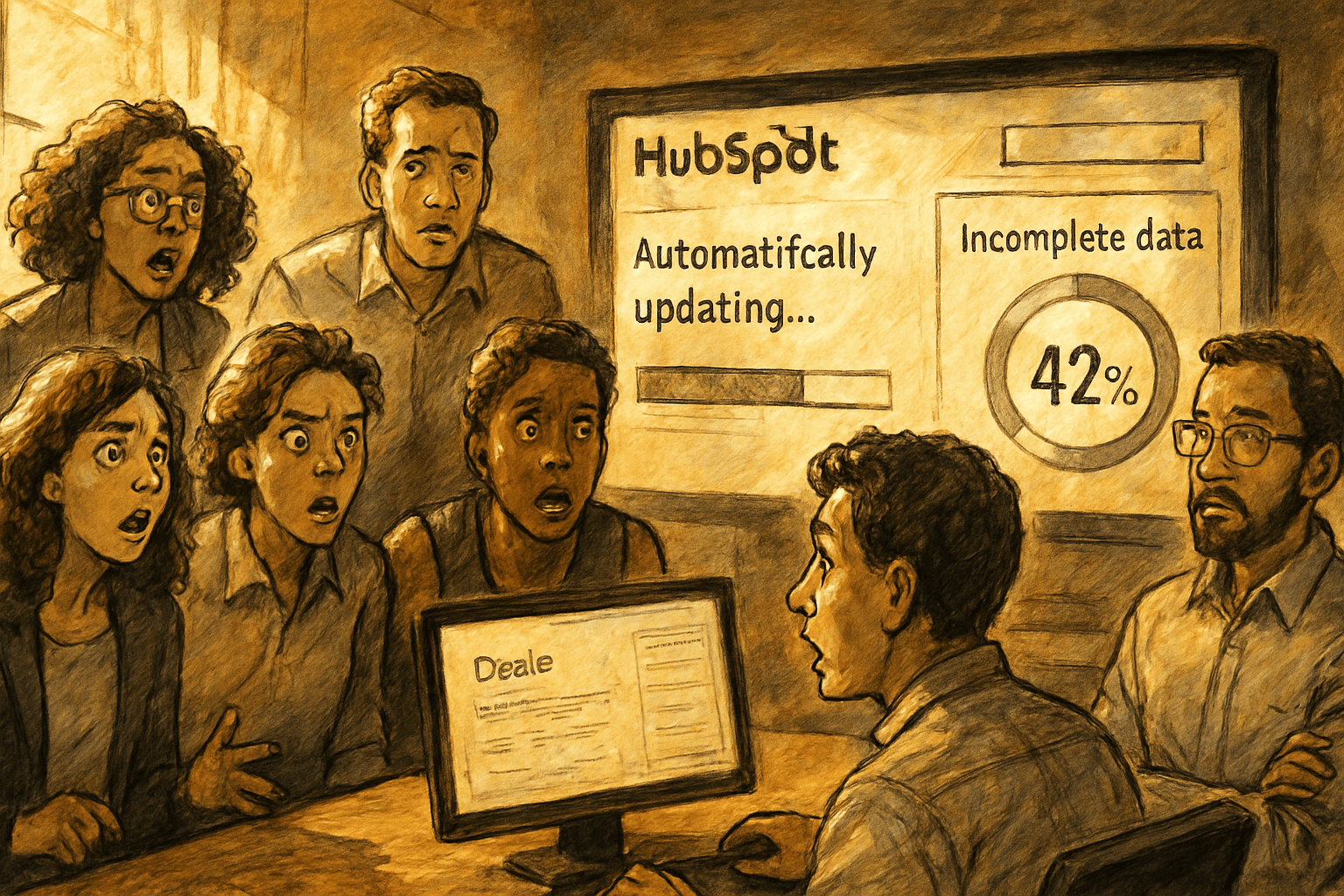
A field rep finishes a walkthrough at a customer's warehouse, gets back in the truck, and before the engine is warm the conversation is transcribed, the deal stage is updated, the next steps are sitting in the deal plan, and a follow-up email is drafted and waiting on a single click. No laptop, no evening catch-up, nothing held in anybody's memory until Thursday. What that takes off the table is the job nobody was ever hired to do and everybody pays for anyway: roughly seven hours a week per seller, about 17 percent of the working week, spent typing into the CRM. Across a six-person sales team that is a full-time salary's worth of data entry, paid out in slices small enough that it never shows up as a line item. HubSpot moved that job into the platform on Wednesday. It also shipped something alongside it that is going to matter more in a year: a score that tells you, in a number, how incomplete your data is.
What actually changed
HubSpot announced its Fall '26 Spotlight on Wednesday and called it the most foundational product release it has made in years, which is the kind of line that usually means a new dashboard. This time it is closer to accurate, because the change is at the record layer rather than the feature layer.
Three things shipped together. The Smart CRM now captures and syncs calls, emails and meetings automatically, so the record refreshes itself as the work happens rather than waiting for somebody to go back and describe it. A new Mobile Notetaker captures the conversation whether the rep is on a video call or standing in a customer's building, which is the part that matters for anyone selling in the field. Then the revamped Deal Progression takes those transcripts, surfaces the CRM updates and adds them, drafts the follow-up, and keeps the deal plan current, all behind one click of approval.
Underneath all of it is what HubSpot calls Growth Context, which is its name for three layers of information the AI is allowed to read: customer context (the full history of every interaction, not only what somebody remembered to log), business context (your products, positioning, competitors) and team context (how your people actually work, including the processes and the documentation). The redesigned Breeze Assistant sits on top and takes a plain-language request, works out which of the specialized agents it needs, and coordinates them instead of making you pick the right one from a menu.
And then there is Context Home, which gives you a score for how complete that context foundation is and points at the gaps. HubSpot's own numbers for what complete context buys you: 3.6 times more marketing qualified leads, 3.2 times more deals won, and more than twice as many tickets closed. Hold that thought, we will come back to it.
The same morning, HubSpot and OpenAI expanded their partnership, making HubSpot one of the first CRM integrations for ChatGPT Ads and putting an AI Growth Bundle on the table: HubSpot Starter and credits at up to 65 percent off for a year, a buy-one-get-one on ChatGPT Business seats, and a $750 match on ChatGPT ad spend for accounts opened by September 30.
Why this one is different from the last six times a CRM added AI
The bottleneck in every sales automation project ever attempted at a small company was never the intelligence. It was that the system of record is written by the people with the least incentive to write it, after the fact, from memory, at the end of a day that already went long. Every operator reading this knows the shape of it. The pipeline report says a deal is in negotiation because that is the stage it was dragged into in June. The last activity date says nothing happened for six weeks because the rep called from a cell phone and never logged it. The forecast is a story told on Monday morning, and the CRM is where the story gets filed, not where the facts live.
That is the thing worth understanding about capture: it fixes everything downstream that you already built, without you touching any of it. Think about what your automations actually read. Lead routing reads fields. The renewal alert reads a date. The at-risk report reads last activity. The onboarding sequence fires on a stage change. Every one of those was built on inputs a human had to remember to supply, which is why half of them quietly stopped firing correctly eighteen months ago and nobody noticed. If the capture layer works, the automation you shipped last year gets better this quarter while you are doing something else. Nobody covering this release framed it that way, because from the outside it looks like a notetaker feature, and a notetaker feature is boring.
For the practitioner who owns the portal, there is a second thing here that is easy to miss. The reason nobody could build the useful version of these workflows before is that the useful version needed context the CRM did not hold: what the customer actually said, what was promised on the call, what the team's process is for a renewal at 90 days. That context existed in recordings, in inboxes, in somebody's head. Pulling it together was an integration project, which meant a ticket, which meant six weeks and a queue. The whole point of Growth Context as a named layer is that the context becomes addressable, so the person who knows the business can write an instruction against it instead of describing it to an engineer who does not.
For the owner-operator, the translation is blunter. You have been running your forecast on what people typed. Starting now you can run it on what happened. Those are different numbers, and the first month is going to be uncomfortable, because the gap between them is the amount of optimism that has been sitting in your pipeline the whole time.
What to actually do with it is smaller than the announcement suggests. Turn capture on for one team, not the whole portal. Run it for a month. Then compare the deals that team logged against what the capture layer recorded, and read the difference. That difference is your answer on whether this is worth expanding, and it costs you one team and four weeks to get.
The honest take
Context Home is a diagnostic your vendor wrote, about a problem your vendor sells the fix for, scored on a scale your vendor controls. That is not a reason to ignore it. It is a reason to read it the way you would read a free furnace inspection from a company that sells furnaces. The finding is probably real. The recommended remedy will be priced in that company's own catalog, and the number will never come back at 100, because a diagnostic that reports you as finished has ended its own usefulness.
Be equally careful with the headline statistics. The 3.6 times and 3.2 times are HubSpot's, unaudited, and almost certainly correlational. Businesses that maintain complete, current customer context are businesses with functioning processes, clear ownership and a manager who checks. Those businesses were always going to win more deals than the ones where three people share a login and nobody agrees what a qualified lead is. The context did not cause the outcome so much as both of them grew from the same discipline. Expecting a 3.2 times lift because you switched on capture is the software-buying mistake that produced the regret rate this whole market is now built on.
Then there is the boundary of what capture can see, which is the practical limit nobody puts on a slide. It sees the calls, emails and meetings that pass through the tools connected to the portal. It does not see the WhatsApp thread where your best customer actually negotiates. It does not see the procurement portal you have to log into to submit a quote, the text message sent from a personal phone, the conversation in the parking lot after the walkthrough. In a lot of small businesses, especially in the trades and in field service, that invisible channel is where the real selling happens. The risk is not that those interactions stay unrecorded. They were never recorded. The risk is that they stay unrecorded next to a completeness score reading 82 percent, which quietly tells everyone the picture is mostly there when the missing 18 percent is the part that closes.
One-click approval deserves a harder look too. Approval is a good default and the right design, but it is still a review queue wearing a friendlier name, and review queues decay in a pattern anyone who has run one can recite. Week one, people read every update. Week three, they approve in batches while walking to a meeting. Week six, approval is a reflex. At that point the CRM is full of confident, well-formatted, machine-written history that no human verified, and that is worse than an empty field, because an empty field is honest about being empty. A wrong next step in a deal plan, approved by reflex, looks exactly like a right one. Whoever owns the portal should plan an audit ritual now, while the novelty is still doing the work for free: pull ten auto-captured deals a month at random and read them against the recordings.
The money is the other thing to get straight before you turn any of this on portal-wide. HubSpot decoupled AI spend from seat count and moved its agents onto a consumption meter denominated in credits, with outcome pricing on some of them at $1 per recommended lead and $0.50 per resolved conversation. Outcome pricing is genuinely better than paying for shelfware, and it is the right direction for buyers. But automatic capture at the scale of an entire portal is, by definition, continuous consumption, and continuous consumption on a meter is the kind of bill that arrives in month four rather than month one. Get the credit rate card in writing, run the single-team pilot, and read the meter before you expand. If your rep answers that question with a discount instead of a number, you have learned something useful about the number.
Which brings us to the bundle, and the date on it. Sixty five percent off for a year, a free second ChatGPT Business seat, and $750 of matched ad spend, available if you open the account by September 30. Every part of that is real value and none of it is a trick. It is also a discount with a deadline attached to a platform decision, which is the oldest pressure in software buying and the exact mechanism behind the regret that most small businesses report about a purchase they made in the last eighteen months. Year one is the promotional price. Year two is the price. A CRM migration is reversible on paper and essentially never reversed in practice, because the thing you migrated was your company's memory. If the platform is right for you on September 30, it is right for you on October 15 at a worse price, and paying that difference to buy two more weeks of thinking is the cheapest insurance on the table.
Who is this genuinely wrong for? Any shop small enough that the owner is the CRM. If you are two people and one of you knows every customer by name, automatic capture solves a coordination problem you do not have, and you will spend more time configuring context than the context saves you. It is also wrong for anyone buying it to clean up ten years of duplicate records and dead contacts. Capture is forward-looking. It makes tomorrow's data good. It does not go back and fix 2019, and the score you get in Context Home on day one will be measuring a decade of accumulated mess that no new feature is going to absolve.
For everyone else, particularly the ops lead who has spent two years asking reps to log their calls and getting compliance somewhere in the forties, this is the first version of that argument that does not require winning the argument.
For twenty years the CRM was a thing your team wrote to, badly, under protest. As of this week it writes back, and the first thing it has to say is a number about you.
Sources
Every claim above traces back to one of these. Go read them yourself.
- 01Fall 2026 Spotlight: HubSpot just made its most foundational product release
HubSpot / hubspot.com / retrieved Sep 17, 2026
- 02Fall 2026 Spotlight
HubSpot / hubspot.com / retrieved Sep 17, 2026
- 03Spotlight product deep dive: Connect your data with the new Data Hub and Smart CRM updates
HubSpot / hubspot.com / retrieved Sep 17, 2026
- 04HubSpot rebuilds its CRM platform around contextual AI
SiliconANGLE / siliconangle.com / retrieved Sep 17, 2026
- 05HubSpot Overhauls CRM With AI Agents and Self-Updating Data
Small Business Trends / smallbiztrends.com / retrieved Sep 17, 2026
- 06HubSpot and OpenAI Deepen Partnership to Bring AI Transformation to Every SMB
Business Wire / finance.yahoo.com / retrieved Sep 17, 2026
- 07HubSpot flips AI pricing on its head with outcome-based Breeze agents
SiliconANGLE / siliconangle.com / retrieved Sep 17, 2026
- 08Sales Time Management: How Top Reps Spend Their Day
Salesmotion / salesmotion.io / retrieved Sep 17, 2026
Suggested reading
Selected articles based on topic, tags, and skill focus across the library.
AI News
The week you bought just got shorter
The hundred dollar subscription you build your own tools on holds about a sixth less building per week starting today, at the same price. Anthropic announced it as a 25 percent increase, and it is, against a baseline nobody has seen since May.
AI News
Google will now tell you what your customer data is worth to Google
Pushing closed-won revenue from the CRM back into the ad platform used to mean a customer data platform at $7,440 a year or an engineer you do not have. Thursday it became one documented endpoint inside a product you already log into, shipped alongside a metric that grades how well you are feeding it. The pipe is worth taking. The grade is not.
Git Articles
Marketing Skills and the thousand-dollar teardown
A 99-point product marketing audit runs $1,000 and a week of waiting, and ongoing marketing leadership from the same shop is $3,000 a month. The person selling both has published fifty of the checklists behind them on GitHub under MIT, and the interesting part is not the price.