LibraryRepo of the day9 min read
Activepieces and the Zapier task meter
The integration your RevOps person keeps filing a ticket for, when a deal closes, enrich the account, post to Slack, open the onboarding task, is a paid Zapier meter that bills by the task. Activepieces is the self-hosted version that runs the same flows for the cost of a small server, and the interesting part is the pivot into AI agents.
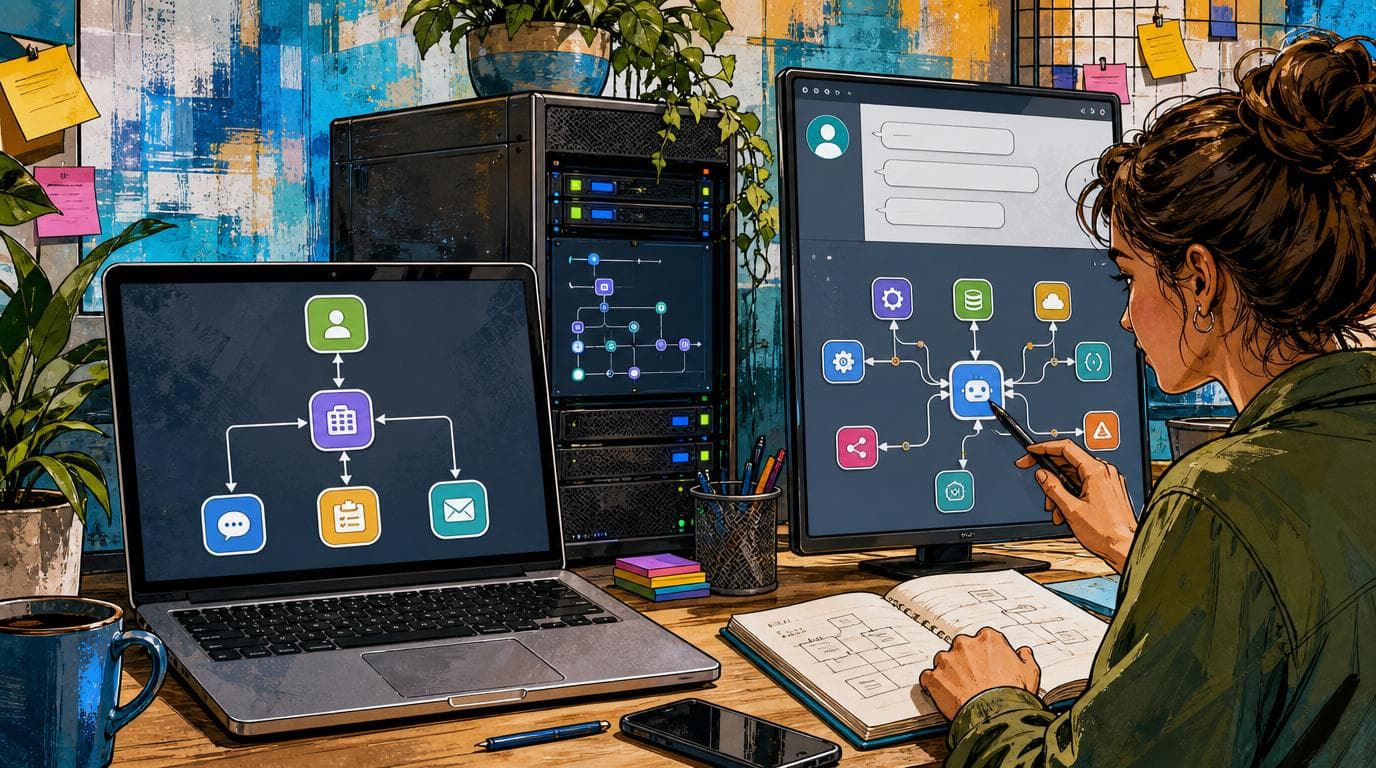
There is a job that lands on every operations person's desk and never gets prioritized. A deal closes in the CRM. Somebody now has to enrich that company's record, drop a note in the right Slack channel, spin up the onboarding task in the project tool, and email the account manager the summary. It is four steps, it happens twenty times a day, and it is exactly the kind of glue that engineering will not touch until the next quarter. So it gets done by hand, or it gets wired up in a paid automation tool that quietly bills by the task and gets more expensive the more you actually use it.
Activepieces is the open-source version of that automation tool, and it is meant to run on a server you control. Self-hosted, the Community Edition has no task limit and no flow limit, which means the recurring cost is not a subscription at all, it is whatever a small virtual server costs you, call it twelve dollars a month. The paid product it stands in for is Zapier, whose Team plan runs about 103 dollars a month billed monthly for 2,000 tasks, and whose meter keeps climbing as your flows fire. The repo crossed 22,000 stars doing the boring version of this. The reason it is worth writing up today is that it stopped being boring.
What actually changed
Activepieces started life as a straightforward Zapier clone: a visual builder where you pick a trigger, chain some actions, connect a few hundred apps, and let it run. That is still the core of it, and the core is MIT licensed, the genuinely permissive kind you can fork and sell without asking anyone. What has changed over the last few releases is that the project repositioned itself around AI agents and the Model Context Protocol. Its own description now leads with "AI Agents and MCPs and AI Workflow Automation" and advertises roughly 400 MCP servers, which is the part that matters if you have been trying to give an AI assistant real reach into your tools.
The 0.85.0 release notes read like a company that decided the automation graph and the AI agent are the same product. There is an in-app chat that calls your flows as tools, with the ability to stop a response mid-stream and auto-recover a stuck run. There is a "Run Agent" step you can drop into a flow. Flows an MCP client creates get tagged with an AI badge so a human can see what the machine built. Native Anthropic thinking is wired in, different models run at different tiers, and the piece framework picked up metadata fields specifically so an agent can reason about which action to call. New connectors keep landing in the same releases, Salesloft, Gorgias, Buffer, Omnisend, the ordinary go-to-market plumbing, alongside the AI machinery.
That combination is the news. A visual automation builder is a known quantity. A visual automation builder that also exposes every one of your connected apps to an AI agent through MCP, and lets that agent assemble flows, is a different tool wearing the same clothes. It means the thing a RevOps person builds on a Friday is no longer just "if this, then that." It can be "watch this inbox, decide which of these six things to do, and do it," with the deciding handled by a model and the doing handled by the same connectors that used to just move data from A to B.
Why it matters to a small operator
Start with the money, because that is the honest lede and everyone glosses it. Zapier's meter is per task. Every action a flow takes is a task. That four-step flow when a deal closes is four tasks, times twenty deals a day, times twenty-two working days, is 1,760 tasks a month from one automation. The Professional plan starts at 750 tasks. You are already on Team, at roughly 103 dollars a month billed monthly (a little under 70 if you pay for the year up front), and that is one flow. Real operations run dozens. The tool that was supposed to save you money becomes a line item nobody wants to defend in the budget review, and the instinct is to turn flows off to stay under the cap, which defeats the entire point of having them.
Self-hosted Activepieces removes the meter. The flow can fire a hundred thousand times and the bill does not move, because there is no bill, there is a server. That is the whole pitch and it is a real one. For the owner-operator who bought an automation subscription and now rations it, this is the difference between automating everything that should be automated and automating only what fits under the ceiling.
For the RevOps or ops practitioner, the displaced cost is not really the subscription. It is the six-week wait. The integration you cannot get engineering to build, the internal tool that never clears the backlog, is now something you stand up yourself in an afternoon. Activepieces gives you the visual builder for the ninety percent that is drag-and-drop, and a code step for the ten percent that needs a bit of TypeScript, so you are not blocked the moment you hit something the pre-built pieces do not cover. And because the AI agent piece is built in, the tool you ship can now make judgment calls you would otherwise have to hardcode or escalate. That is the internal build most ops people have been quietly wanting and could not get resourced.
There is a second-order benefit that is easy to miss. When you self-host, your customer data, your CRM records, your inboxes, the contents of every flow, live on your server and pass through your infrastructure. With a hosted automation vendor, all of that transits their systems by design. For a business that handles anything sensitive, health, finance, legal, "the data never leaves our box" is not a nice-to-have, it is sometimes the only version of the workflow that is allowed to exist at all.
The honest take
Free is doing a lot of work in that lede, so here is what it actually costs.
Setup is not zero. The realistic path is Docker on a small cloud server, and if you have deployed a container before, you are looking at one to two hours to a working instance, plus more to get authentication, a domain, and HTTPS configured properly. If you have never touched Docker, budget an afternoon and expect to read documentation, because the "competent non-engineer" this is aimed at still needs to be comfortable pasting commands into a terminal and reading an error when something does not come up on the first try. This is self-hostable, not one-click. Be honest with yourself about which of those you are signing up for.
The server is real money, just small money. A VPS that comfortably runs Activepieces and a Postgres database is roughly 12 to 20 dollars a month on the usual providers. Call it 150 to 240 a year. That is still a rout against a scaling Zapier bill, but it is not zero, and it comes with the thing nobody markets: you now own the uptime. When the server falls over at 2am, there is no support line. The flow that was supposed to email the account manager just silently did not, and you find out when the account manager asks where the summary is. Zapier's price includes somebody else being responsible for it staying up, and for a business where a missed automation means a missed customer, that responsibility is worth paying for. Do not pretend it is not part of what you are dropping.
The connector count is not the same either. Zapier advertises somewhere north of 8,000 app integrations. Activepieces has a few hundred pieces plus the MCP servers. For the common stack, CRM, Slack, email, sheets, the calendar, the popular go-to-market tools, you are covered. For the obscure vertical app your industry runs on, you may not be, and building a new piece is a real task, not a checkbox. Check that your actual tools are in the list before you migrate anything, not after.
The license has an asterisk, and it is the one the README will not lead with. The core is MIT, but everything under the packages/ee directory is under a separate commercial license, per the LICENSE file itself. That enterprise directory is where features like SSO, custom role-based access control, and audit logs live. So "open source" is true and "you can self-host the whole product for free" is mostly true, but if what you need is single sign-on for a team of twenty and an audit trail for compliance, you are either back on a paid tier or outside the free grant. Read the license, not the badge, before you build a company process on top of it.
Then there is the bus-factor question every self-hosted pick has to answer. Activepieces is a venture-backed company with a real team and a fast release cadence, which is a plus, the project is not one burned-out maintainer. But a company can pivot, get acquired, or move the good parts behind the commercial line, and the MIT core is your insurance against that: you can keep running and, if it came to it, fork what you have. That insurance is only as good as your willingness to actually maintain a fork, which for most small teams is theoretical. The realistic version is that you are betting on the company staying pointed the way it is pointed now.
Last, the AI agent features are the newest and therefore the least battle-tested. An agent that assembles and runs flows against your live systems is powerful and is exactly the kind of thing that does something surprising in month three. Give it scoped credentials, watch what it builds, and do not point it at anything irreversible until you have seen it behave for a while. The AI badge on machine-created flows exists precisely because you are supposed to be checking.
None of this is a reason not to run it. It is the difference between running it with your eyes open and running it because a blog said free. The math genuinely favors self-hosting the moment your automation volume is real, and the AI and MCP direction makes this more interesting than the Zapier-clone framing suggests. Just price in the afternoon, the server, and the pager, because those are the parts the word "free" is quietly hiding.
The question worth sitting with is not whether you can replace the subscription. You can. It is whether your operation is at the point where owning the uptime is cheaper than renting it, because the day you self-host is the day the automation stops being somebody else's problem and starts being yours.
Sources
Every claim above traces back to one of these. Go read them yourself.
- 01Activepieces repository
Activepieces / github.com / retrieved Aug 03, 2026
- 02Activepieces 0.85.0 release notes
Activepieces / github.com / retrieved Aug 03, 2026
- 03Activepieces LICENSE
Activepieces / github.com / retrieved Aug 03, 2026
- 04Zapier pricing
Zapier / zapier.com / retrieved Aug 03, 2026
Related reading
Nearest neighbours by meaning, drawn from the whole library rather than from matching tags. Some of these are from a different series on purpose.
Vibe coding weekly
Nothing went red for sixteen days
As of today the approval prompt is off by default, which finally lets a non-engineer hand an agent a job and walk away. This week I found three pipelines on my own site that had been failing without producing a single error, one of them for sixteen days, and the thing that hid the worst one was a code comment claiming a number had been measured when nobody ever measured it.
The daily read
Your required fields were never required
The required field you configured in HubSpot has been optional for every robot pointed at your CRM: the AI agent, the nightly script, the Zap nobody owns. HubSpot said on Tuesday that changes with the September API version, and the part worth reading twice is that it changes on your schedule, not theirs.
Repo of the day
pdf-inspector and the ten-cent invoice
Google will read a supplier invoice for ten cents a document and a generic page for thirty dollars a thousand. Firecrawl open sourced the piece that decides which of your documents need to be sent to a meter at all, and by their own count about half of them never did.