
LibraryFoundational AI: Do's and Don'ts3 min read
Use a premortem to find a plan’s weak spots
Before committing to a plan, ask AI to imagine it has failed and list plausible reasons. Use the results to find questions your team should answer, not to predict what will happen.
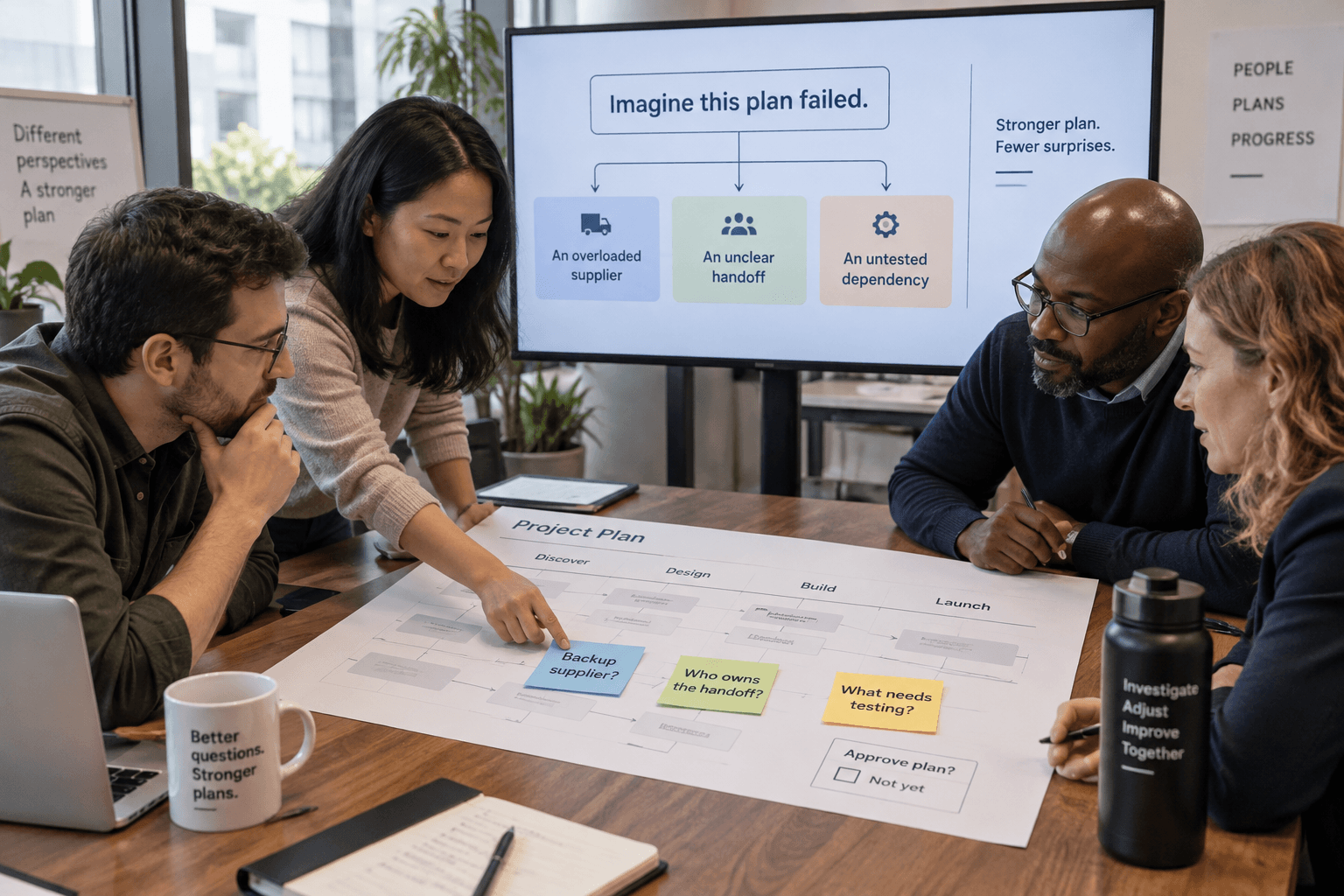
A plan can look complete because everyone in the meeting already knows the parts that might make it fail. The awkward handoff, the missing approval, the one person who owns the only usable data: people may leave those details unsaid until the project is underway.
Try a premortem before you commit. Ask AI to imagine the plan has failed, then list plausible reasons. The point is to get specific questions onto the table while you can still change the plan.
The method comes from project planning, not from AI. Gary Klein’s description of a project premortem asks a team to assume the project has already failed and generate plausible reasons for that outcome. AI can help you prepare a first list, but your team has to decide which items deserve attention. OpenAI’s prompting guidance also recommends giving a prompt clear, specific context. Neither source establishes that an AI-generated premortem will predict failures or improve a particular project.
Give the exercise enough context to be useful
Pick a plan that is still changeable and narrow enough to describe in a few sentences. For example, imagine a small agency plans to start a monthly review of client campaign results. The purpose is to spot accounts that need follow-up, and the first review is scheduled four weeks from now.
A vague prompt such as “What could go wrong?” may return familiar answers that don’t help you inspect this plan. Instead, state the goal, relevant constraints, and the kind of response you need.
Illustrative prompt:
Imagine our first monthly review of client campaign results has failed to produce useful follow-up. Based only on the plan below, list five plausible reasons. For each, identify the assumption it depends on and one question the team should answer before starting. Separate details stated in the plan from assumptions you are making. Do not present these possibilities as predictions. Plan: We will review campaign results once a month to identify accounts that need follow-up. The first review is scheduled four weeks from now.
This is an illustrative prompt, not a report of a test or a real agency result. It gives the AI a scenario and limits its task. The answer might mention that nobody owns the follow-up, that the figures arrive too late, or that the team has not agreed what counts as a result worth discussing. Those are possibilities for the team to check, not facts about this fictional plan.
Turn suggestions into questions you can answer
Read the list and separate three things: what the plan says, what the AI inferred, and what you don’t know yet. A suggestion is more useful when you can connect it to an observable detail. “Nobody owns follow-up” can become “Who is responsible for assigning and recording the next step?” “The numbers arrive too late” can become “When are the source reports available, and who confirms them?”
Take the specific questions back to the people who own the work. Ask whether the proposed failure mode fits the process, what evidence supports it, and what small change would reduce the risk. You might add an owner to the plan, confirm a report deadline, or decide that one measure needs a shared definition before the review starts.
Do not treat the AI’s list as a complete risk review. It only works from the information you provide and patterns it can generate; it may miss the issue the team knows from experience or invent one that doesn’t apply. For a high-stakes decision, use the exercise to support discussion with knowledgeable people, not to replace it. If the answer is generic, add a concrete constraint or ask about one part of the plan, then check it again with the people closest to that work.
The useful result is not a longer risk list. It is a short set of questions that someone can answer before the team commits time, money, or a promise to a customer.
Sources
Every claim above traces back to one of these. Go read them yourself.
- 01Performing a Project Premortem
Harvard Business Review / hbr.org / retrieved Oct 29, 2026
- 02Prompt engineering best practices for ChatGPT
OpenAI Help Center / help.openai.com / retrieved Oct 29, 2026
Suggested reading
Selected articles based on topic, tags, and skill focus across the library.
Foundational AI: Do's and Don'ts
Make a decision table before asking AI to apply a rule
When a work rule depends on several conditions, map the combinations and their outcomes before asking AI to apply it. The table can expose gaps your prompt would otherwise hide.
Foundational AI: Do's and Don'ts
Separate what someone did from why you think they did it
AI can turn a late reply or missed deadline into a confident story about someone's intent. Keep the observed behavior separate from the explanation before it shapes a business decision.
Foundational AI: Do's and Don'ts
Give AI a scope note before a review
When AI reviews only part of a report or record set, make that boundary visible before you use its conclusion. A short scope note helps you spot what the answer cannot cover.