
LibraryFoundational AI: Do's and Don'ts2 min read
Give AI a scope note before a review
When AI reviews only part of a report or record set, make that boundary visible before you use its conclusion. A short scope note helps you spot what the answer cannot cover.
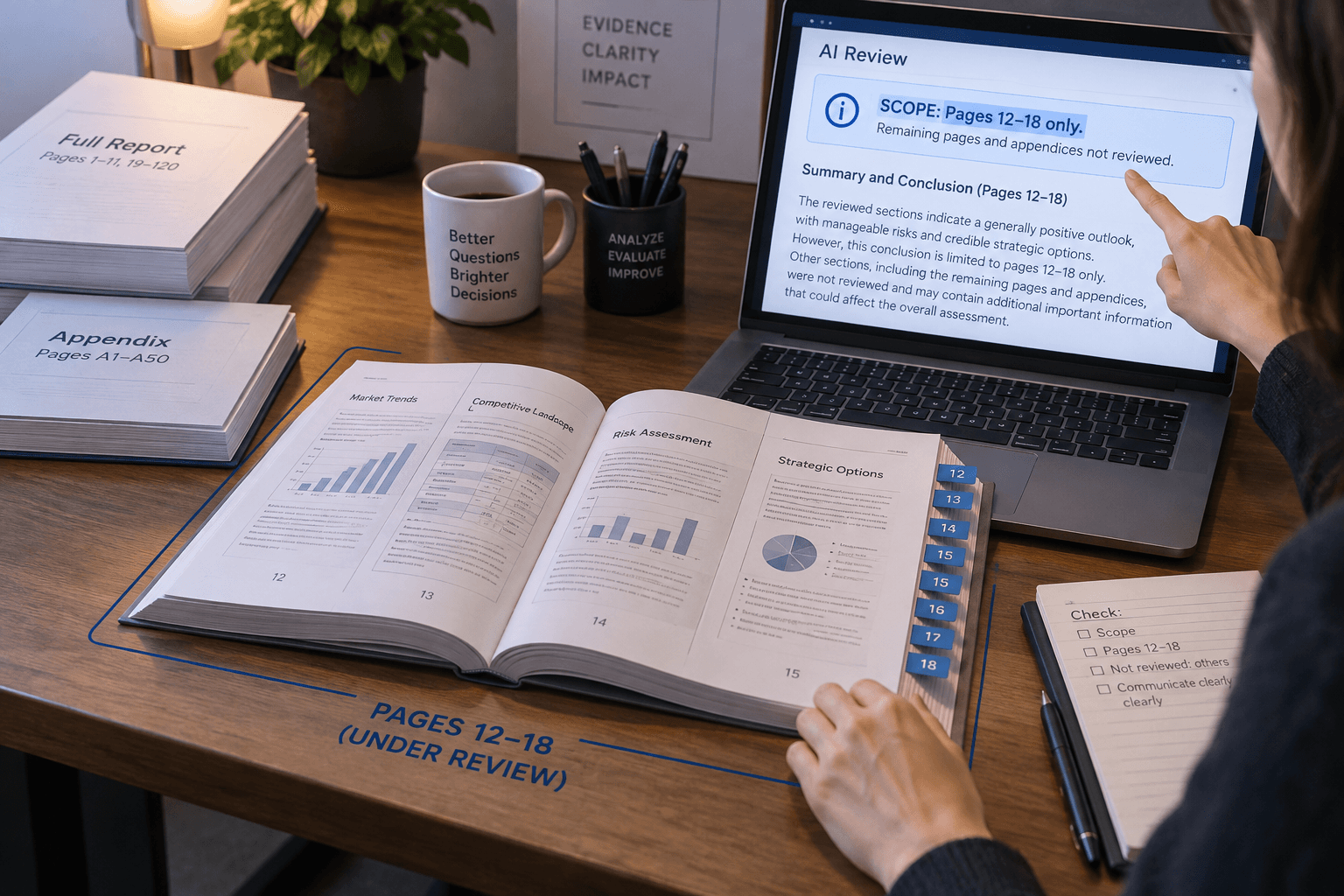
A report says customer onboarding is slowing down. You ask AI to review the spreadsheet you have, and it finds several delayed accounts. The conclusion sounds definitive. But the spreadsheet only covers one region and is missing the latest week.
The useful concept is a scope note: tell AI what it is reviewing, what is outside the review, and what conclusion the material can support. NIST's AI Risk Management Framework Playbook recommends defining the intended context of use and documenting knowledge limits. For a small review, a few plain sentences can make those boundaries easier to see.
Try it on one review
Choose a low-consequence task where you know what material you are providing, such as reviewing a draft monthly operations summary. Before asking for a conclusion, state the scope:
Review only the attached summary for changes in onboarding delays. It covers the Northeast region through October 24. It does not include the last week of October or other regions. First, restate what you can and cannot assess from these inputs. Then identify any conclusion that would require information outside this scope. Do not fill gaps with assumptions.
This is an illustrative prompt, not a tested recipe. Adjust it to match your actual material. The important part is to describe the boundary accurately, not to use special wording.
Illustrative example: AI replies that the summary can show whether delays changed in the Northeast through October 24, but it cannot establish the current company-wide trend because other regions and the final week are absent. That response does not prove the model understood the summary. It gives you a specific statement to check before relying on its analysis.
Compare the scope it restates with the files, dates, and sections you actually supplied. If it includes material you did not provide, says an omitted period is covered, or skips a limitation you named, correct the scope or stop. If the boundary is right, keep it beside the conclusion when sharing the result. Don’t let a local finding become a company-wide claim just because the answer reads smoothly.
Know what this check can’t do
A scope note helps describe the limits of the review. It does not make the data complete, establish that the analysis is accurate, or ensure the model noticed every omission. NIST notes that generative AI can produce false or internally inconsistent content, including in context-heavy tasks. Check important claims against the underlying material, especially when they could affect customers, money, or staff.
Use this for a review whose inputs are bounded and inspectable. If you cannot say what records were included, the first task is to find that out. If the decision depends on missing information, gather it before treating the AI's conclusion as a basis for action.
The practical check is simple: can you describe what the AI reviewed, and does its conclusion stay within that boundary? If either answer is unclear, the review is not ready to guide the decision.
Sources
Every claim above traces back to one of these. Go read them yourself.
- 01NIST AI Risk Management Framework Playbook: Map
National Institute of Standards and Technology / airc.nist.gov / retrieved Nov 04, 2026
Suggested reading
Selected articles based on topic, tags, and skill focus across the library.
Foundational AI: Do's and Don'ts
Make a decision table before asking AI to apply a rule
When a work rule depends on several conditions, map the combinations and their outcomes before asking AI to apply it. The table can expose gaps your prompt would otherwise hide.
Foundational AI: Do's and Don'ts
Separate what someone did from why you think they did it
AI can turn a late reply or missed deadline into a confident story about someone's intent. Keep the observed behavior separate from the explanation before it shapes a business decision.
Foundational AI: Do's and Don'ts
Use a premortem to find a plan’s weak spots
Before committing to a plan, ask AI to imagine it has failed and list plausible reasons. Use the results to find questions your team should answer, not to predict what will happen.