LibraryThe daily read9 min read
The agent can live in your building now
Meta released a 30-billion-parameter agent model on Monday under Apache 2.0 that runs the whole tool-calling loop on one desktop machine, offline. The bill it displaces is not the chat subscription. It is the loop bill, and the compliance answer that killed the project before it started.
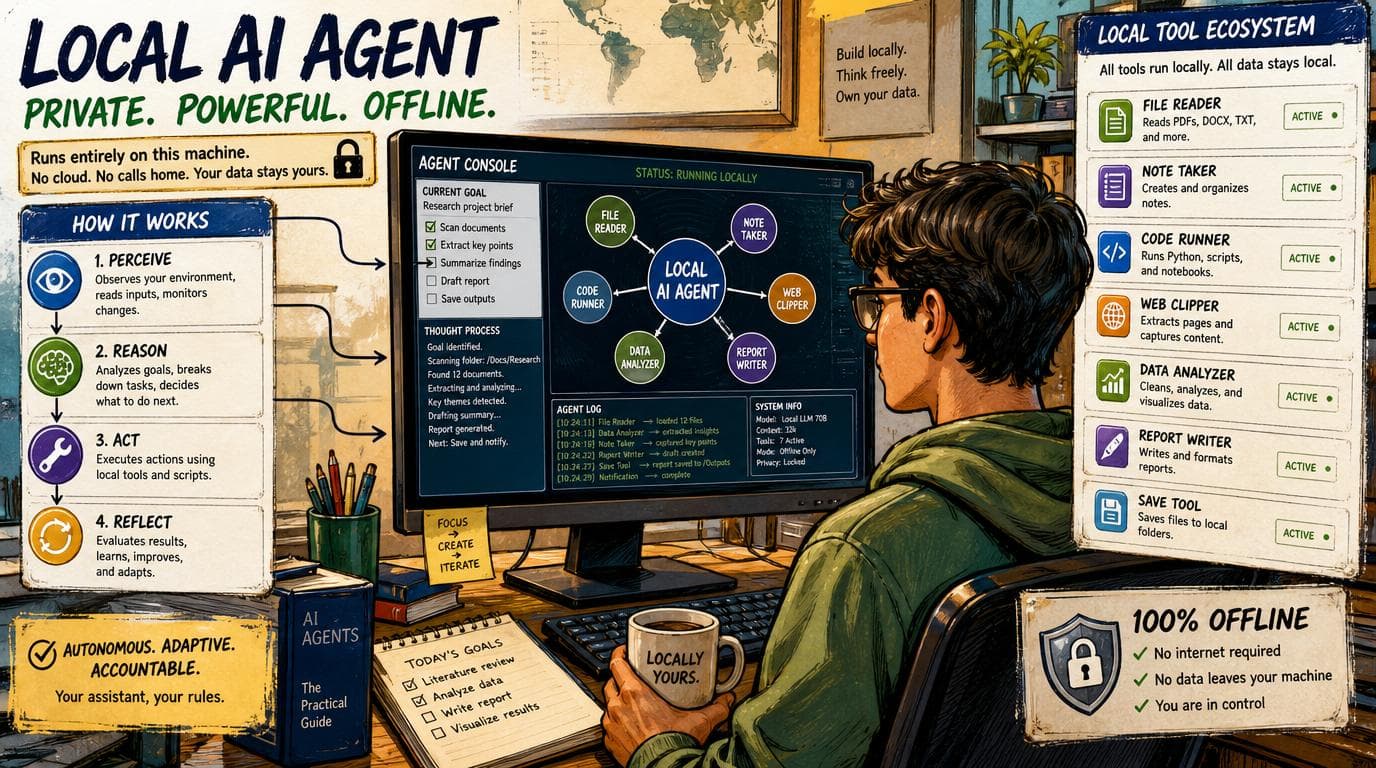
A thirty-person insurance brokerage has a folder of client applications that nobody is allowed to upload anywhere. Every automation project that shop has tried to start in the last two years died in the same meeting, at the moment somebody asked where the documents actually go and the honest answer was a vendor's server in Virginia. As of Monday that shop can run an agent that reads the folder, calls the rating tool, writes the results back, and retries the step that failed, on a computer in the back office with the network cable unplugged. Meta released Muse Glimmer under an Apache 2.0 license, thirty billion parameters, and the whole point of it is that the agent loop runs on hardware you already paid for.
What actually changed
Meta Superintelligence Labs published the weights on Monday, free, with no restrictions on commercial use, modification, or redistribution. Apache 2.0 is the permissive end of the spectrum, which matters more than it sounds: you can build a product on this, sell it, and never tell Meta.
The technical claim is narrow and specific. At full precision a thirty-billion-parameter model needs more than 55 GB of memory, which is more than any consumer graphics card has. Meta compressed the weights to roughly four bits, which brings the language model under 20 GB, and shipped a small companion model that proposes whole blocks of tokens at once so the main model can verify them in parallel instead of generating one token at a time. The result fits inside a 24 GB or 32 GB machine with room left over for working memory and for the image encoder, and it is fast enough that an agent taking twelve steps does not feel like watching paint dry. Meta measured it on MacBook M4 Max and M5 Max laptops and on an RTX 5090.
What separates this from the last two years of small open models is what it was trained for. Most of them were trained to be good at answering. This one was trained on the loop: many sequential tool calls, diagnosing a failed call and retrying rather than halting, holding a plan together across a long run, and reading screenshots and documents as images alongside the text. It takes a 128K context window, handles more than a hundred languages, and works with the open agent scaffolds people already run. Meta compares it to Gemma4-31B and Qwen3.6-27B, which is the honest comparison set, its own size class.
If you do not want to run it yourself, it is already on the hosted providers. Together AI serves it at $0.35 per million input tokens and $1.50 per million output, and OpenRouter lists the same rates.
The bill that nobody shows you before you build
Here is the thing about agents that nobody explains to an operator until the invoice arrives, and it is the reason this release is a cost story and not just a privacy story.
A chatbot is cheap because a conversation is short. An agent is expensive because of how the loop works. At every single step, the model gets sent the whole history again: the original instruction, every tool call it made, every result those tools returned, every note it wrote to itself. Step one might be five thousand tokens. Step twenty is ninety thousand. You are not paying for a conversation, you are paying to re-read the same growing transcript twenty times in a row.
Run the arithmetic on a real shape. An agent doing a thirty-step job where the context averages fifty thousand tokens a step burns about 1.5 million input tokens in one run. On Claude Sonnet 5 at $2 per million input that is roughly $3.20 with output included. Fine. Now run it twenty times a day across a small team, five days a week, and you are at about $1,400 a month for one automation. That is a headcount conversation, not a software conversation, and it is the number that turns a successful pilot into a project that quietly gets shut off in month four.
The obvious objection is prompt caching, and it is a fair one. Cached input on Sonnet 5 reads at $0.20 per million instead of $2.00, which would cut that bill by most of itself. But caching only pays out when the front of your prompt is stable and you come back inside the cache window, which is five minutes by default. That works beautifully for a developer hammering the same codebase all afternoon. It does almost nothing for the shape a small business actually wants, which is an agent that wakes up every twenty minutes, checks whether anything showed up in the shared inbox, and goes back to sleep. That agent misses the cache every single time, and it pays full freight on every check that found nothing.
On the same math, the hosted Muse Glimmer rate lands somewhere near $250 a month. On your own machine it lands at the electricity, which for a desktop that idles most of the day is coffee money.
What this changes for a small shop
Three things, and the ranking is not what the vendors would tell you.
The first is that the compliance answer changes. Not the security posture, the answer. Most small businesses do not have a written AI policy, they have one person who says no, and that person says no because they cannot explain to a client where the file went. A model running on a box in your own building removes the question rather than answering it. That is worth more than any per-token saving to a bookkeeping firm, a medical billing office, a law practice, or anybody who has ever been handed a client security questionnaire.
The second is that you stop rationing. This one is subtle and it is real. When the meter is running you design around it without noticing. You make the agent check hourly instead of every two minutes. You give it a summary of the ticket instead of the whole thread, because the whole thread costs more. You cap it at ten steps because you got a scary bill once. Every one of those decisions makes the agent worse at its job, and none of them appear in the design document as "we made it dumber to save forty dollars." A model that costs nothing per call lets you build the version you actually wanted, which is usually the one that looks at everything and gives up less easily.
The third is that a small model on the agent loop is a genuinely different product from a small model that chats. Failure recovery is the capability that matters here and it is the one people underrate. The reason most homemade automations die is not that the model said something dumb, it is that a tool returned an unexpected shape at 2am and the whole run halted, and nobody noticed until Thursday. A model trained to diagnose that and retry is the difference between an automation you trust and one you babysit.
The honest take
Start with the sentence Meta is leaning on: it runs on a single consumer GPU. That is true, and it is doing a lot of quiet work. The card Meta benchmarked on, the RTX 5090, carries a $1,999 list price and was selling on Amazon at $4,598 as of August 1, roughly 130 percent over list, because 32 GB of GDDR7 is the most supply-constrained memory on the market. Apple's high-memory desktops have been in and out of stock all year for the same underlying reason, a DRAM squeeze driven by AI datacenter buildout. So the free model runs on hardware that the AI boom has priced like a used car. Budget four to five thousand dollars for the machine, not two, and check availability before you promise anyone a date.
Second: on day one, the frictionless path is the hosted API, which is the opposite of the pitch. Meta says the optimized integrations for llama.cpp, MLX, and ExecuTorch are landing "in the coming days," and the same goes for the one-click local runners most non-engineers would actually use. If you go looking for this on your laptop this week you may find a rough edge or two. Give it a fortnight.
Third, and this is the one that will bite people: a local model does not make your workflow local. Your data stops leaving the building at the model, and then leaves the building at step four, when the agent calls a cloud CRM's API, or a web search, or your accounting platform, or the enrichment service you like. The model is one hop in the loop. If the point of the exercise is that the client file never goes anywhere, you have to audit every tool the agent can reach, and most agent scaffolds make that harder to see than it should be. Running the model yourself buys you a real thing, but it does not buy you the thing the marketing implies unless you do the rest of the work.
Fourth, this is a thirty-billion-parameter model and it will lose to a frontier model on judgment. Meta's own comparison set is other models its size, which is the honest framing and you should read it that way. Where it will disappoint you is ambiguity: a vague instruction, a document that contradicts itself, a decision that needs somebody to weigh two bad options. Point it at well-defined, repetitive, high-volume work where a wrong answer is cheap to catch, and it will earn its keep. Point it at the judgment calls and you will spend more time correcting it than you saved. Meta also says the four-bit compression causes minimal to no degradation on agentic tasks, which is a scoped claim about their benchmarks, not a promise about your invoices. Test it on your own documents before you believe it.
And month three, the part nobody plans for: you now own a computer. There is no SLA on the box in the closet, nobody gets paged when it stops, and the person who set it up is the same person who is on vacation the week it stops. That is the real product a cloud API sells, and it is the line item that does not show up in the comparison spreadsheet. Apache 2.0 means no vendor can retire this model or reprice it out from under you, which is a genuine benefit. It also means nobody is going to improve your copy of it either. You are now the one who decides when to download twenty gigabytes of new weights and re-test every prompt you wrote against them.
None of that argues against doing it. It argues for doing it on one workflow first, the boring high-volume one where the data is sensitive and the answers are checkable, and letting that run for a quarter before you move anything else.
The thing that got cheap this week is not intelligence. It is patience, the willingness to look at every message and every file and every failed attempt without anyone counting, and most small businesses have at least one job that never needed anything else.
Sources
Every claim above traces back to one of these. Go read them yourself.
- 01Introducing Muse Glimmer: An Open Agentic Model That Runs on Your Device
Meta Superintelligence Labs / research.meta.ai / retrieved Aug 11, 2026
- 02Muse Glimmer API: pricing, benchmarks and model card
Together AI / together.ai / retrieved Aug 11, 2026
- 03Muse Glimmer 30B, API pricing and providers
OpenRouter / openrouter.ai / retrieved Aug 11, 2026
- 04Claude plans and API pricing
Anthropic / anthropic.com / retrieved Aug 11, 2026
- 05RTX 5090 price tracker, August 2026
videocardprices.com / videocardprices.com / retrieved Aug 11, 2026
- 06Mac mini and Mac Studio go out of stock, is it the RAM crisis or an M5 refresh?
The Next Web / thenextweb.com / retrieved Aug 11, 2026
Related reading
Nearest neighbours by meaning, drawn from the whole library rather than from matching tags. Some of these are from a different series on purpose.
The daily read
Your spreadsheet just got a front end
A twelve-person team pays about $2,880 a year for a tool whose actual job is putting a usable view on data that already lives in a spreadsheet. Google now builds that view from one sentence and writes changes back to the sheet, and it fixes none of the reasons the spreadsheet was a bad system of record.
The daily read
The mark that survives the paste
Every Claude model launched since August 2 weaves an invisible watermark into the text it generates, worldwide, and it travels when the text is copied and pasted. The detector that reads it has not shipped yet, which means for now the mark is a liability you carry and not a check you can run.
The daily read
Your required fields were never required
The required field you configured in HubSpot has been optional for every robot pointed at your CRM: the AI agent, the nightly script, the Zap nobody owns. HubSpot said on Tuesday that changes with the September API version, and the part worth reading twice is that it changes on your schedule, not theirs.