
LibraryFoundational AI: Do's and Don'ts6 min read
One example is not a procedure
AI can turn one unusual case into a polished procedure that sounds like a team rule. Separate what happened once from what your process actually requires before sharing the draft.
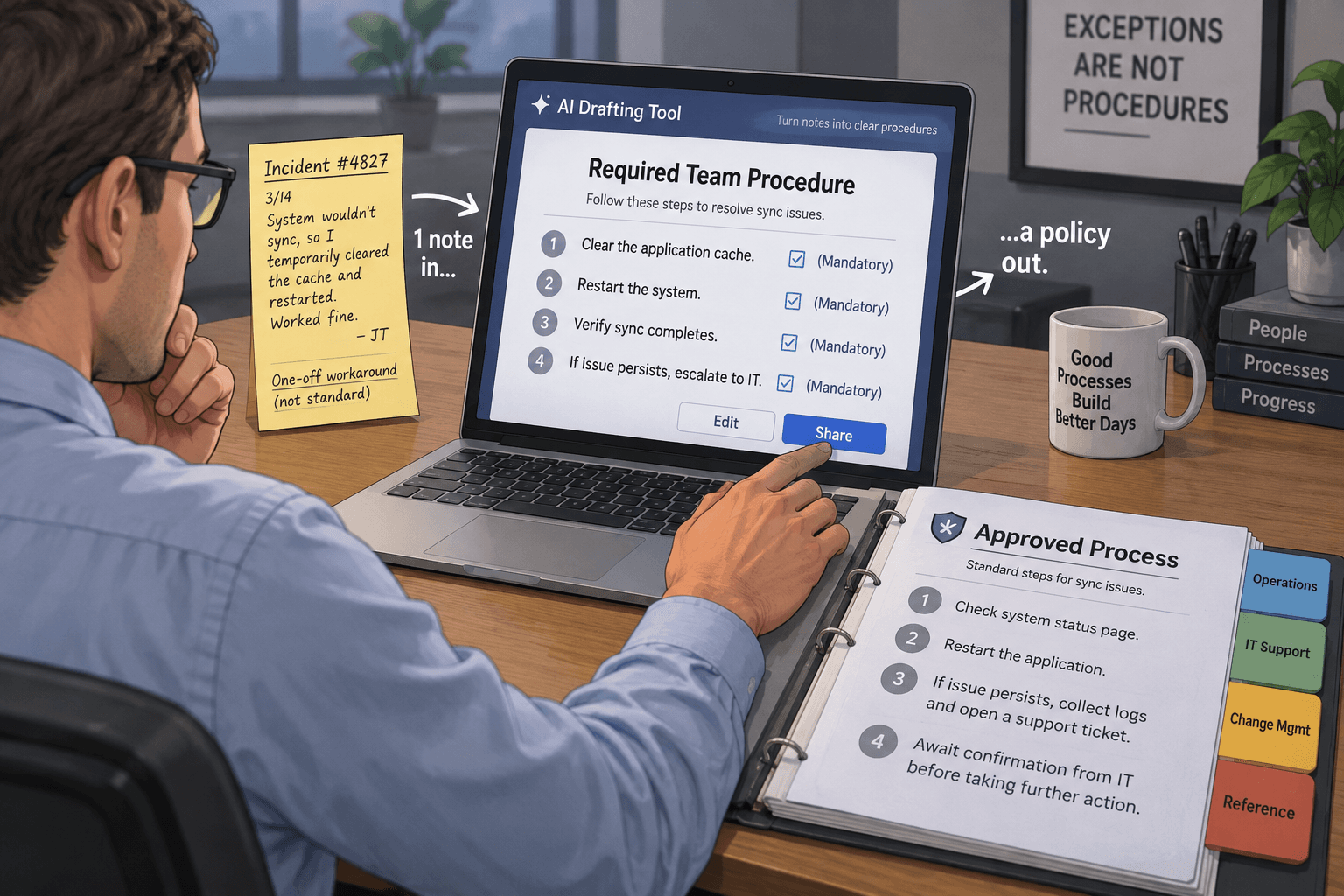
A customer case gets resolved, and someone asks AI to turn the notes into a procedure. The result looks clean: numbered steps, clear owners, a confident rule about when to escalate. The trouble is that the case may have been unusual. A detail that was true once can look like a rule when it is rewritten as a procedure.
AI can help organize a first draft. It cannot tell from one example whether a step came from policy, a person’s judgment, or a one-time workaround. Before you share the draft, separate those things.
Start with the source, not the polished draft
Say what the material is and what you want from it. For example:
These notes describe one completed customer case. Draft a procedure proposal based on the notes. For each step, label it as a stated policy, an action taken in this case, or a question that the notes do not answer. Do not turn a case-specific action into a general rule. Do not fill gaps with assumptions.
This instruction helps the model keep different kinds of statements visible. It does not guarantee that the labels are right. OpenAI’s guidance on ChatGPT accuracy and limitations says ChatGPT can give incorrect or misleading information, including overconfident answers to ambiguous questions. Treat a neat procedure as a draft to check, not evidence that its rules are established.
Consider a hypothetical example. Notes say a support specialist refunded a late shipment after checking the carrier record, then asked a manager to approve an extra credit because the customer had been affected twice. The AI draft says:
- Check the carrier record.
- Refund the shipment when delivery is late.
- Add a customer credit when the delay happens twice.
The first step is described in the notes. The refund may have followed policy, or it may have been a judgment call. The extra credit was part of this particular case. The notes do not say that every second delay qualifies, who can approve a credit, or whether another condition matters. A fluent draft can blur those differences.
Mark what each step is based on
Review the draft one sentence at a time. Use three labels:
- Existing rule: The current policy, approved process, or system behavior explicitly says this.
- Observed action: Someone did this in the example, but the source does not establish it as a rule.
- Open question: The available material does not say what the team should do.
You can ask AI to make a table with the proposed step, the note or policy that supports it, and the label. Then check every row against the original material. A source reference is useful only if it points to wording that actually supports the step.
In the example, the carrier check is an observed action unless the notes also cite an approved procedure. The refund threshold and the extra-credit rule are open questions until someone checks the applicable policy or asks the person who owns it. Do not quietly promote either one just because the steps form a plausible sequence.
This is a task for context, not just careful wording. NIST’s AI Risk Management Framework Core recommends defining the context and intended purpose of an AI-supported task, including the specific task the system supports and how people will use or oversee its output. For a draft procedure, that means being clear whether AI is organizing one case, summarizing an existing policy, or proposing a change. Those are different jobs.
Look for the cases that would change the rule
Once you have a tentative procedure, look for cases that don’t fit it. Do not use the AI’s examples as proof; use real, approved records that your team is allowed to share with the tool.
Ask a process owner or experienced teammate to find examples such as:
- A similar situation where the team made a different decision.
- A case where a required detail was missing.
- An exception that needed an approval or a different team.
- A case that looked similar at first but turned out to follow another process.
You can ask AI to compare these cases with the draft and flag where the steps or conditions differ. Keep the original examples and policy available while you review. A mismatch is a signal to investigate, not proof that someone handled the case incorrectly. The second case may also be unusual, or the policy may have changed. Confirm which source is current and who can resolve the difference.
If you only have one case, be explicit about what you can conclude: “This draft describes the actions recorded in one case. The notes do not establish a general policy.” That is a useful working document. It is not a finished procedure.
Let the owner decide what becomes a rule
A procedure affects what people do next. The person responsible for that process should decide which steps are already required, which proposed changes are acceptable, and when a case needs review. NIST’s framework calls for clear roles and responsibilities around human oversight. In day-to-day work, that can be as simple as naming the person who approves the procedure and the policy or record they used to do it.
Before sharing the final version, check that it:
- Links or points to the current source for each important rule.
- Separates established policy from the steps taken in examples.
- Says what to do when required information is missing or a case does not fit.
- Names any approval or escalation that the process owner has confirmed.
- Identifies an owner who can correct the procedure when the process changes.
If a step changes customer treatment, eligibility, money, access, or another consequential decision, leave the unresolved choice with the authorized person. A procedure can help a team apply a decision consistently, but drafting one does not create the authority to make that decision.
When a single example is enough
One case can still be enough to document what happened, prepare questions, or draft a clearly labeled proposal. It can also reveal that an existing procedure was hard to follow. Those are worthwhile uses. What it cannot do by itself is prove that every detail should become standard practice.
If the procedure concerns a low-consequence task and an owner can review it, start with one example and keep the draft visibly provisional. If you need a rule that affects people or customers, gather the governing policy and cases that show the boundaries before treating the text as instructions.
Use AI to make the example easier to examine. Let the process owner decide what the example means for everyone else.
Sources: NIST AI Risk Management Framework Core and OpenAI guidance on ChatGPT accuracy and limitations.
Sources
Every claim above traces back to one of these. Go read them yourself.
- 01AI Risk Management Framework Core
National Institute of Standards and Technology / airc.nist.gov / retrieved Nov 02, 2026
- 02Does ChatGPT tell the truth?
OpenAI Help Center / help.openai.com / retrieved Nov 02, 2026
Suggested reading
Selected articles based on topic, tags, and skill focus across the library.
Foundational AI: Do's and Don'ts
Make a decision table before asking AI to apply a rule
When a work rule depends on several conditions, map the combinations and their outcomes before asking AI to apply it. The table can expose gaps your prompt would otherwise hide.
Foundational AI: Do's and Don'ts
Separate what someone did from why you think they did it
AI can turn a late reply or missed deadline into a confident story about someone's intent. Keep the observed behavior separate from the explanation before it shapes a business decision.
Foundational AI: Do's and Don'ts
Audit HubSpot Customer Agent conversations, not just its score
HubSpot’s Customer Agent reports can show volume, resolution, handoffs, and coaching opportunities. Pair those metrics with a small, consistent review of actual conversations to judge answer quality.