
LibraryFoundational AI: Do's and Don'ts5 min read
An AI explanation is another output to check
A convincing explanation can still be wrong. When AI recommends an action, check the evidence behind it instead of treating its reasoning as proof.
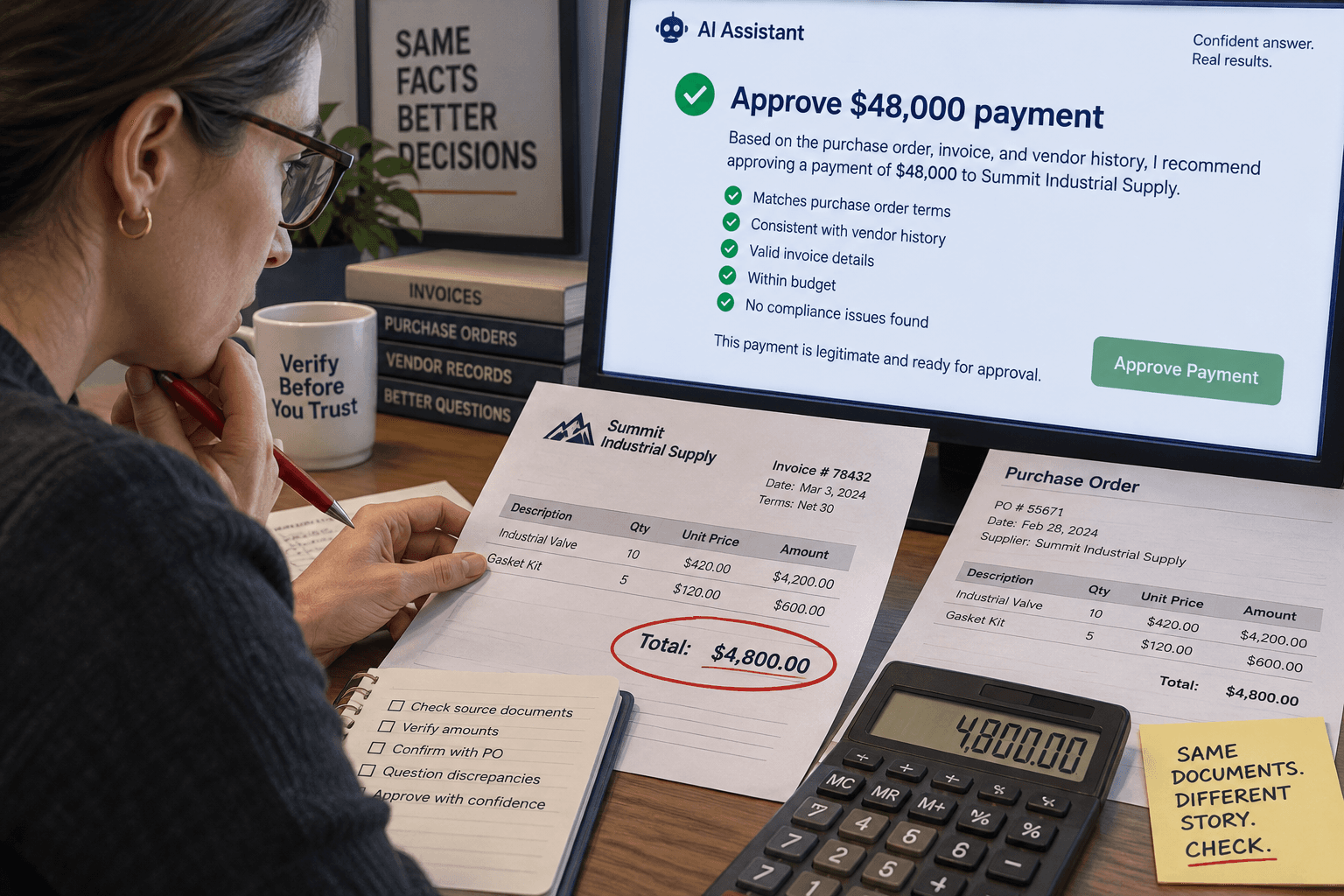
A recommendation can sound more reliable after AI explains it. That explanation may still be wrong.
Say an AI reviews a few support notes and recommends changing your refund process. It adds a tidy rationale: customers with delayed orders are more likely to request refunds, so the team should offer one earlier. The rationale sounds sensible. But did the notes show that pattern? Did the AI confuse a customer asking about a refund with one who received one? Did it leave out cases that point the other way?
A useful rule is check the evidence, not the confidence of the explanation. NIST warns that generative AI can confidently present false content and may generate reasoning that appears to justify an incorrect answer. A convincing rationale is still AI output. It is not independent evidence. NIST's Generative AI Profile describes both risks.
Separate the answer from the evidence
When AI makes a recommendation, split the response into two parts:
- The claim: What action does it recommend, and what does it say will happen?
- The support: Which facts, records, or rules does it rely on?
Then check the support directly. If it says three cases had the same cause, open those cases. If it says a policy requires a particular action, read the relevant policy passage. If the explanation gives no checkable support, treat the recommendation as a possibility to investigate, not a conclusion to adopt.
This is different from asking AI to explain itself more clearly. A second explanation may be easier to read, but it is still another generated response. NIST notes that generated reasoning or citations can themselves be confabulated, meaning they may sound persuasive while being false or inaccurate.
Try a small evidence audit
Choose a low-consequence recommendation that you can check against records you are authorized to use. For example, you might ask AI to review a few non-sensitive, anonymized service requests and suggest one change to the handoff process. This example is hypothetical, not a tested workflow.
Before asking, decide what would count as support. For instance: the original requests show the same handoff delay; the dates and outcomes are recorded; and the proposed change addresses that delay without creating a new approval or customer commitment.
Ask AI for a reviewable answer, such as:
Recommend one possible change based only on these records. List the specific facts you used and identify where each appears. Separate direct observations from your interpretation. Include any evidence that points against your recommendation. If the records do not support a conclusion, say what is missing. Do not change a record or send a message.
Treat this as a way to organize the review, not a guarantee that the answer will be accurate. Check each cited fact against the original record. Confirm that dates, amounts, status, and context are correct. Look for a relevant item the answer did not mention, including evidence that contradicts the recommendation. If it cites a rule, open the current rule rather than relying on a paraphrase.
Keep a short note of what you found:
| Check | What to record | | ---------------------------- | ---------------------------------------------------------------- | | Recommendation | The proposed action, in plain language | | Supporting evidence | The specific records or policy passages you verified | | Missing or contrary evidence | Details that weaken, limit, or complicate the claim | | Decision owner | The person who decides whether to act | | Next step | Test, revise, investigate further, or leave the process as it is |
The table is a simple review aid, not a formal risk framework. Its purpose is to keep a polished explanation from hiding the difference between what a record says and what someone infers from it.
Watch for the explanation that outruns the record
A useful explanation should survive comparison with its cited evidence. Slow down if it:
- turns a possibility into a fact, such as saying a customer _will_ leave when the record only says they asked a question;
- treats several examples as a general pattern without showing how many cases were reviewed or what was left out;
- uses a confident business phrase such as “the main cause” without pointing to evidence that distinguishes it from other causes;
- cites a source that does not say what the explanation claims; or
- cannot name what evidence would change its recommendation.
These are prompts to investigate, not proof that a recommendation is wrong. The source may support the claim once you read it in context. The point is to test the connection between evidence and conclusion rather than rewarding fluent wording.
Keep the decision with the person who owns it
Some tasks are low consequence and easy to reverse. Others affect customers, money, access, or staff. The amount of review should fit the decision and the cost of getting it wrong. For a small internal draft, checking a few underlying facts may be enough. For a policy change or action affecting a customer, ask the relevant owner to review the records and applicable rules before anything changes.
NIST's AI Risk Management Framework says roles and responsibilities in human-AI decision-making should be clear, and that system outputs should be interpreted in context. It also recognizes that human-AI results vary by task and setting. That guidance is voluntary and needs to fit the organization; it does not prescribe the exact review steps above. NIST's discussion of human-AI interaction explains why responsibilities and context matter.
There is a fair limit to this advice: not every AI response needs an audit trail. If you ask for a few headline ideas or a rewrite of a note you will review anyway, a formal evidence check may cost more than it saves. Use the audit when AI's explanation could persuade someone to take an action whose basis matters.
If the evidence checks out and the accountable person agrees, decide whether to test the change on a small, reversible set of work. If the evidence is mixed, record the uncertainty and gather what is missing. If the explanation cannot be tied to reliable support, set the recommendation aside. The decision should rest on evidence you can verify, not on how convincingly AI explains its answer.
Sources: NIST's Generative AI Profile and NIST's human-AI interaction appendix.
Sources
Every claim above traces back to one of these. Go read them yourself.
- 01Artificial Intelligence Risk Management Framework: Generative Artificial Intelligence Profile
National Institute of Standards and Technology / nvlpubs.nist.gov / retrieved Nov 04, 2026
- 02Appendix C: AI Risk Management and Human-AI Interaction
National Institute of Standards and Technology / airc.nist.gov / retrieved Nov 04, 2026
Suggested reading
Selected articles based on topic, tags, and skill focus across the library.
Foundational AI: Do's and Don'ts
Make a decision table before asking AI to apply a rule
When a work rule depends on several conditions, map the combinations and their outcomes before asking AI to apply it. The table can expose gaps your prompt would otherwise hide.
Foundational AI: Do's and Don'ts
Separate what someone did from why you think they did it
AI can turn a late reply or missed deadline into a confident story about someone's intent. Keep the observed behavior separate from the explanation before it shapes a business decision.
Foundational AI: Do's and Don'ts
Audit HubSpot Customer Agent conversations, not just its score
HubSpot’s Customer Agent reports can show volume, resolution, handoffs, and coaching opportunities. Pair those metrics with a small, consistent review of actual conversations to judge answer quality.