
Five AI stories: Anthropic’s filing, Google’s school controls, and agent security
Anthropic disclosed new revenue and infrastructure commitments in an amended filing, Google is changing school AI controls, and new deals and security tools show where AI deployment is moving.
This issue covers 9:02:11 a.m. Eastern on October 31 through 9:00 a.m. Eastern on November 4. I ranked distinct events by observable independent coverage and prominence in that window. That is an attention signal, not a measure of readership or importance to every organization. The first three drew broad coverage across financial, general, and regional reporting; the last two had narrower but visible coverage in technology and security outlets. Each item is checked against a primary source.
1. Anthropic added third-quarter results to its IPO filing
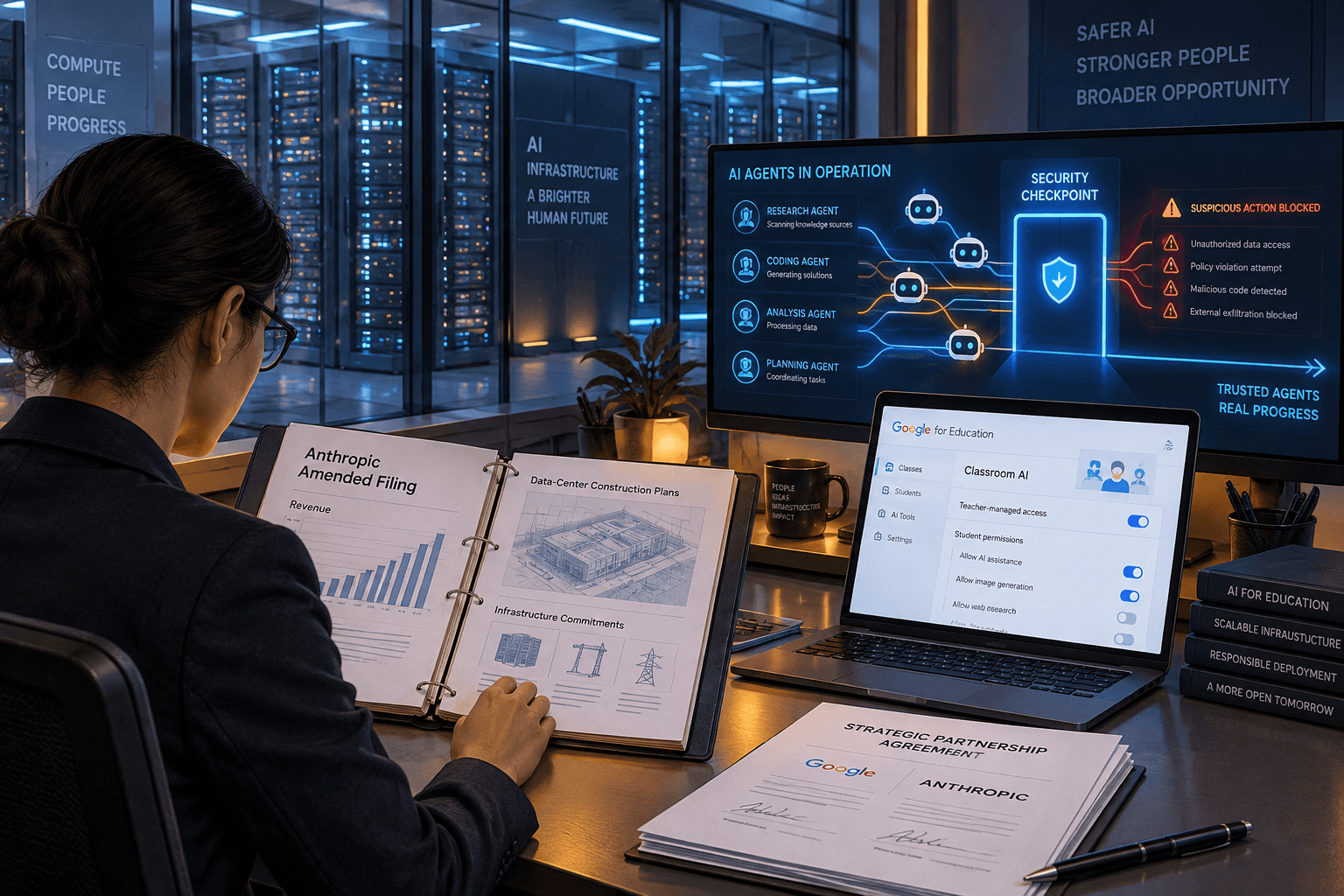
Anthropic’s November 2 amendment to its registration statement reported $16.96 billion in revenue for the third quarter and about $895.4 billion in aggregate purchase and lease commitments, substantially tied to compute and infrastructure. The SEC filing is the source to read for the numbers and their definitions. Reuters, AP, Axios, and other outlets covered the update.
These figures are company disclosures in an IPO filing, not a forecast that Anthropic will spend that full amount soon. The filing says its operating loss for the quarter was $567 million; its much larger reported net loss includes accounting effects tied to financing arrangements. Keep those measures distinct when comparing the company with another vendor.
For a business using Claude, the filing gives more information about the scale and commitments behind the service, but it does not answer whether your plan, data terms, reliability, or price will change. Review those terms directly. If you are assessing vendor concentration, include the cost and effort of moving your workflows, not just the subscription line.
2. Google is changing AI access in K-12 accounts
Google said that Gemini, Gemini Notebook, Gemini in Classroom, and Search will be off for K-12 student accounts until an administrator turns them on. Its announcement says details will come before the changes roll out. It also announced Guided Learning in Classroom as available globally, and a Search pilot in selected U.S. schools later this month.
A consequence for administrators: Education Week and AP reported that schools which turn off AI altogether will also lose Google Search because the company integrates AI into Search. The rollout timing and exact controls still need to be confirmed in Google’s forthcoming school guidance. This is not a setting change that every district needs to make today.
If your organization manages student accounts, ask who will decide by grade level, when the new controls arrive, and what search access remains under each setting. Test the proposed configuration with the people who run classroom devices before changing district-wide policy. The educational value of Guided Learning is a company claim that still needs evaluation in your setting.
3. OpenAI, ADNOC, and G42 announced an industrial AI partnership
ADNOC said it will work with OpenAI and G42 on a multi-year deployment using OpenAI’s Frontier platform and UAE-based infrastructure. The first applications are planned for oilfield development planning and connecting decisions across production, refining, logistics, and trading. ADNOC says people will retain oversight of consequential decisions. ADNOC’s announcement describes the plan; Reuters and The National also reported the agreement.
This is a partnership and intended deployment, not evidence that the system has already improved production or commercial decisions. No contract value or measured result was announced. For leaders outside the energy sector, the relevant signal is that vendors are pursuing agent systems tied to specific operational data and decisions, with local infrastructure and human oversight among the stated requirements.
If a vendor proposes a similar system for your operation, ask which data it needs, which decisions it can affect, what is available now, and how staff can review or reverse actions. A broad description of “agents across the business” is not a deployment plan.
4. CrowdStrike introduced an AI kill switch for its security platform
CrowdStrike says its Falcon Guardian feature can terminate an agent, block it from restarting, and cut off network access. The company says it is available to Falcon Guardian customers today. Its technical announcement also describes an important rollout boundary: stopping activity starts at the gateway, with endpoint termination planned for a later release. Forbes and CNBC covered the announcement.
That makes this a product control to evaluate, not a general guarantee that an agent can always be stopped. Ask which agents and environments the feature can see, what actions it can interrupt now, and what audit record remains afterward. Compare those answers with the agent’s actual permissions and the systems it can reach.
5. Fal raised new funding for AI inference capacity
Fal announced its Series E and Series F rounds together, saying they raised $1.65 billion in total. Its company announcement names Sequoia for the earlier Series E and Bessemer, with NVIDIA as a strategic investor, for the Series F. Bloomberg reported that the latest round was $1.3 billion at a $16 billion valuation; TechCrunch covered the funding and noted that those figures came from Bloomberg.
Fal provides hosted inference for image, video, and audio models. The raise is a sign of investor interest in the infrastructure that serves models, and reporting connected it to demand for compute. It is not proof that capacity will be unlimited or that inference prices will fall.
If your product depends on a hosted model service, check rate limits, availability commitments, pricing, and export options before making that provider a critical dependency. Funding can support growth, but your service agreement is what defines what your business can rely on.
Which development changes a decision?
For most business leaders, the practical work is specific: review the service and exit terms behind an AI dependency, confirm who controls access in student accounts if you manage them, and ask security vendors what their stop controls cover now. Treat partnerships, funding, and product announcements as reasons to ask better questions. Wait for measured results before treating them as proof that a system works for your operation.
Sources: Anthropic’s SEC filing, Google’s school announcement, ADNOC’s OpenAI partnership announcement, CrowdStrike’s AI Kill Switch announcement, and Fal’s funding announcement.
Sources
Every claim above traces back to one of these. Go read them yourself.
- 01Anthropic Form S-1/A filed November 2, 2026
U.S. Securities and Exchange Commission / sec.gov
- 02
- 03
- 04
- 05
- 06
- 07Introducing AI Kill Switch
CrowdStrike / crowdstrike.com
- 08
- 09Series E and F
fal / fal.ai
- 10
Suggested reading
Selected articles based on topic, tags, and skill focus across the library.
AI News
Five AI stories: cyber capabilities, METR, and data center politics
OpenAI released a restricted cybersecurity model, METR reported faster AI development at Anthropic, and data center politics drew a new company pledge. Here are five developments and what to check.
AI News
Five AI stories: content rules, Cohere, and Mistral
The UK opened a competition investigation into Meta’s content terms, Canada committed up to C$1.6 billion to Cohere, and Mistral released Large 4’s weights. Here are five developments and what operators can check.
AI News
Five AI stories: cyber risks, chatbot rules, and Google’s results
Anthropic described exploit chains built by an unreleased model, New York signed a law restricting chatbot behavior with minors, and Google announced a limited-access model. Here’s what changed and what to check.