
LibraryFoundational AI: Do's and Don'ts3 min read
Separate must-haves from preferences before comparing options
Before asking AI to compare tools or proposals, label which requirements are deal-breakers and which are preferences. That keeps a nice-to-have from outweighing a condition the work depends on.
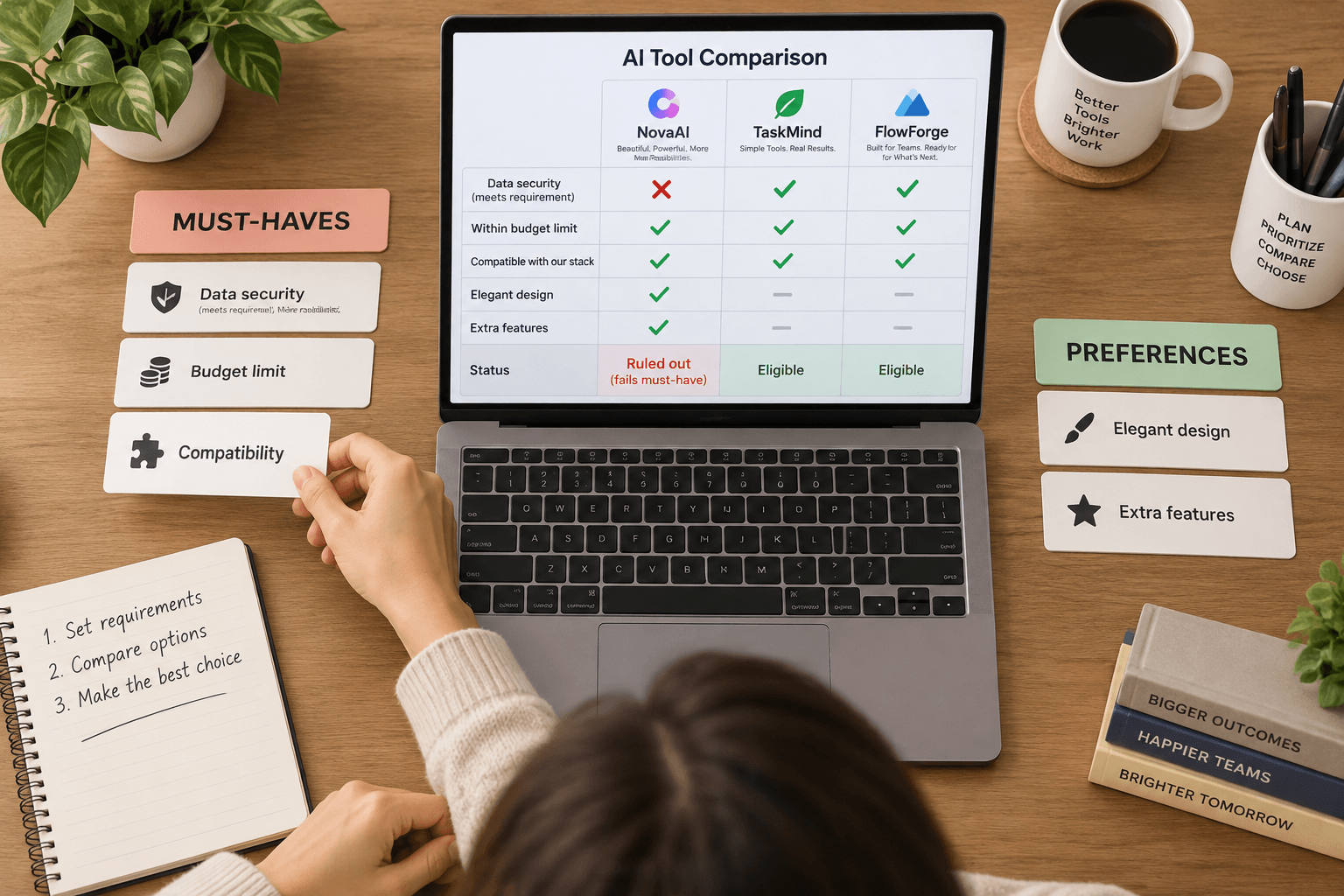
When you ask AI to compare two proposals, it may give one a strong score for price and ease of use even though it fails a requirement your team cannot bend. Before you ask for a comparison, separate must-haves from preferences.
A must-have is a condition an option has to meet to remain viable. A preference is something you would like, but could trade away for a better fit elsewhere. Making that distinction explicit gives the model a clearer job than asking it to pick the “best” option. Anthropic’s prompting guidance recommends stating desired output constraints clearly. OpenAI’s prompt engineering guidance likewise recommends clear instructions and specific requirements. Neither makes the comparison itself reliable; you still need to check its work.
Write the boundary before the comparison
Pick a real decision with a short list of options and a source for each one, such as vendor proposals or product documentation. Write two lists before you share anything with AI:
- Must-haves: conditions that rule an option out if they are not met.
- Preferences: qualities that help distinguish options that meet the must-haves.
Keep each item specific enough to check. “Works with our process” is hard to assess. “Can export the records we need in a usable format” is easier, if that is in fact a requirement for your team.
Then ask AI to apply the two lists in order. For example:
Compare these options using the supplied documents. First check each must-have and mark it met, not met, or unclear, with a supporting passage for each result. Treat an option with a must-have marked not met as ineligible. Do not use preferences to offset a failed must-have. For options that pass, compare the preferences and explain the trade-offs. If the documents do not establish a point, mark it unclear. Do not choose which requirements matter to us.
This prompt is an illustrative starting point, not a tested recipe. Replace the example requirements with your own and provide the material you want compared.
Check whether the boundary held
Review the must-have results first. Follow each reference back to the source and check that it supports the exact condition. “Available” may not mean available on your plan. “Export” may not mean export of the records or fields you need. If a requirement is unclear, ask the vendor or the person who owns that requirement before treating it as satisfied.
Next, confirm that an option marked ineligible did not end up ranked first because it scored well on preferences. Among the options that pass, the preferences can help describe trade-offs. They do not turn the model’s ranking into a decision. A short table with the condition, status, and source passage is often easier to inspect than a single overall score.
The value of this exercise is the order of the comparison: eligibility first, trade-offs second. If you cannot explain why a condition is a deal-breaker, move it to preferences or clarify the business need with the person who owns it. If the source material is incomplete, keep the result unclear rather than asking AI to fill the gap.
This approach stops helping when the criteria themselves are unsettled, the documents omit important terms, or options need evidence beyond what you supplied. In those cases, the next step is to resolve the requirement or get better evidence, not to ask for a more confident ranking. Before your next comparison, write down what would rule an option out and what you are willing to trade away.
Sources
Every claim above traces back to one of these. Go read them yourself.
- 01Prompting best practices
Anthropic / platform.claude.com / retrieved Nov 02, 2026
- 02Prompt engineering
OpenAI / developers.openai.com / retrieved Nov 02, 2026
Suggested reading
Selected articles based on topic, tags, and skill focus across the library.
Foundational AI: Do's and Don'ts
Make a decision table before asking AI to apply a rule
When a work rule depends on several conditions, map the combinations and their outcomes before asking AI to apply it. The table can expose gaps your prompt would otherwise hide.
Foundational AI: Do's and Don'ts
Separate what someone did from why you think they did it
AI can turn a late reply or missed deadline into a confident story about someone's intent. Keep the observed behavior separate from the explanation before it shapes a business decision.
Foundational AI: Do's and Don'ts
Use AI to check the cutoff, not just the easy cases
When a work rule changes at a number or deadline, ask AI to draft examples just below, at, and just above it. Check each result against the rule you own.